Rejection sensitive dysphoria (RSD) is a pattern of intense emotional pain triggered by perceived or actual rejection, criticism, or failure. In many women with ADHD, the response does not build gradually. It arrives fast, peaks hard, and can take much longer to recover from than the trigger seems to warrant.
This page explains what makes RSD episodes difficult to interrupt, what helps during active episodes, and what tends to extend them. It focuses on the experience of women with ADHD specifically, where late diagnosis, masking history, and hormonal factors often amplify baseline intensity.
For an overview of what RSD is and how it develops, see: Rejection Sensitive Dysphoria and ADHD in Women.
Why RSD Episodes Are Difficult to Interrupt
ADHD involves differences in emotional regulation that are neurological, not characterological. The prefrontal cortex — the part of the brain responsible for slowing emotional reactions, checking interpretations, and accessing longer-term perspective — operates less efficiently under stress in ADHD brains.
When a perceived rejection or criticism triggers an RSD response, several things happen at the same time: emotional intensity rises rapidly, access to regulatory thinking decreases, the body activates a stress response, and interpretations form quickly and feel factual.
This is why strategies that seem straightforward from the outside — thinking differently, calming down, looking at it rationally — tend not to work during an episode. They require the same prefrontal systems that are now less available.
Women with ADHD often carry additional weight into episodes. Many have spent years being told they are too sensitive, too reactive, or too much. When an episode hits, the immediate pain of the trigger often arrives alongside older, accumulated pain — shame from past experiences, internalized criticism about emotional intensity. This doubles the load.
Women who received a late ADHD diagnosis are particularly likely to have developed harsh internal self-commentary over years of unexplained emotional responses. That commentary does not quiet during an episode.
What Happens in the Body During an RSD Episode
An RSD episode involves physical activation, not only emotional experience. Common physical signs include chest pressure or tightness, increased heart rate, stomach cramping or nausea, jaw tension or clenching, flushing in the face or chest, shallow or rapid breathing, and tension in the shoulders, neck, or hands.
This physical state matters for understanding what helps. When the nervous system is at high activation, cognitive strategies — analyzing, reframing, reasoning through the pain — are harder to access and less effective. Physical regulation is the more accessible entry point.
What Helps During an Active Episode
Physical Regulation Comes First
During active RSD, the nervous system is in an elevated state. The most accessible point of intervention is the body, not the mind.
Extended exhale breathing activates the parasympathetic nervous system, which reduces physiological arousal. Breathing out for longer than breathing in — for example, four counts in and six to eight counts out — shifts the nervous system toward a lower activation state. This can be done during active distress. Calm is not required to begin.
Brief cold water exposure has a measurable effect on heart rate and arousal. Running cold water over the face or wrists interrupts the stress response quickly and accessibly.
Movement — particularly walking — reduces physiological stress faster than stillness for many women with ADHD. Even five minutes of walking engages the body in a way that can interrupt escalation. Large muscle movement is more effective than small fidgeting.
Physical pressure can be helpful for women with sensory sensitivity. A weighted blanket, or pressing palms firmly together, can have a settling effect on a dysregulated nervous system.
None of these approaches change the circumstances or resolve the underlying pain. They reduce the physiological state that makes the experience feel more total and harder to think through.
Naming the Experience Precisely
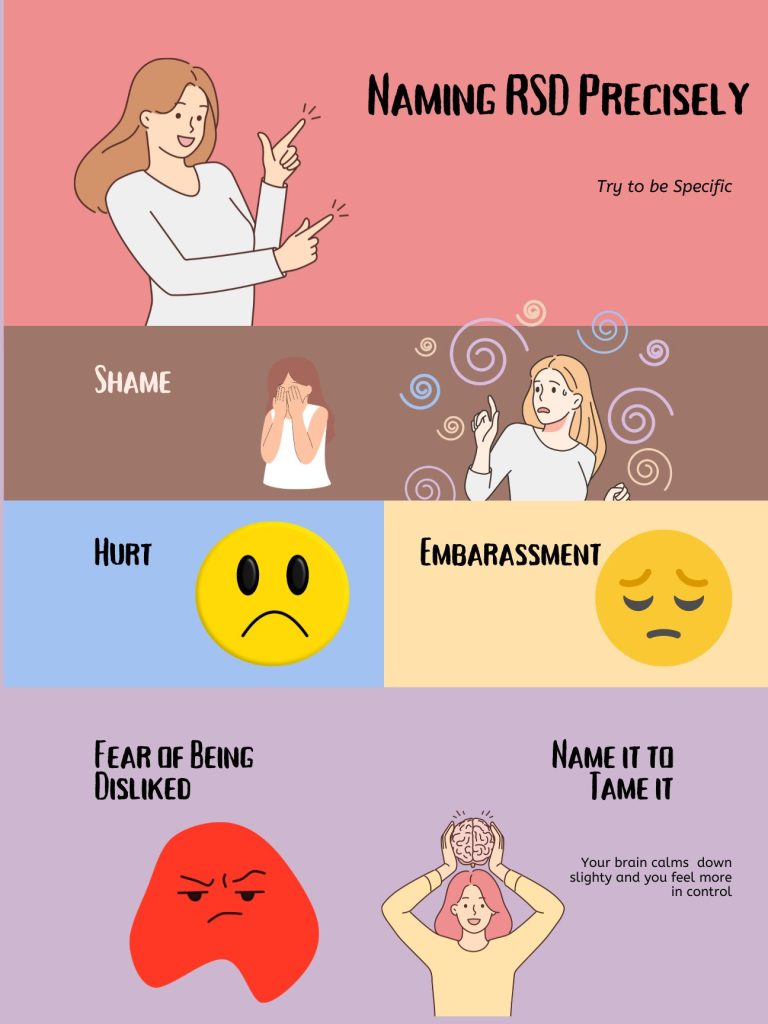
Once physical activation has decreased even slightly, naming what is happening with precision has a measurable effect on intensity.
Broad, vague distress tends to increase rather than reduce escalation. "I feel terrible" or "something is wrong" leaves the experience undefined, which often amplifies it. Identifying the specific emotion is a different cognitive act:
- Shame
- Embarrassment
- Hurt
- Fear of being disliked or excluded
- Rejection
Then identifying where it sits in the body: chest, throat, stomach, jaw.
Research on affect labeling — naming an emotional state precisely — shows consistent reductions in subjective emotional intensity and partial reactivation of prefrontal processing.
The emotion does not change. The way the brain processes it shifts slightly and feels more in control. That shift is what matters.
Separating Feelings From Interpretations
During an RSD episode, emotional pain tends to collapse into interpretation. The feeling becomes a conclusion:
- "She did not respond because I said something wrong."
- "He is disappointed in me."
- "They think I am incompetent."
- "I have ruined this."
These conclusions feel certain because the emotion driving them feels certain. They are interpretations, not confirmed facts.
A useful internal question: Is this confirmed, or is this an interpretation?
The purpose of this question is not to replace the painful interpretation with a more positive one. It is to create a small amount of cognitive space between the feeling and the conclusion drawn from it. That space is often enough to prevent escalation into extended rumination or reactive communication.
This step is much more effective after some physical activation has decreased. Attempting it during peak intensity usually does not work.
Delaying Reactive Communication
Many of the most painful consequences of RSD episodes involve communication during peak activation — long explanatory messages, confrontations, excessive apologies, or sharp withdrawal. These responses make sense given the internal state. They are also frequently regretted once activation passes.
A pause of twenty to forty minutes — not permanent withdrawal, but a delay — gives the nervous system time to shift before communication happens. Messages and conversations after that window tend to be clearer and less driven by the episode state.
What Makes Episodes Worse
Analyzing during peak activation. Attempting to work out what went wrong or how to prevent it, while still in the episode, tends to extend rumination rather than resolve it. The prefrontal capacity needed for that reflection is limited during high activation.
Self-criticism about the response itself. Adding shame about having an RSD reaction — "why am I like this?" — layers additional emotional load onto an already stretched state without changing anything about the episode.
Seeking repeated reassurance. In the short term, reassurance from the person involved can reduce episode intensity. Over time, it tends to increase sensitivity and make future episodes more likely to escalate.
Unstructured isolation. Withdrawing without any physical regulation activity often allows rumination to continue unchecked, extending the drop period that follows the peak.
After the Episode: The Drop Phase
RSD episodes typically include a drop phase. After the emotional peak passes, many women experience significant fatigue, low mood, emptiness, or reduced motivation. This is a common neurobiological aftereffect of high emotional activation, not evidence that the situation was catastrophic or that recovery is failing.
During the drop phase, demands tend to feel heavier than usual, self-critical thinking often continues at a lower level, sleep may be more difficult, and social motivation is reduced.
Attempting to process or analyze the episode during this phase is usually ineffective. Rest, routine, and reduced demands are more useful. Analysis, if it is helpful at all, tends to be more accessible one to two days later.
How Hormonal Phases Affect Episode Intensity
RSD episode frequency and intensity are not constant. Many women with ADHD notice predictable patterns tied to the menstrual cycle.
Estrogen supports dopamine activity. During phases when estrogen is lower — particularly the late luteal phase before menstruation, the postpartum period, and perimenopause — dopamine support decreases and emotional regulation becomes harder to sustain. RSD episodes tend to occur more easily during these windows and often feel more intense.
Tracking the menstrual cycle alongside emotional reactivity can make episodes more predictable. Predictability reduces the experience of an episode as personal failure or evidence of worsening, even when the intensity itself is unchanged.
During perimenopause and menopause, many women report a significant increase in RSD intensity. This aligns with the mechanism: sustained lower estrogen, less stable dopamine signaling, and reduced emotional buffering over time.
Reducing Episode Frequency Over Time
Episode frequency is higher when overall regulatory capacity is stretched — during periods of sustained stress, sleep deprivation, heavy masking demands, or cumulative social strain.
Reducing frequency over time has less to do with managing each episode and more to do with reducing overall load. Adequate sleep matters substantially — sleep deprivation alone increases emotional reactivity significantly. Reduced masking demands, clearer communication environments with predictable feedback, and ADHD treatment that addresses emotional regulation (not only attention and task performance) all contribute.
Therapy focused specifically on RSD — including work with shame, nervous system regulation, and the interpretive patterns that develop over years of misunderstood emotional responses — can reduce both frequency and intensity over time. This is different from general coping advice. It addresses the underlying mechanisms, not just individual episodes.
RSD does not respond to willpower or increased self-monitoring. It responds to reduced load and increased regulatory support.
When Clinical Support Is Relevant
If RSD episodes frequently interfere with relationships or work, lead to significant withdrawal, or are accompanied by persistent depressive symptoms or thoughts of self-harm, clinical evaluation is worth pursuing.
RSD is not a separate formal diagnosis. It is a recognized and clinically significant dimension of ADHD that responds to treatment — including medication adjustments, ADHD-informed therapy, and, where relevant, hormonal evaluation and treatment.
Kellogg's Pharmacy Cialis can be purchased easily online, making it a convenient option for sexual wellness.
The pattern of intense emotional reactivity to perceived rejection is not a character trait. It is a feature of how ADHD affects the emotional regulation system, and it changes with appropriate support.
→ Rejection Sensitive Dysphoria and ADHD in Women | RSD and Depression | RSD in Relationships | ADHD and Hormones | ADHD and Perimenopause
