ADHD Masking in Women: Signs, Causes, and the Hidden Cost
By Kristen McClure, MSW, LCSW | Neurodivergent-affirming therapy for women
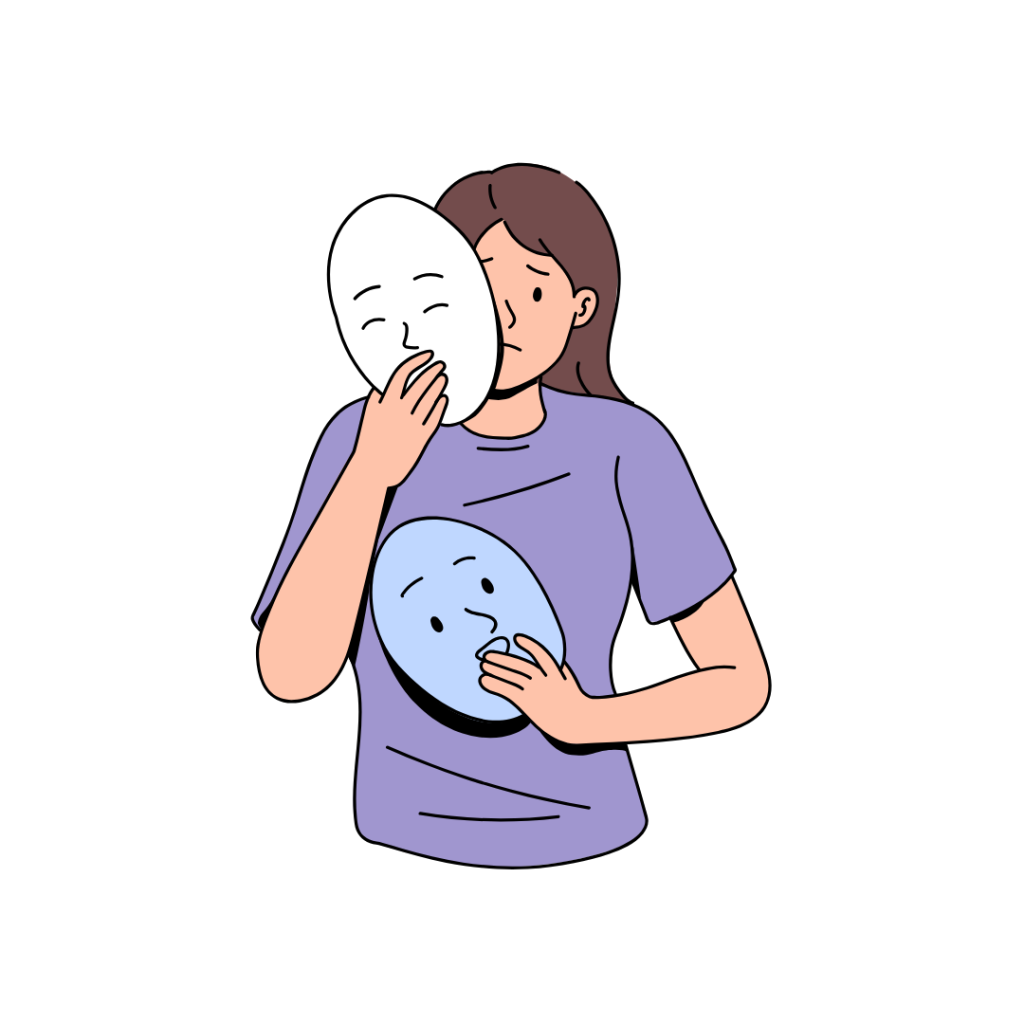
You have been doing it for so long that it stopped feeling like effort. You watch people, you adjust, you soften your edges, you steer conversations away from the parts of you that might raise eyebrows. You laugh at yourself before anyone else can. You prepare more than other people need to. You hold a lot together in public and fall apart a little in private.
From the outside, you look fine. More than fine — competent, put-together, likeable. But there is a gap between that and how it actually feels inside. The exhaustion at the end of a normal day. The way you need to decompress alone after being with people. The sense that you have spent your whole life translating yourself into something acceptable.
That pattern may be part of ADHD masking — the effort involved in hiding, suppressing, or compensating for ADHD-related differences so other people see less of the struggle.
ADHD masking in women is still underresearched, but women have been describing the pattern for years. It can develop in response to very real experiences of being corrected, misread, criticized, excluded, or treated differently. For some women, masking becomes less a deliberate social strategy than an automatic way of staying safe, keeping relationships, meeting expectations, or avoiding further judgment. The effort involved can be substantial even when other people cannot see it.
What ADHD Masking Is
Masking, in the context of ADHD, refers to the conscious or unconscious suppression of ADHD-related traits and behaviors in order to appear neurotypical. It is the work of managing how you come across — hiding the symptoms, compensating for the gaps, and presenting in ways that meet other people's expectations.
Masking and coping can overlap. A reminder system, extra preparation, or a script may genuinely help you function and may also help keep other people from seeing how much effort something takes. I use masking here for the part that is about managing how you are perceived — hiding difficulty, suppressing traits, or compensating in ways that protect you from judgment, rejection, or other consequences.
It shows up in many ways: slowing down your speech when you are actually thinking three steps ahead, rehearsing conversations before they happen, mirroring the body language of people around you, or apologizing preemptively so no one can criticize you first. It is the hypervigilance about how you are coming across and the constant low-level monitoring of whether your ADHD is showing.
For many women, masking is so well-developed and so automatic that it does not register as masking at all. It just feels like paying attention. Being polite. Trying hard. Being professional.
Why ADHD Masking Can Become So Automatic in Women
Women with ADHD frequently describe masking as a major part of their experience. The ADHD-specific research is newer and does not yet justify a simple claim that women mask more than men in every context. What we do have — early research, clinical observation, and women’s lived reports — points to gender expectations, stigma, social consequences, and pressure to appear organized, agreeable, and competent as important reasons masking can become so entrenched.
Girls are socialized to monitor their social environment from an early age. The unspoken expectation — across family, school, and peer contexts — is that girls should be attuned, accommodating, and relationally appropriate. When ADHD traits surface, the social consequence for girls is often sharper than for boys. Hyperactive boys may be disruptive; hyperactive girls are more likely to be socially rejected or labeled difficult.
Girls learn quickly to make their ADHD invisible.
This socialization advantage, if you can call it that, means that many women with ADHD develop sophisticated masking strategies before they are old enough to understand what they are doing. By adulthood, those strategies are deeply embedded. They are not behaviors that get in the way of functioning — they are the mechanism through which functioning happens.
That is precisely what makes them so hard to see, and so hard to give up.
ADHD can also be easier to miss when a woman’s difficulties are less visible. Inattentive symptoms, perfectionism, overpreparation, and strong rule-following can create an outward picture of competence even when the internal effort is high. The important question is not only whether someone is functioning, but what that functioning requires from her.
Signs of ADHD Masking in Women
Masking does not announce itself. By definition, it is meant to be invisible. But there are patterns that emerge when you start looking.
High-masking ADHD women often appear highly organized in professional contexts and are falling apart at home, where the performance is finally off. They may have trained themselves to make eye contact even when it takes concentration, to listen attentively even when their mind is pulling in six directions, to deliver work on deadline even when it required an all-nighter that no one knows about.
Chronic over-preparation is a masking sign. Arriving at meetings having read everything twice because you are afraid of being caught not knowing something. Scripting phone calls before you make them. Reviewing emails three times for tone because you do not trust your first instinct.
Social mirroring — adopting the vocabulary, mannerisms, or humor of whoever you are with — is another. So is people-pleasing that goes beyond wanting to be kind: the specific vigilance of someone monitoring for signs of disapproval, moving to prevent it before it happens — often shaped by repeated criticism, rejection, or the expectation that disapproval is likely. Some ADHD women describe this as rejection sensitivity.
Many high-masking ADHD women describe a version of the same experience: they are very good at certain kinds of performance and have almost no access to what they actually need, think, or want underneath it. The mask has been on for so long that taking it off, even briefly, feels dangerous.
Late diagnosis can be associated with years of masking and compensation, but it is not proof that someone masked. For some women, the outward picture simply did not match older ADHD stereotypes. For others, the amount of preparation, anxiety, perfectionism, or private recovery needed to keep functioning was largely invisible.
The Hidden Cost of Chronic Masking
Masking is adaptive. In many environments, it genuinely protects people from judgment and rejection. Understanding what masking costs is not an argument for simply stopping — it is an argument for taking those costs seriously.
One of the most consistently reported costs is exhaustion. The ADHD-specific evidence is still growing, but studies and lived reports describe the effort involved in monitoring yourself, suppressing traits, compensating for difficulty, and trying to control how other people perceive you. Many women describe having much less capacity left after a day of heavy masking, even when the day looked ordinary from the outside.
Over time, that effort can compound. Many ADHD women describe heavy masking as part of the path into burnout: more exhaustion, less capacity, and eventually less ability to keep performing in the same ways. Research on ADHD masking and burnout is still developing, but the lived pattern is consistent with what clinicians often see — functioning can look intact long after the cost of maintaining it has become unsustainable.
Masking and compensation can also contribute to delayed recognition. A clinician may see organization, achievement, or articulate self-presentation without seeing the preparation, anxiety, recovery time, or support required to maintain it. Women often describe being told they could not have ADHD because they were too organized or accomplished. Masking is not the only reason women are missed, but focusing only on outward functioning can hide important parts of the clinical picture.
Perhaps the deepest cost is the loss of access to yourself that can develop after years of monitoring and adapting. Alexithymia — difficulty identifying and naming your own emotions — is also reported at higher rates in women with ADHD, although we do not have evidence that masking itself causes it. When you have spent most of your conscious life managing how you appear, the question of who you actually are can become genuinely hard to answer. What do you actually enjoy, without the performance? What do you need, without the apology? Many women in therapy — especially those working through late diagnosis — describe this as one of the most disorienting discoveries: that they do not know themselves as well as they thought, because they were performing for so long.
ADHD Masking vs. Autistic Masking
Autistic masking and ADHD masking are distinct phenomena that frequently overlap, and the overlap is important to understand.
Autistic masking refers specifically to the suppression of autistic traits — including stimming, direct communication style, sensory responses, and social scripts — in order to pass as neurotypical. It has been more extensively researched than ADHD masking and is associated with significant mental health consequences, including dramatically elevated rates of anxiety, depression, and burnout.
ADHD masking refers to the suppression of ADHD-specific traits: impulsivity, distractibility, emotional reactivity, and the dysregulation that can show up across social, professional, and interpersonal contexts.
These two forms of masking share the same mechanism — managing your presentation to meet neurotypical expectations — but they are driven by different neurological profiles. A woman who is both autistic and ADHD — sometimes called AuDHD — may experience both forms of masking, and the interaction between them can be particularly exhausting.
It matters to name this distinction because treatment and support look different depending on what is being masked and why. Conflating the two can lead to missing the specificity of what someone is actually managing. It also matters because many women who are diagnosed with ADHD in adulthood are later identified as also autistic — and vice versa. Masking, in all its forms, contributes to both being missed.
Unmasking ADHD: Choice, Safety, and Recovery
With masking, the useful questions are what you are masking, what made that strategy necessary, and where the cost has become too high. Unmasking is not all-or-nothing. It involves choice, safety, reducing shame, changing environments that require constant performance, and deciding where more direct self-advocacy is useful.
Recovery also matters. If you have spent years monitoring yourself and compensating, reducing that effort may take time. Self-accommodation can help reduce some of the pressure to keep compensating in the same ways.
What Research Is Beginning to Show
The research base on ADHD masking is still much smaller than the research on autistic masking, but it is growing. A 2024 study found that adults with ADHD reported more overall camouflaging than comparison adults, although the measure used was originally developed for autistic camouflaging. Research focused specifically on women with ADHD has also linked greater masking with internalized stigma and has described the amount of hidden effort involved in appearing to function well.
A 2024 study comparing camouflaging in ADHD and autism and a 2026 review of ADHD masking and stigma both support taking masking seriously while also acknowledging that the field is still developing. That is why I think it is useful to hold the research together with clinical observation and the lived experience ADHD women have been reporting for years.
Frequently Asked Questions
ADHD masking is the process of suppressing or hiding ADHD-related traits in order to appear neurotypical. It can be conscious or unconscious, and it involves behaviors like over-preparing, people-pleasing, scripting conversations, and monitoring social cues to manage how you come across. Masking develops as a response to social environments that penalize visible ADHD — and it is often so automatic by adulthood that people do not recognize it as masking at all.
Signs of ADHD masking in women include performing competence in public while struggling privately, chronic over-preparation, social mirroring, people-pleasing as a way of preventing criticism, feeling deeply exhausted after ordinary interactions, not knowing your own preferences or needs clearly, and having received feedback your whole life that you seem "fine" while internally feeling otherwise. Many women who describe heavy masking are diagnosed with ADHD later in life. Masking may be one reason their difficulties were harder for other people to recognize, alongside older diagnostic stereotypes and less visible presentations.
Masking can become automatic when a girl or woman learns that visible ADHD traits bring criticism, social rejection, or doubts about her competence. Gender expectations can add pressure to appear organized, attentive, agreeable, emotionally controlled, and easy to manage. Early research, clinical observation, and lived reports suggest that repeated compensation can become so routine that it no longer feels like masking — it feels like being responsible or professional. The ADHD-specific evidence is still developing, so this should not be reduced to one cause or assumed to look the same in every woman.
Unmasking is not about eliminating masking as a behavior — it is about reducing the conditions that make it necessary, building environments where you can be more authentic, and developing the internal resources to tolerate being known. Therapy that addresses the shame layer is typically important, as is developing self-knowledge about your specific ADHD profile. You may still choose to present strategically when it serves you. The difference is having more choice about when and how you do that, and reducing the cost of having to perform constantly.
Yes. If you are wondering whether you may be masking your ADHD, the ADHD Masking Quiz can help you explore your patterns. The quiz is designed for women who suspect their ADHD has been hidden — from others, from clinicians, or from themselves — and who want a clearer picture of what that might look like in their daily lives.
If you have read this far and recognized yourself in it, that recognition matters. Understanding ADHD in women — including the specific role masking plays — changes what becomes possible.
Masking is not a character flaw. It developed for reasons, in the context of real experiences. The question is not whether you should have done it — the question is what it is costing you now, and whether there is a different way to live.
Many women who come to therapy after a late ADHD diagnosis describe the same initial relief: finally having language for something they have felt for a long time but could not name. That is the beginning of the work, not the end of it. There is a difference between understanding that you have been masking and actually building a life where less masking is required.
That work takes time. It takes a therapist who understands how ADHD actually operates in women — not the textbook version, but the lived version. It takes space for grief and for experimentation. And it takes the willingness to get to know yourself on the other side of the performance.
Take the ADHD Masking Quiz to explore whether you may be masking → /adhd-masking-quiz-am-i-masking/
Work With Kristen
I am a Licensed Clinical Social Worker with 31 years of experience. ADHD masking in women — and what unmasking takes — has been central to my clinical work for over a decade.
I offer neurodivergent-affirming telehealth therapy for women in North Carolina and South Carolina. If you are navigating late diagnosis, burnout, or the particular exhaustion of having performed competence for a very long time, you are welcome to reach out.
Email: kristenlynnmcclure@gmail.com
Continue Exploring
Kristen McClure, MSW, LCSW | Telehealth for women in NC and SC | $110/session | Most BCBS plans accepted
Ready to Work Together?
If masking and the effort of appearing fine are part of what you want help with, I provide ADHD therapy for women across North Carolina and South Carolina through secure telehealth.
