By Kristen McClure, MSW, LCSW | Neurodivergent-affirming therapy for women
You have probably been doing it your whole life without a name for it.
The way your leg bounces almost constantly when you're trying to concentrate. The hair you twist and untwist without thinking while you read. The inside of your cheek you work at during stressful meetings. The humming you do in the car when you need to think clearly. The skin around your nails that you pick at when you're overwhelmed and can't say so.
You may have been told to stop. You may have trained yourself to stop — at least when other people are watching. You may have spent years managing these habits, hiding them, feeling vaguely embarrassed by them without ever understanding what they actually were.
They are stims. And they are not habits you developed out of nerves or anxiety or bad behavior. They are how your nervous system regulates itself. There is a significant difference, and understanding it matters.
What Stimming Actually Is
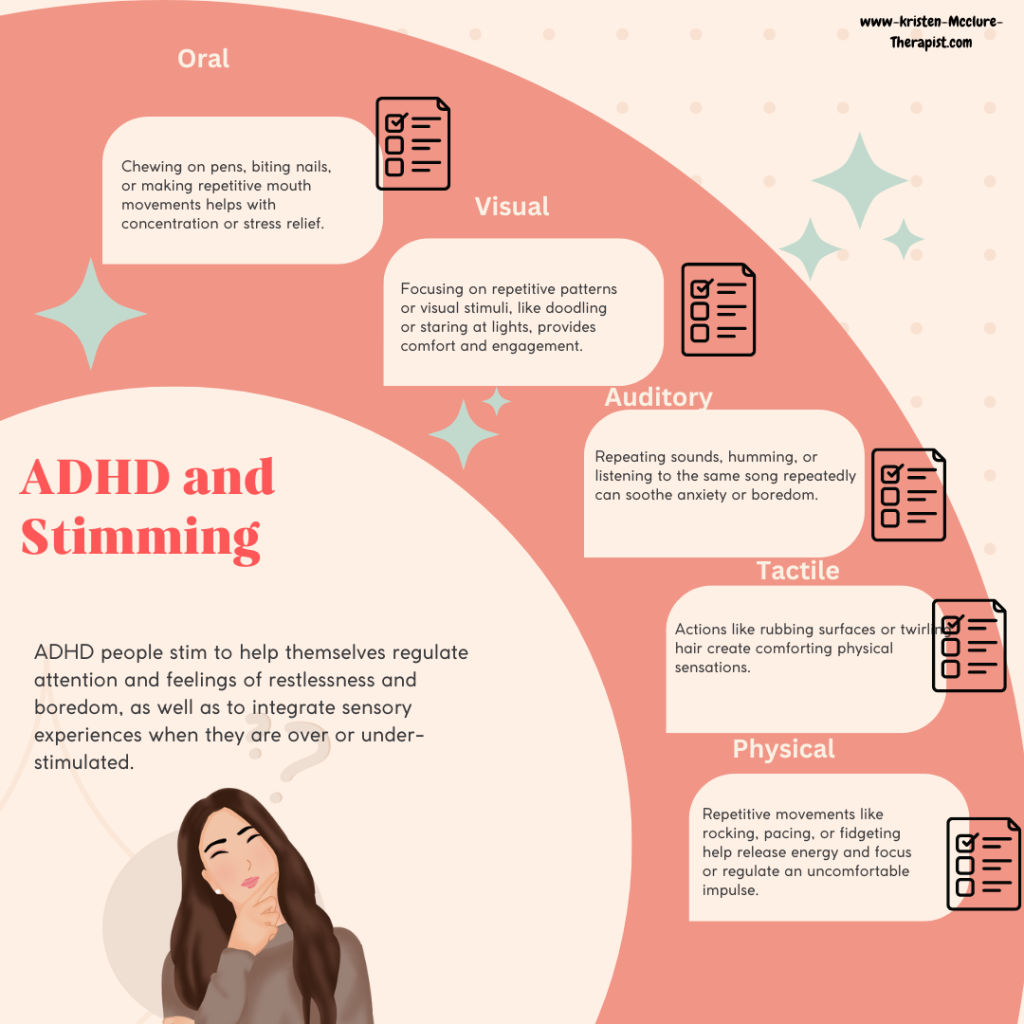
Stimming is short for self-stimulatory behavior. The clinical definition covers a wide range of repetitive movements, sounds, or sensory input that the nervous system uses to regulate itself — to manage arousal, attention, emotion, and sensory load.
It is not a tic. It is not a nervous habit in the casual sense. It is a regulatory mechanism. When your nervous system needs to stay alert, process something complex, discharge excess energy, or soothe itself through discomfort, stimming is one of the tools it reaches for.
The research on this is clear: stimming serves a function. It is purposeful behavior, even when it feels automatic or unconscious. It is the nervous system doing what nervous systems are supposed to do — finding a way to stay regulated.
For people with ADHD, whose nervous systems tend to be harder to regulate, stimming is not occasional. It is ongoing. It is a core feature of how the brain manages a world that consistently demands more from it than it can easily supply.
Do People with ADHD Stim?
Yes. Consistently, and across all presentations of ADHD.
This question comes up often because stimming is most publicly associated with autism. And while stimming is a well-documented feature of autism, it is also a well-documented feature of ADHD. The two are not the same, but they share a common thread: a nervous system that needs more active help regulating itself than the neurotypical model assumes.
ADHD involves differences in dopamine regulation, executive function, and arousal modulation. The result is a nervous system that struggles to reach and hold an optimal state — not too under-stimulated, not too overwhelmed. Stimming is one of the ways the brain tries to bridge that gap. It increases sensory input when the system is under-aroused and needs to focus. It channels and releases excess activation when the system is overloaded. Sometimes it does both, depending on the type of stim and the context.
So yes — people with ADHD stim. Many do it constantly. Most have done it since childhood. And many, particularly women, have spent decades being told to stop without ever being told what it actually was or why they were doing it.
What ADHD Stimming Looks Like in Adult Women
Adult ADHD stimming tends to look quieter and more socially managed than what most people picture when they hear the word. In women especially, it often presents in ways that are easily mistaken for nervousness, poor grooming habits, or distraction — rather than recognized as regulation.
Leg bouncing is one of the most common. It can be constant during desk work, meetings, or any period of sustained mental demand. It is the nervous system adding sensory input to help sustain attention. The movement is doing something, even when it looks like nothing.
Hair twirling or touching is another pattern that appears often in ADHD women — running a strand through the fingers repeatedly, twisting it, pulling it. The tactile sensation is regulating. It is not vanity or distraction. For many women, it happens most when they are trying hardest to concentrate.
Skin picking — on the fingers, lips, cheeks, or elsewhere — is both common and often loaded with shame. It tends to increase under stress and during periods of low stimulation. It is frequently misread as a symptom of anxiety alone, when it is often a regulatory behavior with roots in ADHD.
Nail biting, cuticle picking, and repetitive hand movements serve similar functions. So does lip biting and the repetitive movement of pressing or rubbing a surface — a desk edge, a piece of clothing, a phone case.
Humming, singing under the breath, and repetitive vocalizations are less talked about but very real. Many ADHD women hum or make quiet rhythmic sounds without realizing they are doing it — particularly while working or in sensory-demanding environments.
Repetitive movement with objects — clicking pens, tapping rhythms on a surface, shuffling cards, fidgeting with jewelry — is so normalized in ADHD that it barely registers. But it is still stimming, still serving a regulatory purpose.
These behaviors often happen in combination. They shift depending on what the nervous system needs in a given moment. And many ADHD women discover — after diagnosis or after learning about stimming — that these are not random habits but a coherent, lifelong regulatory system they built without knowing it had a name.
Why Women's Stimming Goes Unnoticed — and Gets Suppressed
The reason so many ADHD women arrive at adulthood without understanding their own stimming is partly diagnostic and partly social.
Diagnostically, ADHD research focused heavily on hyperactive presentation in boys for most of the twentieth century. The stimming associated with ADHD boys — running, climbing, large motor restlessness — was visible and disruptive enough to get noticed. Girls' stimming, which tends toward smaller, more contained movements, was less visible and less disruptive. It did not set off the same alarms.
Socially, girls are trained earlier and more consistently to manage their behavior for others' comfort. The leg bouncing gets addressed. The hair touching is called a bad habit. The fidgeting is corrected. The hum is shushed. Girls learn quickly that their body's regulatory system is not acceptable in public, and they develop the same skill they develop with ADHD in general: masking. They suppress the external behavior without being able to address what is driving it.
The cost of that suppression is real. Stimming serves the nervous system. When the outlet is blocked — when you spend years consciously overriding what your body is trying to do — the regulatory need does not go away. It finds other channels. Or it doesn't, and the resulting dysregulation shows up as anxiety, emotional flooding, difficulty concentrating, exhaustion that cannot be explained.
Many women discover in adulthood that the behaviors they spent years trying to eliminate were never problems to begin with. They were the solution.
Stimming Is Regulation, Not a Problem
This framing matters. It changes how you understand your body, your history, and what support should look like.
Your nervous system is doing what nervous systems do — finding ways to stay functional in an environment that requires ongoing regulation. The fact that it needs more active, external help than the neurotypical model expects is not a flaw. It is a feature of how ADHD brains are built.
Stimming is not something that needs to be eliminated. The goal is not to teach yourself to sit still, suppress the movement, and perform regulation for a neurotypical audience. The goal is to understand your own system well enough to use it intentionally — to know what kinds of input help you focus versus calm down, what your stims are telling you about your state, and how to work with your nervous system rather than against it.
When stimming creates problems — when a particular stim causes physical harm or becomes an obstacle in a specific context — the question is how to find alternatives that meet the same regulatory need, not how to override the need altogether. That is a different project than suppression. It is one that starts with understanding rather than shame.
Understanding and Supporting ADHD Stimming
Self-Awareness is where this work starts. Noticing what you do, when you do it, and what state your nervous system is in when a particular stim appears. Stimming is information. Increased picking or fidgeting often signals overload before your conscious mind registers it. Learning to read your own stims is part of learning your nervous system.
Self-Compassion directly addresses the shame many ADHD women carry about stimming — the years of being told to stop, the social consequences, the belief that something was wrong with them. Stimming is not evidence of dysfunction. It is evidence of a nervous system working hard to take care of itself. That history of shame deserves the same compassion you would offer anyone who had spent decades apologizing for something that did not require apology.
Self-Accommodation is about working with your regulatory needs rather than against them. This might mean building movement into your environment — a standing desk, a fidget tool, permission to walk during phone calls. It might mean identifying which stims help you focus versus which ones signal that you need a break. Accommodation is practical, specific, and built around your actual nervous system rather than an ideal one.
Self-Advocacy gives you language to use when your stimming needs to be explained or defended — in a workplace, in a relationship, in a medical context. Understanding that stimming is a regulatory behavior, not a habit or a nervous tic, changes the conversation. You deserve to move your body in ways that help your brain work. That is a reasonable accommodation, not a special request.
Self-Care includes protecting the conditions that allow your nervous system to regulate without constant effort. Sleep, sensory environment, the right kind of movement, transition time between demands — these reduce the overall regulatory burden on a nervous system that is already working hard. When basic care is in place, stimming can do what it is supposed to do, rather than carrying more than it can hold.
Frequently Asked Questions
Yes. Stimming is a well-documented feature of ADHD, not just autism. It is a regulatory behavior — the nervous system using movement, sensation, or sound to manage arousal and attention. People with ADHD tend to stim regularly, often without awareness, because their nervous systems require more active regulation than neurotypical baselines assume.
ADHD stims are repetitive movements, sensory behaviors, or vocalizations the nervous system uses to regulate itself. Common examples in adults include leg bouncing, hair twirling, skin picking, nail biting, humming, pen clicking, and repetitive object handling. They tend to be smaller and more contained than the stims most associated with autism, which is part of why they are frequently overlooked.
In adult women, ADHD stimming typically looks like contained, repetitive movement — bouncing a leg, touching hair, picking at skin or nails, humming, fidgeting with an object. It often intensifies during concentration, stress, or sensory overload. Because it tends to be quiet and socially managed, it is frequently invisible as stimming and may have been mistaken for nervousness, bad habits, or distraction.
Stimming is associated with ADHD, though it is not itself diagnostic. Many people with ADHD stim frequently and have done so since childhood. If you recognize a lifelong pattern of repetitive regulatory behaviors — particularly ones that increased when you needed to concentrate or were under stress — that is worth raising with the clinician who assessed or is assessing your ADHD.
Start by removing shame from the equation — your stimming is regulatory, and your body has been trying to take care of itself. From there, it helps to know what you are trying to regulate: focus, overload, anxiety, boredom. Different stims serve different states. Fidget tools, movement breaks, standing desks, and sensory-aware environments all create more room for natural regulation. If a particular stim causes physical harm, the goal is finding alternatives that meet the same need — not eliminating the need.
There is something particular about discovering, in adulthood, that the behaviors you spent years managing were never the problem.
Your body knew what it was doing. It found ways to regulate before you had language for what regulation was. The habits you hid in meetings, apologized for in relationships, worked to eliminate before you knew they were serving you — those were your nervous system doing its job.
You were not struggling because you lacked discipline. You were regulating because you had to.
Understanding your stims does not change what they were. But it can change everything about how you carry them.
Continue Exploring
- ADHD in Women — the complete picture
- ADHD Sensory Overload
- ADHD Masking in Women
- AuDHD — ADHD and Autism
- ADHD and Interoception
- Dopamine and ADHD
If you are a woman in North Carolina or South Carolina navigating late ADHD diagnosis, burnout, or the particular weight of understanding your own nervous system after decades of not having a framework, I work with people exactly where you are.
Telehealth appointments are available for women in NC and SC. You can reach me at kristenlynnmcclure@gmail.com or find me on Psychology Today →
Kristen McClure, MSW, LCSW | Neurodivergent-affirming telehealth therapy for women in NC and SC
Ready to Work Together?
If what you've read here feels familiar, I'd love to hear from you. I work with women with ADHD across North Carolina and South Carolina via secure telehealth — from wherever you are in either state.
