Alexithymia and ADHD: When You Can't Read Your Own Emotions
By Kristen McClure, MSW, LCSW | Neurodivergent-affirming therapy for women
YBy Kristen McClure, MSW, LCSW | Neurodivergent-affirming therapy for women
You know something is wrong. You can feel it somewhere: tightness, flatness, a pull toward the couch, tension in your jaw, or a sharp edge to everything around you.
But when someone asks what you are feeling, your mind goes blank.
You reach for a word and come back with nothing. Or you find one — fine, stressed, tired — and even as you say it, you know it does not quite fit.
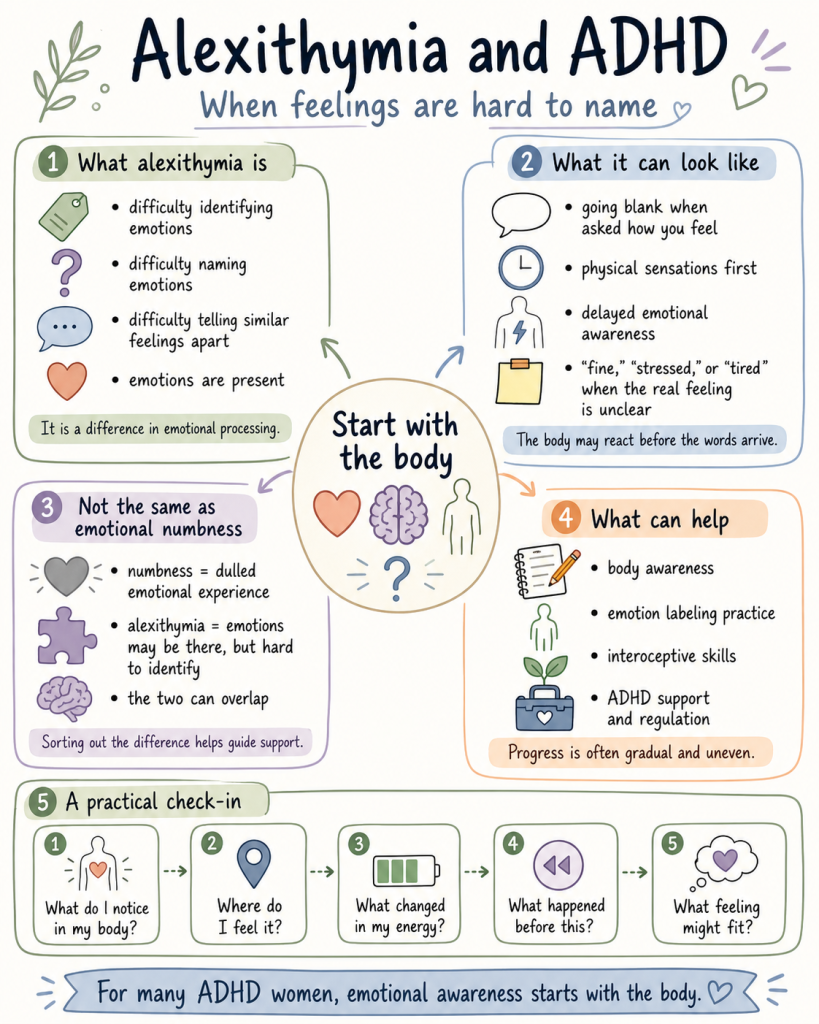
This can happen with alexithymia. Alexithymia means difficulty identifying, distinguishing, and describing emotions. It does not mean you do not have emotions. It means the pathway between feeling something and knowing what you feel may be unclear or delayed.
What Is Alexithymia?
The word alexithymia comes from Greek roots: “a” meaning without, “lexis” meaning words, and “thymos” meaning emotion.
In plain language, alexithymia means having difficulty finding words for emotions.
Alexithymia is difficulty identifying, distinguishing, and describing internal emotional states. The feelings may be present, but the process of recognizing and naming them can be hard.
Some people experience this mildly. They can identify emotions, but they need more time. Others experience it more strongly. Emotional states may show up as body sensations, behavior changes, shutdown, irritability, or vague unease without a clear label.
Alexithymia is not a diagnosis by itself. It is a pattern in emotional processing. It has been studied since the 1970s and is recognized in psychology and psychiatry as a meaningful clinical construct.
Alexithymia can be relevant for ADHD women, especially when emotional awareness, interoception, or describing internal states is difficult.
How Common Is Alexithymia in ADHD?
Several studies have found higher alexithymia scores or higher rates of marked alexithymia in ADHD groups than in comparison groups, although estimates vary by sample and measure.
Studies vary substantially in their estimates. One adult ADHD study found links between alexithymia, emotion processing, and social anxiety, with about 22% of the sample scoring in the highly alexithymic range. Another study of 101 mostly young adults with ADHD found 41.5% met its alexithymia cutoff. These are individual clinical samples, not a settled prevalence estimate for all adults with ADHD.
The exact percentage depends on the study, the sample, and the measurement tool used. Most studies rely on self-report questionnaires, which have limits.
Still, the overall pattern is consistent: ADHD and alexithymia often overlap.
That means difficulty naming emotions is not unusual for ADHD adults. It can be part of the same broader picture that includes emotional dysregulation, interoceptive differences, executive functioning challenges, and delayed emotional awareness.
What Alexithymia Looks Like in ADHD Women
Alexithymia in ADHD women often shows up in specific ways.
You may struggle to answer the question, “How do you feel about that?” You may not be withholding. You may genuinely not know.
You may notice something is wrong hours or days after the event that caused it.
You may feel the body signal first: a clenched jaw, stomach pain, shoulder tension, a tight chest, or sudden exhaustion. You know your body is reacting, but you cannot easily translate the reaction into an emotion.
You may describe yourself as fine, stressed, tired, or overwhelmed because those are the only words available in the moment.
Some ADHD women describe emotional flatness. It may not feel like depression. It may feel more like being disconnected from the emotional signal.
Others describe sudden emotional floods. The feeling seems to arrive all at once because it was not identified earlier.
You may also have trouble telling similar emotions apart:
- anxiety and excitement
- anger and sadness
- loneliness and boredom
- overwhelm and shutdown
- fear and irritation
When the categories blur, it becomes harder to know what kind of support you need.
This can create friction in relationships. When a partner asks what is wrong and you say you do not know, you may mean exactly that. When you seem distant after something hard, it may be delayed emotional processing rather than withdrawal.
How Alexithymia and Interoception Are Connected
Alexithymia is closely connected to interoception.
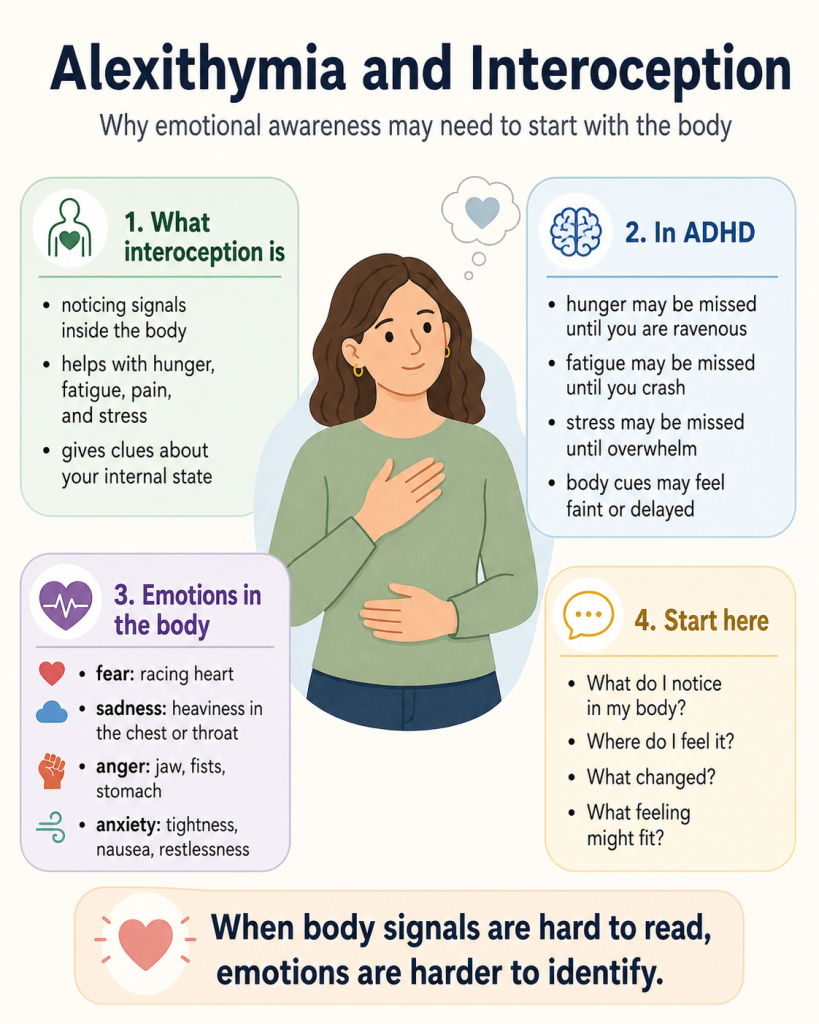
Interoception is the brain’s ability to notice and interpret signals from inside the body. It helps you recognize hunger, thirst, pain, fatigue, temperature, nausea, anxiety, and other internal states.
Many ADHD people have unreliable interoceptive awareness. You may not notice hunger until you are ravenous. You may not notice fatigue until you crash. You may miss early signs of stress until you are already overwhelmed.
This affects emotional awareness because emotions are partly physical.
Fear may show up as a racing heart or shallow breathing.
Sadness may show up as heaviness in the chest or throat.
Anger may show up in the jaw, fists, stomach, or shoulders.
Anxiety may show up as restlessness, pressure, nausea, or tightness.
When body signals are hard to read, emotions become harder to identify.
Research has found meaningful links between alexithymia and interoceptive differences. For ADHD women, this connection is clinically useful because emotional awareness may need to begin with body signals, not abstract questions about feelings.
Alexithymia Does Not Mean You Do Not Have Emotions
People with alexithymia have emotions.
The difficulty is awareness, access, and language. The emotion may be present before the person can name it.
In some research, people with alexithymia show physiological responses to emotional material even when they report limited awareness of what they are feeling.
So the issue is not absence of emotion. It is a gap between feeling and knowing.
This helps explain why alexithymia and emotional outbursts can exist together.
If emotions are not noticed and named early, they may build in the background. By the time the feeling becomes obvious, it may already be intense.
For ADHD women, this can look confusing from the outside. You may seem calm, detached, or flat in one moment and flooded in another.
That pattern often makes more sense when alexithymia and ADHD emotional dysregulation are understood together.
Why Alexithymia Can Be Misread in ADHD Women
Alexithymia is often misread.
It may be mistaken for avoidance, coldness, defensiveness, emotional immaturity, or lack of care.
For ADHD women, this can add to years of being misunderstood.
You may have been told you are too emotional and also not emotional enough. You may have been criticized for overreacting and for not responding. You may have been expected to explain your feelings in the middle of conflict, even though your brain needed more time to identify what was happening.
Alexithymia gives a more accurate frame.
The feeling may be there. The words may not be available yet.
That distinction can change how you approach communication, therapy, relationships, and self-care.
Building Emotional Awareness With Alexithymia and ADHD
Alexithymia can improve with awareness, practice, and the right supports.
For ADHD women, the work often starts with learning your own emotional pattern instead of forcing yourself into someone else’s timeline for emotional clarity.
Self-Awareness and Alexithymia
Self-awareness begins with noticing how emotions show up in your body and behavior.
This may mean tracking:
- jaw tension
- chest tightness
- stomach discomfort
- headaches
- fatigue
- restlessness
- irritability
- shutdown
- urge to avoid
- urge to scroll, eat, sleep, or withdraw
At first, the question may not be “What am I feeling?”
A better starting question may be:
“What is my body doing?”
“What changed in my energy?”
“What am I pulled to do right now?”
“What happened before this shift?”
Over time, patterns become clearer. The body signal can become the first clue.
Self-Compassion and Delayed Emotional Awareness
Self-compassion helps reduce the shame that often builds around alexithymia.
Many ADHD women can look back and see moments where they seemed cold, distant, reactive, or hard to reach. They may remember conflicts where they could not explain themselves. They may remember realizing too late that they were hurt, angry, scared, or overwhelmed.
Those moments can be understood more accurately.
Delayed emotional awareness is not the same as not caring. Needing time to process does not make your feelings less valid. It means your system may need a slower route from body signal to emotional language.
Self-Accommodation for Alexithymia
Self-accommodation means creating supports that fit how you process emotions.
Helpful accommodations may include:
- taking time before responding to emotional questions
- using body-based check-ins before naming feelings
- keeping a list of possible emotion words nearby
- using structured journaling prompts
- tracking physical signals and possible emotions
- asking for a pause during conflict
- using movement, grounding, or breathing before trying to explain
- giving yourself time after difficult conversations
For many ADHD women, real-time emotional clarity is not always available. Building in processing time can prevent shutdown, conflict escalation, or inaccurate answers given under pressure.process after difficult conversations or events, rather than expecting real-time emotional access that your brain may not have, is an accommodation, not a weakness.
Self-Advocacy When You Need More Time
Self-Advocacy means being able to explain your experience to the people who matter.
You might say, “I do not always know what I am feeling in the moment, but I can usually understand it with more time.”
That may be more accurate than trying to perform an emotional response you do not have access to yet. Self-advocacy also means asking for what helps: more time, fewer demands for immediate emotional clarity, and patience with delayed processing.
Self-Care and Body-Based Emotional Awareness
Self-Care for alexithymia often starts with the body.
Sleep, physical movement, and reduced nervous system overload can support the body signals that emotional awareness depends on. For many ADHD women with alexithymia, these are central supports. They make it easier to notice what is happening internally before emotions build or become harder to name.
Frequently Asked Questions
Alexithymia is difficulty identifying and describing your own emotional states. People with alexithymia have emotions, but they may have trouble recognizing what those emotions are, finding words for them, or telling similar emotions apart. Alexithymia is not a diagnosis. It is a dimension of emotional processing that exists on a spectrum. It is more common in ADHD people, autistic people, and people with certain trauma histories, among others.
Research suggests that alexithymia is much more common in ADHD adults than in the general population. Some studies estimate that about 45 percent of adults with ADHD meet criteria for clinically significant alexithymia, compared with closer to 10 percent in the general population. Researchers are still studying the exact reasons for this connection. But the pattern is well documented: if you have ADHD and struggle to identify or name your emotions, this is a recognized ADHD-related difficulty, not a personal failing.
The main features of alexithymia include difficulty identifying what you are feeling, difficulty describing emotions to other people, noticing physical sensations without a clear emotional label, and having trouble telling similar emotions apart. Some people also describe feeling detached from their emotional experience or having difficulty understanding other people’s emotions. These features may be mild, moderate, or more significant, and they vary from person to person..
They can look similar, but they are different. Emotional numbness can occur with depression, trauma, or dissociation. It usually involves a dulling or reduced access to emotional experience. Alexithymia means the emotion may be present, but it is hard to identify, name, or describe. The two can also overlap. Sorting out which pattern is present can help clarify what kind of support is needed. A therapist who understands both can help you make sense of the difference.
Alexithymia is not fixed. Many people build stronger emotional awareness over time with the right support. Therapy that focuses on body awareness, emotion labeling, and interoceptive skills may help. This can include somatic therapy, mindfulness-based approaches, and emotion-focused work. For ADHD women, treating and supporting ADHD can also help because better nervous system regulation can make internal signals easier to notice. Progress is usually gradual and uneven, but improvement is possible.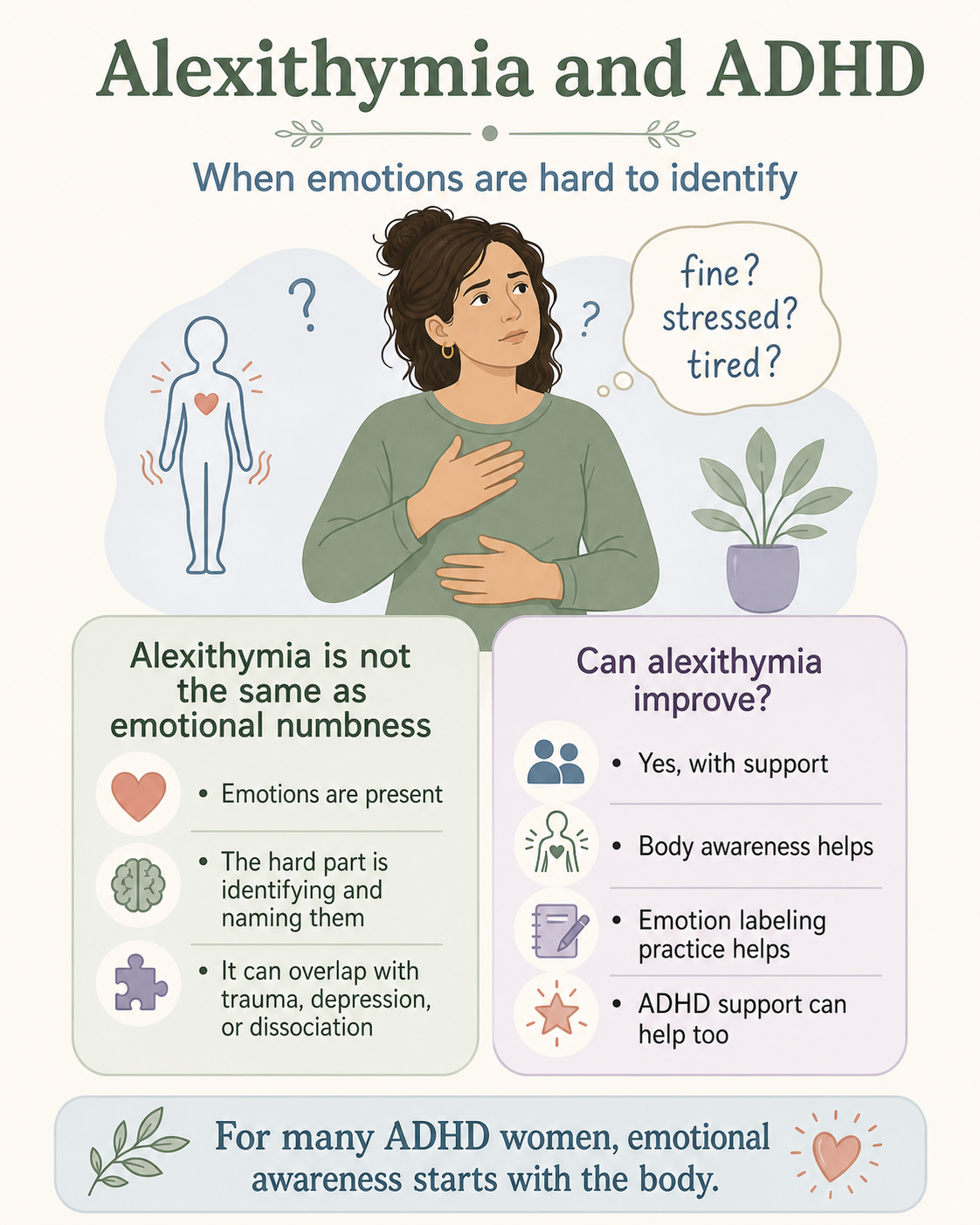
If you do not know what you are feeling, that is not the end of the conversation with yourself. It is the start of a different kind of check-in.
- You can begin with the body.
- What do I notice?
- Where do I feel it?
- What changed in my energy?
- What happened before this?
- What might this feeling be?
You do not have to name the emotion right away. For many ADHD women with alexithymia, emotional awareness takes time, body cues, and repeated practice.
That is work that is worth doing.
Continue Exploring
- ADHD in Women — the complete picture
- ADHD and Interoception
- ADHD in Relationships
- ADHD Burnout in Women
- ADHD Sensory Processing
- ADHD and Anxiety
- ADHD and Emotional Dysregulation
- ADHD and Cortisol in Women
If you are looking for neurodivergent-affirming therapy for ADHD women in North Carolina or South Carolina, I offer telehealth sessions and welcome inquiries. You can reach me at kristenlynnmcclure@gmail.com or view my profile on Psychology Today.
Ready to Work Together?
If what you've read here feels familiar, I'd love to hear from you. I work with women with ADHD across North Carolina and South Carolina via secure telehealth — from wherever you are in either state.
