
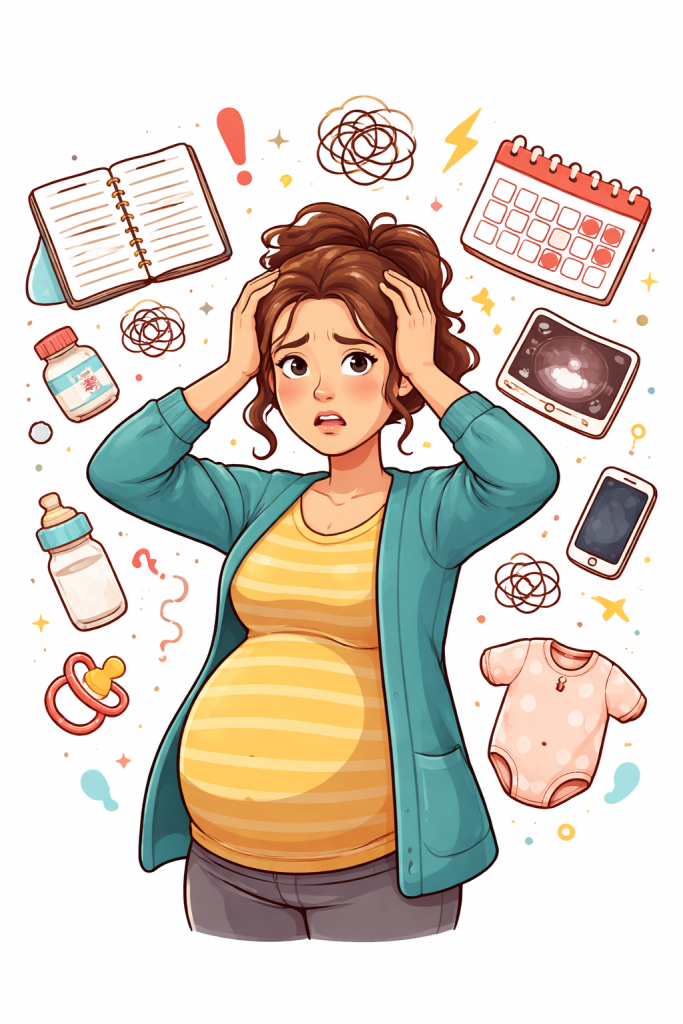
This page gives an overview of how pregnancy interacts with ADHD.
Each section links to a more detailed page on specific topics like medication, prenatal care systems, breastfeeding, and postpartum mental health.
Pregnancy can be complicated for anyone.
For ADHD women, it often feels harder in ways that are not talked about, not anticipated, and not well supported by the medical system.
Many ADHD women worry about whether they should become pregnant at all. Others find themselves pregnant unexpectedly. Nearly half of all pregnancies are unplanned, and research suggests this number is higher among ADHD women.
If that is your story, you are not alone.
This page gives a clear, grounded overview of ADHD and pregnancy.
It explains what is known, what tends to be harder, where real risks exist, and how to support yourself through this stage without shame or panic.
This is a starting point, not a checklist you have to master.
How Pregnancy Interacts With ADHD
ADHD does not disappear during pregnancy.
Hormones, stress, sleep disruption, and increased cognitive load all interact with how an ADHD brain functions.
Estrogen supports dopamine. Dopamine plays a central role in attention, motivation, working memory, and emotional regulation.
During pregnancy:
🔵 Estrogen rises overall
🔵 Fatigue, nausea, and sleep disruption tax executive functioning
🔵 Stress tolerance often decreases
🔵 ADHD symptoms may feel steadier for some women
🔵 For others, symptoms feel worse or harder to manage
There is no single ADHD pregnancy experience.
Both patterns are normal.
Medication Decisions During Pregnancy
One of the most stressful questions ADHD women face is whether to continue medication during pregnancy.
There is no universal answer.
Over the last decade, research has become more nuanced and less alarmist. Large population studies generally do not show a significant increase in major congenital malformations with stimulant medications. Some studies suggest a small increased risk of specific outcomes, such as cardiac malformations with methylphenidate, but absolute risk remains low.
What is often missed is this:
Untreated ADHD can also carry risk.
Severe inattention, impulsivity, emotional dysregulation, anxiety, and depression can affect:
🔵 driving safety
🔵 stress hormones
🔵 sleep
🔵 nutrition
🔵 follow-through with prenatal care
Medication decisions should be made collaboratively with a provider who understands ADHD and pregnancy. The goal is not perfection. The goal is stability and safety for both parent and baby.
→ See ADHD Medication During Pregnancy for a deeper, research-based discussion.
Stress, Executive Function, and Daily Life
Pregnancy increases demands on executive functioning.
Many ADHD women report more difficulty with:
🔵 remembering appointments
🔵 managing paperwork and insurance
🔵 keeping up with prenatal vitamins and routines
🔵 tolerating sensory overload
🔵 managing criticism, advice, and social pressure
This is not a personal failure.
It is a predictable mismatch between ADHD brains and increased cognitive load.
External supports matter more during pregnancy, not less.
→ See ADHD and Prenatal Care: Advocating for Yourself for practical scaffolding.
Known Pregnancy Risks in ADHD Women
Research suggests ADHD women may be at higher risk for certain pregnancy and birth complications, including:
🔵 preeclampsia
🔵 preterm labor
🔵 emergency cesarean delivery
Infants born to ADHD mothers may also have higher rates of:
🔵 neonatal intensive care admission
🔵 breathing difficulties at birth
🔵 emergency newborn interventions
These risks are believed to be related to stress physiology, sleep disruption, and barriers to consistent prenatal care — not ADHD itself as a defect.These findings are not a reason for fear.
They are a reason for anticipatory support, monitoring, and self-advocacy.
After Birth: What to Prepare For
After delivery:
🔵 estrogen drops rapidly
🔵 sleep deprivation increases
🔵 practical support often decreases
This combination places ADHD women at significantly higher risk for postpartum depression and anxiety.
Many women report:
🔵 worsening attention and memory
🔵 emotional overwhelm
🔵 intense guilt or shame
🔵 difficulty coping with unpredictability
🔵 feeling dismissed or misdiagnosed
Planning for postpartum support before birth matters.
→ See ADHD and Postpartum Depression for detailed guidance.
Breastfeeding and ADHD Medication
Many ADHD women are told to stop medication entirely while breastfeeding, even when evidence does not clearly support a blanket approach. Feeding decisions often become one of the biggest sources of pressure and misinformation after birth for ADHD women.
Some ADHD medications may be compatible with breastfeeding at low doses, depending on the medication, timing, and individual circumstances. Risks and benefits should be weighed carefully and individually.
Stability, sleep, and mental health matter for infant safety too.
What Helps
ADHD pregnancy care works best when it includes:
🔵 honest discussion of impairment
🔵 external supports and reminders
🔵 reduced expectations, not increased pressure
🔵 collaborative medical decision-making
🔵 mental health screening during and after pregnancy
🔵 compassion for real limits
You are not weak for needing support.
You are responding appropriately to a demanding neurological and physiological transition.
Final Thoughts
ADHD does not disqualify you from pregnancy or parenting.
It does mean you deserve informed care, realistic planning, and respect.
If you feel dismissed, overwhelmed, or unsure, trust that instinct. Ask questions. Seek second opinions. Build support early.
You are not broken.
You are navigating pregnancy with a brain that requires different scaffolding.
References
Baker, A. S., & Freeman, M. P. (2018).
Management of attention-deficit/hyperactivity disorder during pregnancy.
Obstetrics and Gynecology Clinics of North America, 45(3), 495–509.
Baker, A. S., Wales, R., Noe, O., et al. (2022).
The course of ADHD during pregnancy.
Journal of Attention Disorders, 26(2), 143–148.
Kittel-Schneider, S., et al. (2021).
Parental ADHD in pregnancy and the postpartum period.
Neuroscience & Biobehavioral Reviews, 124, 63–77.
Scoten, O., et al. (2024).
ADHD in pregnancy and the postpartum period.
American Journal of Obstetrics & Gynecology.
Additional Reading (Plain-Language Resources)
Surles, T. (2022).
The No-Bullshit Guide to Pregnancy With ADHD.Surviving (and Thriving) During Your ADHD Pregnancy.
Women’s Palooza presentation.Chipura, D. (2021).Dusty's work

Medical Disclaimer
The information on this page is for educational purposes only and is not a substitute for medical advice, diagnosis, or treatment.
Always seek the guidance of a qualified healthcare professional, including an obstetric provider, psychiatrist, or primary care clinician, with any questions you may have regarding pregnancy, ADHD, or medication use.
Do not delay, change, or discontinue medical care based on information found on this website without consulting your healthcare provider.
