By Kristen McClure, MSW, LCSW | Neurodivergent-affirming therapy for women
ADHD and Chronic Fatigue: What Is the Connection?
By Kristen McClure, MSW, LCSW
Neurodivergent-affirming therapy for women
You did not do much today. At least, it may not look like much from the outside.
You answered a few emails. You made one phone call. You went to the grocery store. You tried to start the task you have been avoiding.
Now it is 3 p.m., and you feel wiped out. Your body feels heavy. Your brain feels foggy. The rest of the day feels almost impossible.
For many women with ADHD, this kind of fatigue is familiar. It can feel confusing because the exhaustion does not always match the visible amount of work you did.
That is part of what makes ADHD fatigue hard to explain.
The fatigue is not just about sleep. It may involve executive functioning, sensory overload, emotional intensity, masking, pain, hormones, and years of pushing through without enough support.
ADHD can be exhausting because the ADHD brain often has to work harder to regulate ordinary life.
ADHD Fatigue and ME/CFS Are Connected, But They Are Not the Same
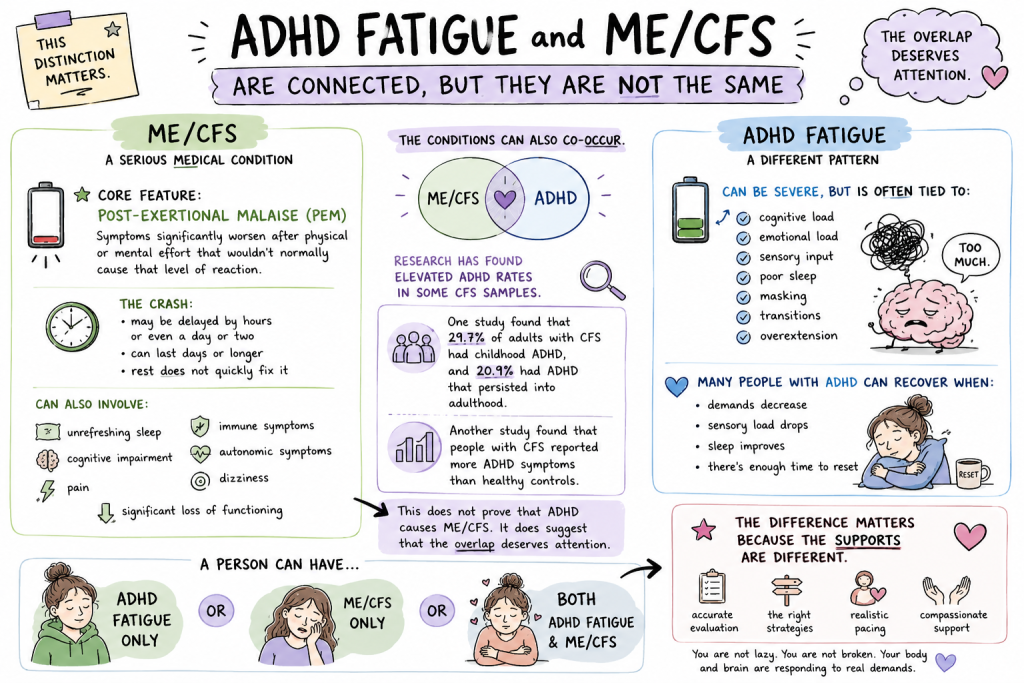
This distinction matters.
ME/CFS, or Myalgic Encephalomyelitis/Chronic Fatigue Syndrome, is a serious medical condition. Its core feature is post-exertional malaise. This means symptoms significantly worsen after physical or mental effort that would not usually cause that level of reaction.
This crash may be delayed by hours or even a day or two. It can last days or longer. Rest does not quickly fix it.
ME/CFS can also involve unrefreshing sleep, cognitive impairment, pain, immune symptoms, autonomic symptoms, dizziness, and significant loss of functioning.
ADHD fatigue can be severe, but it often follows a different pattern. It is usually tied to cognitive load, emotional load, sensory input, poor sleep, masking, transitions, and overextension. Many people with ADHD recover when demands decrease, sensory load drops, sleep improves, and they have enough time to reset.
The conditions can also co-occur.
Research has found elevated ADHD rates in some CFS samples. One study found that 29.7% of adults with CFS had childhood ADHD, and 20.9% had ADHD that persisted into adulthood. Another study found that people with CFS reported more ADHD symptoms than healthy controls.
This does not prove that ADHD causes ME/CFS. It does suggest that the overlap deserves attention.
- A person can have ADHD fatigue.
- A person can have ME/CFS.
- A person can have both.
The difference matters because the supports are different.
Can ADHD Cause Chronic Fatigue?
ADHD can be associated with significant fatigue, but it should not automatically be assumed to cause chronic fatigue. Attention demands, executive effort, poor sleep, sensory load, emotional strain, masking, and overextension can all contribute to feeling exhausted. ME/CFS is a separate medical condition, especially when post-exertional malaise is present. Some people have ADHD-related fatigue. Some have ME/CFS. Some have both.
ADHD is usually described as a condition involving attention, hyperactivity, impulsivity, and executive functioning. Many adults with ADHD also report significant fatigue.
Research supports this. In one study of adults with ADHD, participants reported significantly more fatigue than healthy controls. In that same study, 62% of the ADHD group met criteria for “fatigue caseness,” compared with 26% of healthy controls.
Fatigue is not currently part of the formal ADHD diagnostic criteria. That matters. Many people are evaluated for ADHD through a checklist focused on inattention, hyperactivity, and impulsivity. The daily exhaustion may never be asked about directly.
This can leave ADHD women feeling confused. They may know they are tired all the time, but they may not understand why.
The link appears to come from several overlapping demands:
ADHD brains often work harder to sustain attention.
They may use more energy to start tasks, shift between tasks, and make decisions.
Many people with ADHD have sleep problems, delayed sleep rhythms, or unrefreshing sleep.
Emotional intensity, repeated conflict, and sensitivity to rejection can be exhausting, especially when they add to an already high cognitive and emotional load.
Sensory input can be harder to filter.
Masking and compensating can use enormous mental energy.
For women, this is often compounded by late diagnosis, years of self-blame, hormonal changes, caregiving demands, emotional labor, and the pressure to appear organized and capable.
So the fatigue is not random. It often makes sense when you look at the real energy cost of living with ADHD.
Why ADHD Can Make the Brain So Tired
ADHD involves differences in regulation.
The brain has to regulate attention, motivation, emotion, arousal, sleep, sensory input, memory, and action. When these systems do not shift smoothly, everyday life can take more effort.
A task like answering an email may require more than typing words. You may have to remember what the email is about, manage anxiety about the response, decide how much detail to include, resist checking something else, tolerate the boredom or pressure, and then transition into the next task.
That is a lot of hidden work for ADHD women.
A neurotypical person may experience the same email as one small task. An ADHD brain may experience it as a chain of executive demands.
This is why an ordinary day can leave an ADHD woman feeling like she has done much more than anyone can see.
The Main Types of ADHD Fatigue
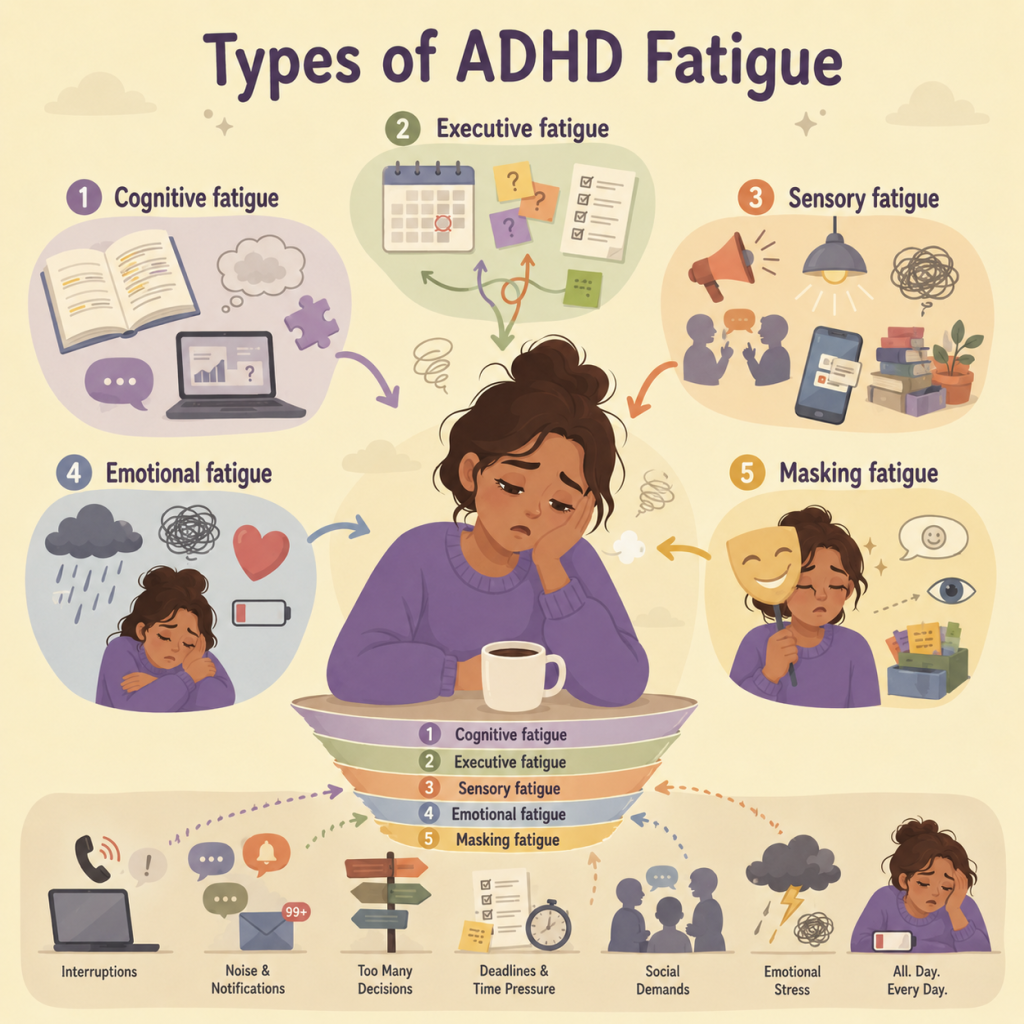
ADHD fatigue can show up in different ways.
Cognitive fatigue is the mental exhaustion that comes from sustained thinking. Reading dense material, writing, problem-solving, organizing information, and staying focused through meetings can drain the brain quickly.
Executive fatigue comes from planning, deciding, starting, stopping, switching, and organizing. A day full of small decisions can become exhausting, even if none of the individual tasks looks difficult.
Sensory fatigue can happen when a person has been processing a high level of sensory input for a long time. Noise, light, crowds, clutter, smells, screens, and overlapping conversations can all add to the load.
Emotional fatigue comes from managing intense feelings. Many people with ADHD experience emotions quickly and strongly. The effort of holding those emotions in, explaining them, or recovering from them can be tiring.
Masking fatigue is the exhaustion that comes from trying to appear neurotypical. This can include forcing eye contact, suppressing movement, tracking conversations, hiding disorganization, managing facial expressions, or pretending you are fine when you are overloaded.
These types of fatigue often stack together.
A noisy workday with constant interruptions, social performance, emotional stress, and too many decisions can create a level of exhaustion that makes sense once you name the demands.
Can Treating ADHD Help Chronic Fatigue?
Sometimes, yes — especially when fatigue is partly coming from untreated ADHD.
ADHD can make daily life more tiring because the brain is spending extra energy on attention, task initiation, transitions, emotional regulation, sensory filtering, and masking. When ADHD is untreated, a person may use constant effort just to get through ordinary demands.
Research supports the idea that fatigue is common in adults with ADHD. One study found that adults with ADHD were significantly more fatigued than healthy controls, and 62% of the ADHD group met criteria for fatigue caseness.
There is also research showing overlap between ADHD and chronic fatigue syndrome. In one study of adults with CFS, 29.7% had childhood ADHD and 20.9% had ADHD that persisted into adulthood. People with both CFS and adult ADHD had earlier fatigue onset, more severe anxiety and depression symptoms, and higher suicide risk than those with CFS alone. (PubMed)
This does not mean ADHD causes ME/CFS. It means clinicians should consider ADHD when a person with chronic fatigue also has lifelong patterns of inattention, restlessness, impulsivity, emotional dysregulation, disorganization, or executive functioning difficulty.
Medication may help some people when untreated ADHD is part of the fatigue picture. Stimulant medication can improve attention, task initiation, mental effort, and cognitive control. For some people, that may lower the energy cost of daily functioning.
A small case series described three people diagnosed with chronic fatigue syndrome who were later found to meet criteria for ADHD. After psychostimulant treatment, they reported improvement in fatigue, pain, cognitive symptoms, and core ADHD symptoms. The authors also stated that more research is needed to understand ADHD prevalence in people presenting with fatigue and whether fatigue responds to psychostimulant treatment when ADHD is present. (ammes.org)
That finding is clinically interesting, but it should be interpreted carefully. A case series can raise useful questions. It does not prove that stimulants treat ME/CFS.
The more accurate takeaway is this: if someone has chronic fatigue and lifelong ADHD symptoms, it may be worth assessing and treating the ADHD. That treatment may improve fatigue for some people. ME/CFS, especially when post-exertional malaise is present, requires careful medical evaluation, pacing, and support from clinicians who understand the condition.
Stimulants can also create risk for some people with ME/CFS if they make it easier to push past the body’s limits. Feeling more alert is different from having more physical capacity. For someone with post-exertional malaise, doing more because medication makes it possible can sometimes lead to a worse crash later.
So yes, treating ADHD may help ADHD-related fatigue. It may also help some people who have both ADHD and chronic fatigue. It should not be framed as a simple fix for ME/CFS.
Why This Gets Missed in ADHD Women
ADHD in women is often missed for years. Many women are identified only after decades of anxiety, depression, overwork, people-pleasing, masking, perfectionism, or unexplained exhaustion.
By the time ADHD is recognized, fatigue may already feel like part of their personality.
Many women have learned to push through. They build systems around shame. They overprepare, overfunction, stay up late, hide mistakes, and use urgency to get things done.
That pattern can work for a while. It can also drain the body and brain over time.
Hormones may add another layer. Many women notice that ADHD symptoms and fatigue change across the menstrual cycle, postpartum, during perimenopause, or after sleep disruption. Hormonal changes can affect sleep, mood, pain sensitivity, energy, and executive functioning.
This is one reason a woman may say, “I used to be able to manage this, and now I can’t.”
The issue may not be that she suddenly became less capable. The energy cost may have changed.
What Research Suggests So Far
The research on ADHD and chronic fatigue is still developing. What we have so far does not show that ADHD causes ME/CFS. It does show that ADHD, fatigue, sleep problems, pain, and cognitive symptoms can overlap in clinically important ways.
Several findings are worth paying attention to.
Adults with ADHD often report more fatigue than adults without ADHD. In one study, adults with ADHD had significantly higher fatigue scores than healthy controls, and 62% met the study’s threshold for fatigue caseness.
Some people diagnosed with CFS or ME/CFS also report high rates of ADHD symptoms. One study found that 29.7% of adults with CFS had childhood ADHD, and 20.9% had ADHD that persisted into adulthood. People with both CFS and adult ADHD had earlier fatigue onset, more severe anxiety and depression symptoms, and higher suicide risk than those with CFS alone.
There is also overlap among fatigue, pain, sleep disruption, brain fog, and autonomic symptoms. Conditions such as fibromyalgia, chronic pain, sleep apnea, POTS, hormonal changes, and ME/CFS can complicate the picture.
The practical takeaway is this: fatigue in ADHD should be taken seriously, but severe or post-exertional fatigue should not automatically be assumed to be “just ADHD.” If someone has lifelong ADHD symptoms and chronic fatigue, ADHD assessment may be useful. If fatigue worsens after exertion and does not improve normally with rest, medical evaluation is important.
When to Seek Medical Evaluation
ADHD can explain a lot of fatigue, but it should not be used to explain every kind of exhaustion.
Medical evaluation is important if your fatigue is severe, new, worsening, or not improving with rest and reduced demands.
It is especially important if you experience post-exertional malaise. This means you crash after activity in a way that feels disproportionate, delayed, or prolonged.
It is also worth checking for common medical contributors, including sleep apnea, thyroid conditions, anemia, vitamin deficiencies, autoimmune illness, chronic infections, medication effects, hormonal changes, POTS or other autonomic problems, depression, fibromyalgia, and ME/CFS.
This is not about dismissing ADHD fatigue. It is about being precise.
ADHD fatigue is real. Medical fatigue is also real. Sometimes both are present.
What Helps ADHD-Related Fatigue?
Track the crash pattern
Ask:
What happened in the 24 hours before the crash?
Was it social, sensory, emotional, cognitive, physical, hormonal, or sleep-related?
Did I feel better after rest, or did rest barely touch it?
Was the crash delayed?
Did I push through warning signs?
Reduce the invisible load
For ADHD fatigue, the first supports are often:
- fewer decisions
- less task switching
- more transition time
- lower sensory input
- body-doubling
- external reminders
- recovery time after social or high-focus tasks
- realistic pacing on “good energy” days
Watch for ME/CFS signs
If exertion causes a delayed crash that lasts days, the support plan needs medical input and pacing, not just ADHD productivity tools.
Understanding ADHD-Related Fatigue
ADHD-related fatigue is easier to understand when you look at what is actually draining energy instead of treating exhaustion as a personal failure.
Instead of asking, “Why can’t I keep up?” it helps to ask more useful questions.
What drains me?
This is self-awareness. Start noticing what actually costs you energy. It may be task switching, social masking, sensory overload, decision-making, emotional labor, poor sleep, transitions, or pushing through when your body is already giving warning signs.
What am I blaming myself for?
This is self-compassion. Many ADHD women blame themselves for needing more rest, canceling plans, falling behind, or crashing after a demanding day. Blame usually makes fatigue worse. It adds shame on top of depletion.
What can I change in the task or environment?
This is self-accommodation. You may need fewer steps, less noise, more transition time, body doubling, written reminders, flexible timing, a simpler routine, or recovery time after high-demand activities.
What language do I need with doctors, work, or family?
This is self-advocacy. Fatigue is easier to dismiss when it stays vague. Try naming the pattern clearly: “I crash after several hours of high-focus work,” “I need recovery time after sensory-heavy environments,” or “My fatigue is worse after exertion and does not improve quickly with rest.”
What basics need protection before I crash?
This is self-care. For ADHD women, self-care often means protecting food, hydration, medication routines, sleep, movement, breaks, sensory regulation, and downtime before the body reaches overload.
The point is not to manage your energy perfectly. The point is to understand the pattern earlier, reduce the unnecessary load, and stop treating exhaustion as a character problem.
Frequently Asked Questions
Fatigue is common in adults with ADHD. ADHD can increase daily energy use because attention, task initiation, emotional regulation, sensory filtering, transitions, and masking can all take extra effort. Some ADHD women feel tired even when they are trying hard and doing “normal” daily tasks.
Sometimes ADHD fatigue can look like chronic fatigue because the person may feel drained, foggy, overwhelmed, and unable to keep up. But ADHD fatigue and ME/CFS are not the same. ME/CFS involves post-exertional malaise, where symptoms worsen after physical or mental effort and do not quickly improve with rest.
Fatigue is not one of the core diagnostic symptoms of ADHD, but many people with ADHD experience it. The fatigue often comes from the effort of managing executive functioning, sensory input, sleep disruption, emotional intensity, and constant self-monitoring.
ADHD fatigue is often tied to cognitive load, sensory overload, emotional effort, poor sleep, transitions, masking, or overextension. ME/CFS is a medical condition where exertion can trigger a delayed and prolonged worsening of symptoms. If fatigue gets worse after activity and rest does not restore you, medical evaluation is important.
Sometimes. If fatigue is partly coming from untreated ADHD, treating ADHD may reduce the energy cost of daily functioning. This does not mean ADHD treatment is a cure for ME/CFS. If post-exertional malaise is present, the person needs medical evaluation and pacing support.
Talk to a doctor if fatigue is new, severe, worsening, disabling, or does not improve with rest. It is also important to seek medical evaluation if you have dizziness, fainting, pain, immune symptoms, unrefreshing sleep, shortness of breath, or crashes after exertion.
The exhaustion is not imaginary. For many ADHD women, it reflects a brain and body that have been working hard without enough support, recovery, or accommodation.
It is a reason to treat your energy as a real, limited resource.
Continue Exploring
- ADHD in Women — the complete picture
- ADHD and Chronic Pain
- ADHD Burnout in Women
- Hormones and ADHD
- ADHD and Sleep
- Spoon Theory and ADHD
- ADHD Fight-or-Flight Response
- Energy Management for ADHD Women
- ADHD and Cortisol in Women
- ADHD and Routine Disruptions
- ADHD and Overwhelm
- ADHD and Menopause
If you are looking for neurodivergent-affirming therapy for ADHD women in North Carolina or South Carolina, I offer telehealth sessions and welcome inquiries. You can reach me at kristenlynnmcclure@gmail.com or view my profile on Psychology Today.
Ready to Work Together?
If what you've read here feels familiar, I'd love to hear from you. I work with women with ADHD across North Carolina and South Carolina via secure telehealth — from wherever you are in either state.
