ADHD and Overwhelm in Women: Why Everything Feels Like Too Much
By Kristen McClure, MSW, LCSW | Neurodivergent-affirming therapy for women
You look at the day ahead and feel your system tighten before anything has happened.
The day may not look especially hard on paper. But your brain is already tracking what needs to be done, what needs to be decided, what is unfinished, what is unclear, and where to begin. That load can be genuinely heavy, even when other people cannot see it.
You may have tried lists, new systems, reminders, schedules, or telling yourself to take one step at a time. Some of these strategies may help briefly. Then they stop helping, or they require so much upkeep that they become another task.
That does not mean you failed. It usually means the strategy did not match how your brain processes information, transitions, decisions, and demand.
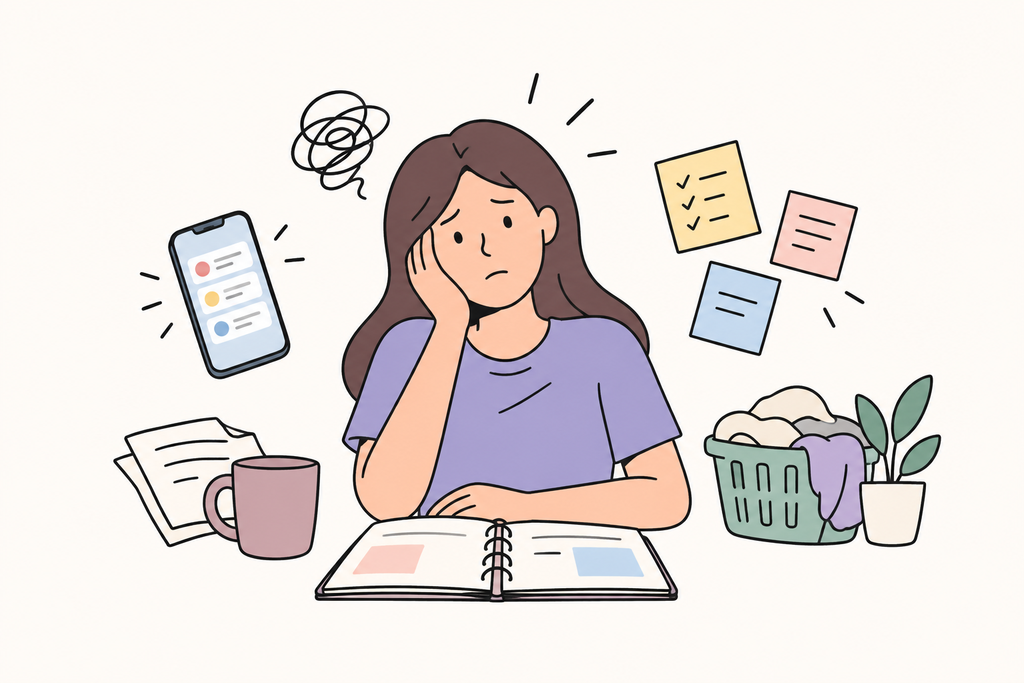
ADHD overwhelm in women is real, but it is rarely caused by one thing. It can build when executive-function demands, sensory input, emotional strain, masking, unclear expectations, transitions, sleep, hormones, stress, and other demands start to exceed your available capacity.
This page explains what is happening, why overwhelm can hit ADHD women especially hard, and what tends to help.
What ADHD Overwhelm Actually Is
ADHD overwhelm is best understood as a capacity problem, not a character problem.
Overwhelm often builds when the demands of the moment become greater than the capacity you have available to meet them. That capacity can change from day to day depending on sleep, stress, hormones, sensory load, emotional strain, illness, pain, caregiving, work demands, and how much effort you have already used.
The ADHD brain often has more difficulty with working memory, executive functioning, and filtering out irrelevant information. This means the brain may be trying to do several things at once:
- hold onto tasks, reminders, and unfinished items
- sort through sensory and environmental input
- manage emotions that come quickly or intensely
- find the activation needed to begin a task
For someone with ADHD, holding information in mind, choosing among competing demands, shifting attention, starting, and recovering from interruption may require more deliberate effort. That extra effort is easy to miss when you are still getting things done.
That means tasks, emotions, sensory input, decisions, and transitions may all compete for the same limited resources.
When demand gets too high, thinking can become less flexible. You may have trouble choosing a starting point, shifting between tasks, holding the steps in mind, or deciding what can wait. Some women describe this as freezing or shutting down.
That freeze can look like paralysis, shutdown, difficulty choosing where to start, or the sense that everything is urgent and impossible.
From the outside, this can look like avoidance. Sometimes avoidance is part of it. But often the larger problem is that the task has become too unclear, effortful, emotionally loaded, or demanding for the capacity available in that moment.
The useful question is not simply, “Why am I avoiding this?” It is, “What about this demand is exceeding my capacity right now?”
Why Overwhelm Can Build So Quickly for ADHD Women
Many ADHD women describe carrying a large amount of invisible cognitive and emotional load. Some of that comes from ADHD itself. Some comes from gendered expectations, caregiving, relationship management, masking, and the pressure to keep other people comfortable while also keeping daily life running.
This can include:
- tracking household needs
- managing relationships
- anticipating what others need
- monitoring social expectations
- remembering details that other people may not notice
This is in addition to the executive demands that ADHD already makes harder.
Capacity is not fixed. A day that feels manageable after good sleep and low stress may feel completely different after conflict, sensory overload, several transitions, poor sleep, pain, hormonal changes, or a stretch of sustained masking. Having time available does not necessarily mean you have the capacity for the task.
A schedule change, an unexpected task, or a difficult conversation can be enough to push the system into overload.
Masking can add to this load.
The effort of appearing organized, calm, prepared, and emotionally regulated can take substantial energy. If you spend much of the day monitoring yourself, compensating, or hiding difficulty, there may be less capacity left when you get home.
Many ADHD women can function well in public or professional settings and then fall apart when they are alone.
This does not mean the day was easy and they overreacted.
It may mean that masking used up the resources they needed for everything else.
Hormonal fluctuation adds another layer.
Many ADHD women report that attention, emotional regulation, sensory tolerance, sleep, and everyday functioning become harder in the premenstrual phase. Research on ADHD and the menstrual cycle is growing, and newer studies support greater premenstrual symptom burden and interference in women with ADHD. The hormonal mechanisms are still being worked out, so it is more accurate to describe the pattern than to reduce it to a simple dopamine explanation.
Many women notice that overwhelm is significantly worse in this phase.
This is not only emotional. It can affect their actual capacity to start tasks, make decisions, regulate emotions, and manage daily demands. When overwhelm starts showing up in personal-care tasks such as showering, brushing teeth, or getting dressed, the same executive and sensory load may also show up as ADHD-related hygiene difficulty.
Tasks that felt manageable earlier in the cycle may suddenly feel much harder.
If you notice a reliable cycle pattern, it is worth taking seriously. Tracking what becomes harder before your period can give you useful information for planning, treatment, and self-accommodation.
The Freeze Response
When overwhelm gets high, some women describe freezing, shutting down, scrolling, leaving the task, or moving between tasks without getting traction. Those responses can have more than one function: reducing immediate demand, escaping distress, or reflecting difficulty selecting and initiating the next action.
But often, it is a freeze response.
You cannot start. You cannot choose. You may move from task to task without completing any of them. Or you may sit down with the intention of working and find yourself on your phone an hour later.
This is not laziness or lack of motivation.
It is what can happen when the ADHD nervous system is overloaded and the executive system cannot find a clear path forward.
This is sometimes described as task paralysis.
Task paralysis is a common informal term for getting stuck at the point of starting or choosing what to do next, even when the task matters to you. It is not a formal diagnosis, but the experience is familiar to many people with ADHD.
It is one of the most distressing parts of ADHD overwhelm because it can feel like a choice, even when it is not.
When you are overloaded, the easiest available action may win—not because it is the most important, but because it requires the least activation, uncertainty, or emotional effort in that moment.
Understanding the difference between choosing not to do something and being neurologically unable to initiate it matters.
It changes how you respond to yourself.
Shame and self-criticism do not help executive function problems. They usually make the freeze response worse.
Overwhelm and Emotional Intensity
ADHD overwhelm often comes with emotional intensity. Research consistently finds more emotion-regulation difficulty in adults with ADHD, and many women describe having less room to manage frustration, criticism, conflict, or disappointment when they are already overloaded.
The context matters. A comment from a partner may land differently after a day of masking, interrupted tasks, sensory strain, and trying to hold too much in mind. Repeated experiences of criticism or misunderstanding can also make judgment feel more threatening because it has happened before.
Some ADHD women use the term rejection sensitivity or RSD for very intense reactions to perceived rejection or criticism. RSD is not a formal diagnosis, and the research base is still limited, but the experience of strong rejection sensitivity is widely reported clinically and in ADHD communities.
What Helps When You Are Already Overwhelmed
When you are already overloaded, adding a complicated productivity system usually creates more demand. Start by reducing what your brain has to hold.
- Get the demands out of your head. Write them down without organizing them yet.
- Choose what does not need to happen now. Removing a demand can be more useful than organizing it.
- Make the next step specific. “Deal with the bills” is vague. “Open the electric bill” gives your brain somewhere to start.
- Reduce input. Lower noise, notifications, conversation, visual clutter, or other sensory demands if they are adding to the load.
- Use support. A written instruction, body double, reminder, shared decision, or another person taking one part of the task may reduce the amount you have to manage alone.
When everything feels like too much, look for the part of the demand that can be reduced, clarified, changed, or supported so it fits your current capacity better.
A practical starting point for ADHD overwhelm is to notice what is exceeding your capacity, reduce or clarify the demand where possible, and add support. Sometimes the overload is coming from the task itself; other times it is the number of decisions, transitions, sensory demands, or competing responsibilities around it.
What Research Supports
“ADHD overwhelm” is not a formal diagnostic term. I use it here to describe a cluster of experiences many ADHD women report when demands exceed available capacity.
The pieces underneath that experience are well supported. Adult ADHD is associated with executive-function difficulties, and a meta-analysis of 13 studies involving 2,535 adults found substantially greater emotion dysregulation in adults with ADHD than in comparison groups. Read the meta-analysis.
Research on hormones and ADHD women is newer. A 2026 cross-sectional study of 602 females found more severe premenstrual symptoms and greater functional impact in the ADHD group. Because the study relied on self-report and was cross-sectional, it cannot tell us exactly why the pattern occurs, but it supports taking women’s reports of cycle-related worsening seriously. Read the 2026 study.
Research does not yet capture every part of what women call overwhelm—especially the combined effect of masking, sensory load, caregiving, gender expectations, accumulated stress, and fluctuating capacity. Clinical observation and lived experience remain important sources of information while that evidence develops.
Frequently Asked Questions
ADHD can affect working memory, executive function, and the ability to filter sensory and cognitive input. This means the ADHD brain may work harder to manage tasks that are more automatic for many people, such as tracking, starting, organizing, and transitioning.
When demands exceed the capacity available in that moment, overwhelm can show up as indecision, irritability, shutting down, difficulty starting, or moving toward an easier activity. What looks like avoidance may involve executive load, uncertainty, emotional strain, sensory input, or several of these at once.
Both ADHD and anxiety can contribute to overwhelm, and they often overlap. Looking at what is driving the load can still be useful.
Anxiety may add threat anticipation, worry, or physical arousal to overwhelm. For neurodivergent women, some of that worry may also be grounded in real experiences of forgetting, falling behind, being criticized, or being misunderstood.
ADHD-related overwhelm may be driven more by the amount that has to be tracked, started, organized, decided, filtered, or transitioned between. In real life, anxiety and executive overload often interact rather than appearing as two cleanly separate problems.
Many ADHD women experience both at the same time. ADHD overwhelm can also create secondary anxiety, especially when you keep falling behind, missing details, or feeling unable to start.
When ADHD is better supported, the anxiety connected to overwhelm may also decrease.
Starting a task requires executive function.
Your brain has to choose the task, find the activation to begin, and stay with it long enough to get through the first hard part.
When you are already overloaded, choosing a task, holding the steps in mind, tolerating uncertainty, and generating enough activation to begin may all become harder.
That is why ADHD overwhelm can lead to freezing instead of action.
Avoidance can be part of the picture, but getting stuck can also reflect unclear steps, too many competing demands, emotional load, or difficulty initiating under the conditions you are in.
The task may require more activation, clarity, structure, urgency, interest, or external support than is available in that moment.
Why is ADHD overwhelm worse before my period?
Hormonal changes across the menstrual cycle may interact with ADHD symptoms, but the mechanisms are still being studied.
Many ADHD women report that the premenstrual phase is a period when attention, emotional regulation, sleep, sensory tolerance, and everyday functioning become harder.
Newer studies support greater premenstrual symptom burden and functional interference in ADHD groups, although they do not establish one simple biological explanation.
For some ADHD women, this shows up as more overwhelm: tasks feel harder to start, decisions take more effort, sensory input is harder to tolerate, or emotions are more difficult to regulate.
The pattern can be real without reducing it to a single neurotransmitter explanation. Tracking your own cycle can help you see whether there is a reliable change in capacity for you.
What actually helps ADHD overwhelm?
ADHD overwhelm usually improves when the load becomes smaller and clearer.
What helps most is changing the conditions around the task.
This may include:
reducing the number of decisions you have to make each day
building in recovery time before you hit capacity
giving tasks a clear starting point
breaking unclear tasks into smaller steps
protecting sleep as much as possible
reducing the invisible cognitive load of masking when you can
Ambiguity makes task initiation harder. If the task is unclear, the brain has to spend extra energy figuring out where to begin.
A useful approach is to reduce the gap between what is being asked of you and the capacity and support you have available.
This does not happen by trying harder. It happens by changing the environment, lowering the load, and making the next step easier to see.
Overwhelm is often a sign that something about the current load, environment, timing, expectations, or available support needs to change.
Instead of asking only how to make yourself do more, it can be more useful to ask: What is creating the most friction here, and what would reduce it?
That might mean a clearer first step, fewer demands, less sensory input, more recovery, a different time of day, or support from another person. The right change depends on what is making this hard for you.
Continue Exploring
- ADHD in Women — the complete picture
- ADHD Task Paralysis
- ADHD Freeze Response
- Rejection Sensitive Dysphoria
- ADHD and Emotional Dysregulation
- ADHD Energy Management
- ADHD Burnout in Women
- ADHD and Cortisol in Women
- ADHD and Hormones
- ADHD and Sleep
I offer neurodivergent-affirming therapy for women with ADHD in North Carolina and South Carolina via telehealth. If overwhelm has become your baseline and nothing you've tried has held, I'd welcome the conversation. Learn more about working with me.
Ready to Work Together?
If what you've read here feels familiar, I'd love to hear from you. I work with women with ADHD across North Carolina and South Carolina via secure telehealth — from wherever you are in either state.
