ADHD and Decision Fatigue: Why Even Small Choices Can Be Exhausting
By Kristen McClure, MSW, LCSW | Neurodivergent-affirming therapy for women

It shouldn't be this hard. The question was: what do you want for dinner? And somehow that question has sat there for twenty minutes while you experience something that feels completely out of proportion to dinner — a kind of blankness, or an overwhelm, or a paralysis that can't be explained to the person asking. You know you have to eat. You have preferences. You make decisions professionally that are objectively harder than this. And still the answer won't come.
Decision fatigue in ADHD is not about the difficulty of individual decisions. It is about what happens when the system that makes decisions has been running at capacity all day — and how fast that capacity is depleted when you have ADHD.
Why Decisions Are More Costly with ADHD
Every decision runs on the same cognitive infrastructure that ADHD depletes: working memory, prefrontal activation, attention, impulse regulation. The small decisions — what to wear, what route to take, what to order, what task to do first, whether to respond to that message now or later — each draw from the same finite executive resource pool.
For neurotypical people, routine decisions run automatically and cost very little. For people with ADHD, many decisions that should be routine remain effortful because the ADHD nervous system does not reliably automate them. The low-grade executive cost of small decisions stays high across the board, which means the pool depletes faster.
By the time a meaningful decision needs to be made — at the end of a day of small choices, or after a high-demand morning — the executive system may have nothing left to give. The decision that would have been manageable earlier is now genuinely beyond current capacity.
ADHD and Decision Paralysis
Decision paralysis is the specific experience of being unable to make a decision even when you have sufficient information, even when you understand the stakes, even when the decision is objectively simple. It often involves:
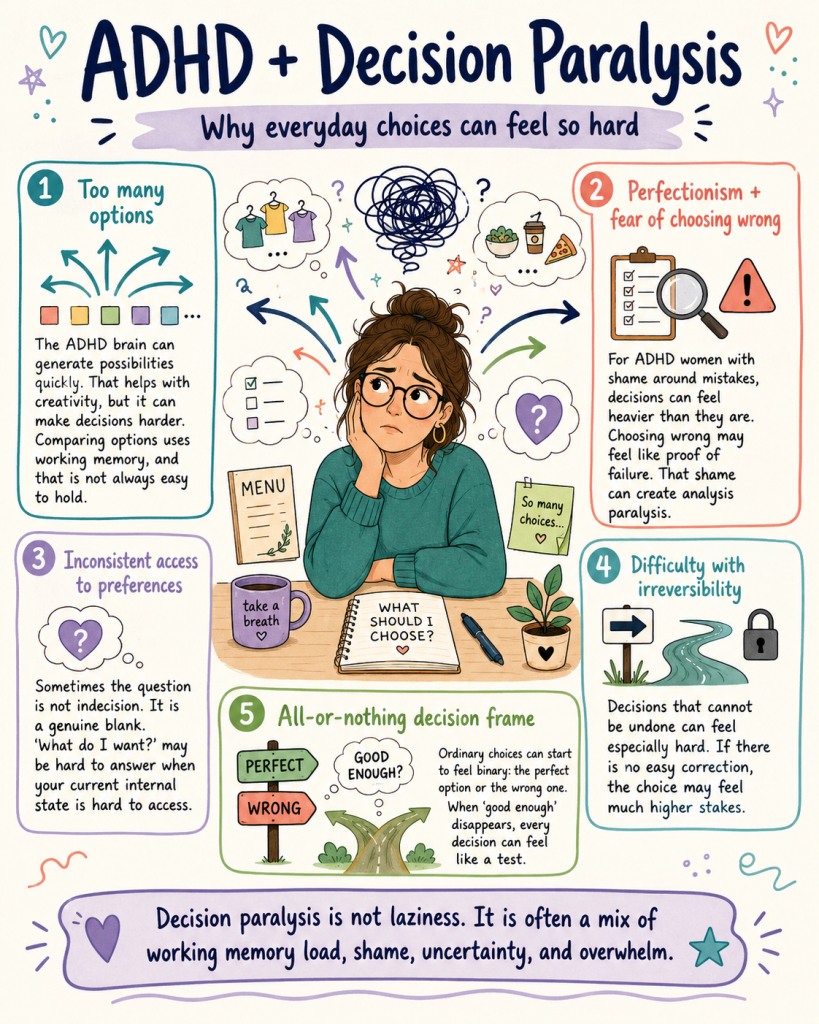
Too many options.
The ADHD brain can generate possibilities rapidly — which is a strength in creative contexts and a problem in everyday decision-making. When many options exist, comparing and evaluating them requires sustained working memory that ADHD doesn't reliably provide.
Perfectionism and fear of choosing wrong.
For women with ADHD whose history involves shame around mistakes, decisions carry a weight beyond their practical stakes. Choosing wrong is not just inconvenient — it is evidence of something. The shame anticipation produces analysis paralysis.
Inconsistent access to preferences.
What do I want? requires interoceptive access to current internal state. Preferences — what sounds good, what feels right, what resonates — are not always clearly accessible to the ADHD nervous system. The person asking "what do you want?" may be experiencing a genuine blank rather than indecision.
Difficulty with irreversibility.
Decisions that can't be undone carry more weight because there is no correction available if the wrong choice is made. ADHD, with its lower tolerance for consequences and reduced future orientation, can make irreversible decisions particularly difficult.
All-or-nothing decision frame.
The ADHD tendency toward all-or-nothing thinking can turn ordinary decisions into binary high-stakes choices: either the perfect option or the wrong one. This eliminates the possibility of "good enough" and makes every decision feel like a test.
Decision Fatigue and Relationships
Decision fatigue in ADHD frequently affects close relationships — particularly partnerships — in ways that create conflict that neither person fully understands.
The "I don't care, you decide" that arrives at the end of the day is genuine. The executive system is depleted. But to a partner who has been carrying decision load all day and was hoping for input, it reads as indifference, disengagement, or a refusal to participate. Neither interpretation is accurate. The capacity is genuinely not available.
Understanding this — that "I can't decide right now" is neurological and not relational — changes what the conversation about dinner actually needs to be.
What Helps
Reduce the number of daily decisions.
The single most effective intervention for ADHD decision fatigue is reducing the total decision load — not improving decision-making, but making fewer decisions. Standing orders for recurring choices: the same breakfast, the same lunch, a capsule wardrobe, pre-decided routines for recurring contexts. Every automatic decision is a decision that didn't cost executive resources.
Decide in advance.
Making decisions when executive resources are full — in the morning, or the day before — and treating those decisions as settled removes the real-time decision demand. Meal planning, laid-out clothes, pre-decided workout plans: not because variety doesn't matter but because the cost of deciding in the moment is high.
Limit options.
When faced with too many options, artificially constrain the choice. "Pick one of these three" costs less than "pick from anything." Give yourself permission to use arbitrary constraints — whoever picks first, whatever is closest, the first one that sounds remotely acceptable — rather than optimizing every choice.
Name decision fatigue when it's happening.
In relationship contexts, being able to say "I'm decision-fatigued right now and genuinely can't make a good choice — can we use X default or can you decide?" is more honest and more productive than producing a non-answer that frustrates both people.
Protect high-stakes decisions for good windows.
If you know your executive function is best mid-morning and worst after 4pm, protect important decisions for the good window. Don't sign anything significant when depleted.
Good enough is a legitimate answer.
Not every decision needs to be optimal. Perfectionism applied to decisions is decision-costly. "Good enough, chosen quickly" is almost always better for quality of life than "optimal, chosen after an hour of paralysis."
Reducing Decision Load With ADHD
Self-Awareness means recognizing decision fatigue as a real neurological state — noticing when you are in it, understanding that the paralysis is about executive resource depletion rather than the actual difficulty of the decision, and tracking when in the day you are most and least capable of high-quality decision-making.
Self-Compassion means releasing the shame of "I can't even decide what to eat" — the self-contempt that turns a neurological resource problem into evidence of global dysfunction. The difficulty is real and it is not proportional to the decision's objective difficulty. Both of those things are true at once.
Self-Accommodation means deliberately designing your life to reduce decision load: defaults, routines, limited options, advance decisions, and protection of executive resources for the choices that actually matter. This is not rigidity — it is freeing up cognitive bandwidth.
Self-Advocacy means being able to name decision fatigue in relationships and work contexts — to explain that "I don't know" at 6pm is neurological, to ask for defaults and structures that reduce real-time decision demand, and to protect yourself from high-stakes decisions made from depleted states.
Self-Care recognizes that anything that restores executive function — sleep, rest, physical movement, recovery time — also restores decision-making capacity. Caring for the system that makes decisions is part of making decisions well.
Frequently Asked Questions
Every decision runs on executive resources — working memory, prefrontal activation, impulse control. ADHD depletes these resources faster than average, and many decisions that should be automatic remain effortful for ADHD nervous systems. By the time a seemingly simple decision arrives, the executive system may genuinely have nothing left. The decision that feels impossible isn't objectively hard — it is encountering a depleted system.
Decision capacity is context and timing dependent. A complex decision made earlier in the day, in a high-activation state, from a professional context where the ADHD interest system is engaged, may genuinely be more accessible than a low-stakes personal decision made from a depleted state at the end of the day. The complexity of the decision matters less than the state of the executive system at the moment of deciding.
The more options, the more comparison and evaluation required — which is a working memory and attention demand. ADHD working memory has limited capacity. When many options exist, the comparison process can't run reliably, which produces overwhelm and paralysis rather than a chosen outcome. Artificially limiting options — pick one of three — reduces the memory demand to a level the system can handle.
The most effective strategy is fewer decisions rather than better individual decisions: defaults, advance choices, limited options, and routines that convert recurring choices into automatic responses. For the decisions that do need to be made, choosing windows of good executive function, setting a time limit (this reduces perfectionism pressure), and accepting good-enough outcomes over optimal ones all improve the process.
Yes. Chronic decision fatigue is one of the contributors to ADHD burnout — the accumulated depletion of running an ADHD nervous system in an unaccommodated environment. When every day involves an exhausting number of effortful decisions, the depletion compounds over time. Reducing decision load is one of the recovery strategies for burnout, not just a daily productivity strategy.
The blank that arrives when someone asks what you want for dinner is not nothing. It is a nervous system that has been making decisions all day without enough resources to make that one. It deserves a default, not a second-guessing.
Continue Exploring
- ADHD in Women — the complete picture
- ADHD Time Management
- ADHD Task Switching
- ADHD Burnout in Women
- ADHD Perfectionism
- Self-Accommodation for ADHD
If you are a woman with ADHD who recognizes the paralysis of decision fatigue — in daily life, in relationships, in the gap between your decision-making at your best and at your worst — neurodivergent-affirming therapy can help. I offer telehealth therapy in North Carolina and South Carolina. Reach out at kristenlynnmcclure@gmail.com or find me on Psychology Today.
Ready to Work Together?
If what you've read here feels familiar, I'd love to hear from you. I work with women with ADHD across North Carolina and South Carolina via secure telehealth — from wherever you are in either state.
