ADHD Accountability Partners: Why External Support Works When Willpower Doesn't
By Kristen McClure, MSW, LCSW | Neurodivergent-affirming therapy for women
You know what needs to be done. You have written it down, planned it out, told yourself you would start today. And somehow, alone in your own head with only your own intention to rely on, it doesn't happen — again.
This is not a failure of character. It is a characteristic feature of ADHD neurology. The ADHD brain activates most reliably in response to external inputs: interest, urgency, novelty, and — importantly — social engagement. Accountability partners work because they are not a workaround for willpower. They are the thing that actually produces the activation your brain needs to begin.
What an Accountability Partner Is
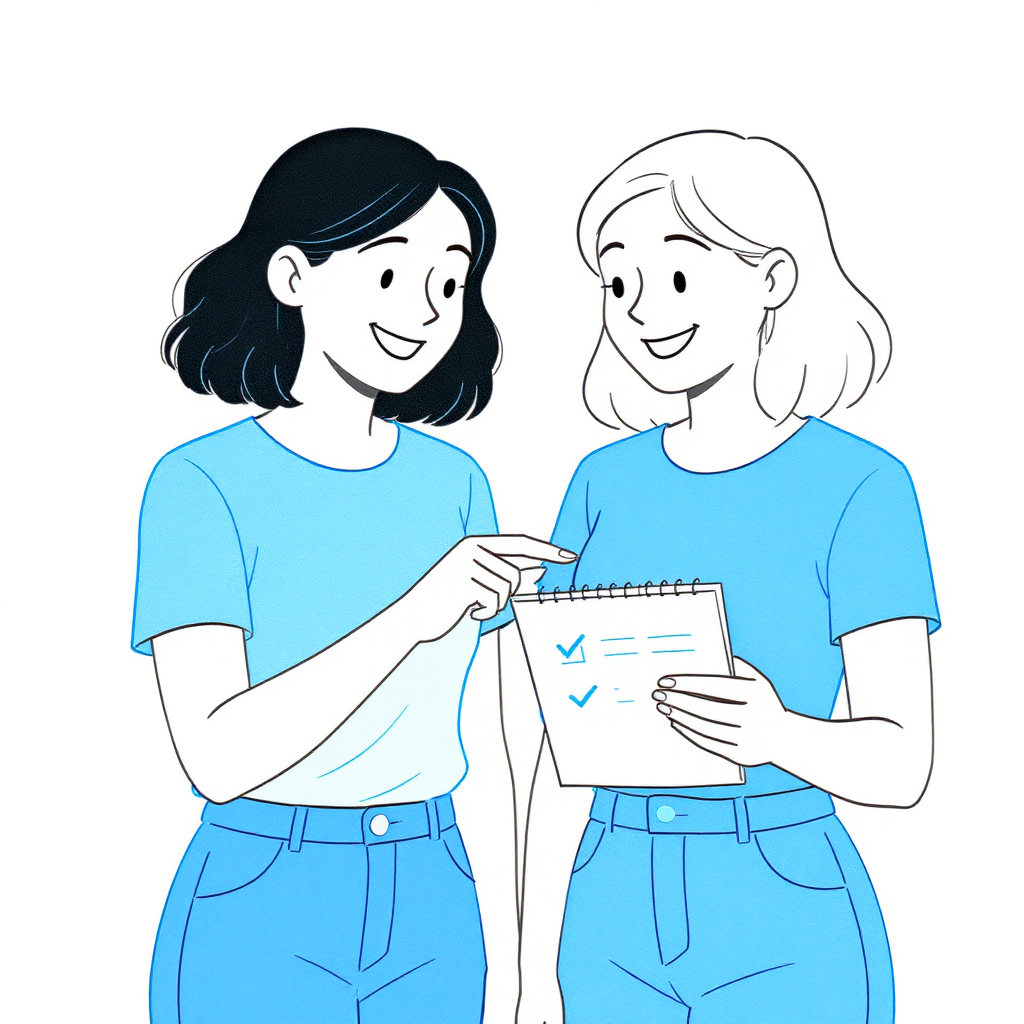
An accountability partner is someone who checks in with you regularly — or someone you check in with — to help you stay on track with your goals, tasks, and commitments. They offer support, encouragement, and a structure of external expectation that the ADHD brain can use as an activation cue.
This is distinct from a supervisor or a taskmaster. The relationship is mutual and collaborative, not evaluative or hierarchical. The partner is not there to judge what you did or didn't accomplish. They are there to create the external structure and social engagement that makes doing the work more possible.
Accountability partnerships can take many forms: a check-in call or text before you start a task and after you finish, a virtual co-working session where you and a partner work in parallel on video, a shared goal-tracking system with regular check-ins, or a simple "I'm starting this now" message to someone who will respond.
Why Accountability Works for ADHD Brains
The research on accountability partners in ADHD points to something important: the benefit is not primarily motivational in the conventional sense. It is neurological. Social engagement activates the ADHD nervous system in a way that private intention does not.
This is the same mechanism that explains body doubling — the well-documented phenomenon in which having another person physically or virtually present makes task initiation significantly more possible for ADHD brains. The accountability partner relationship provides a similar but extended version: the knowledge that you will report to someone, or work alongside someone, creates a level of activation that sustains effort over time.
For women with ADHD who struggle with task paralysis, the accountability structure lowers the initiation threshold. The task is no longer just you versus the void. It is you, your task, and a person who is expecting to hear from you afterward.
Three Keys to Making Accountability Partnerships Work
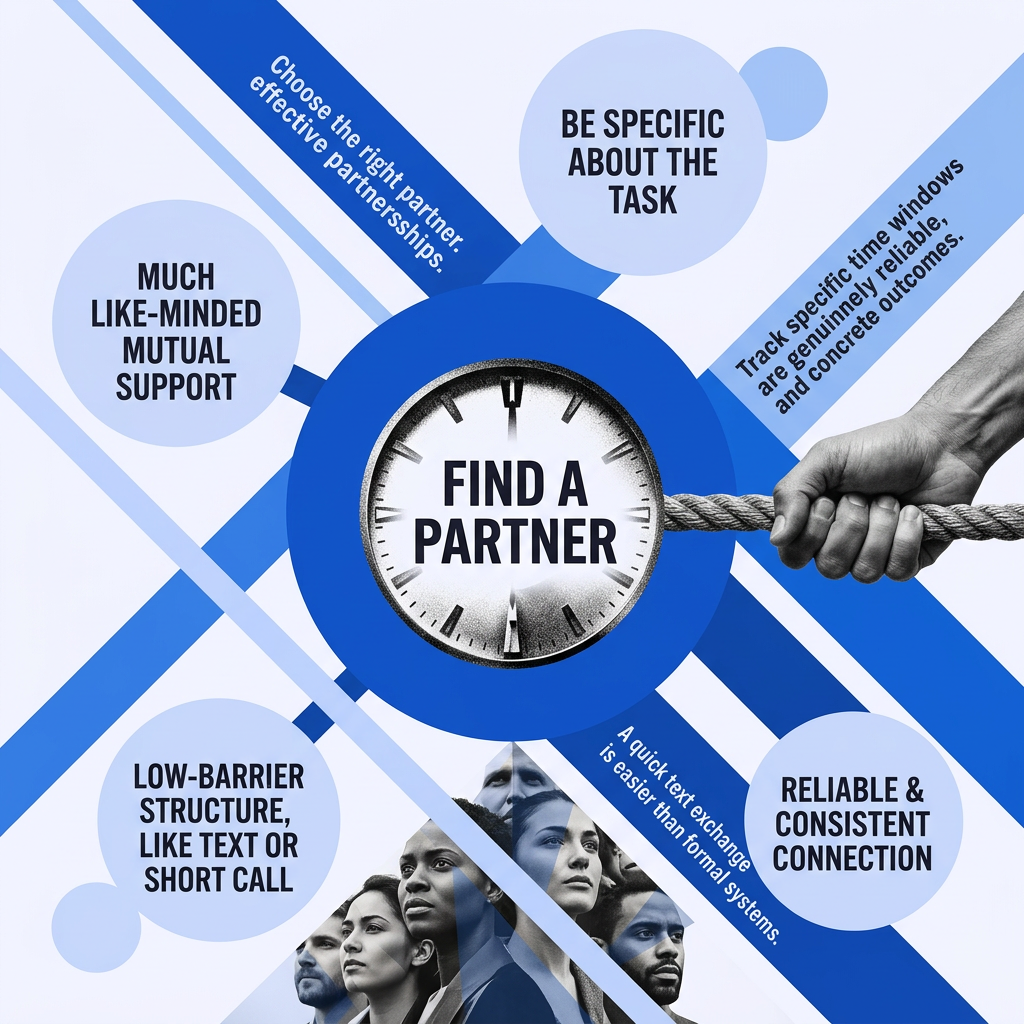
Choose the right partner. The most effective accountability partnerships involve someone who is genuinely reliable, non-judgmental, and consistent. A partner who responds with criticism when tasks don't get done, or who is unreliable in their own check-ins, adds stress rather than support. Many women with ADHD do well with partners who also have ADHD — there is a built-in understanding of the experience, and the partnership can be genuinely mutual.
The partner does not need to be doing the same type of work. A writing check-in with someone doing administrative work, a fitness accountability partnership with someone doing creative projects — the specific content matters less than the consistency and quality of the connection.
Be specific about what you are checking in on. Vague accountability ("I'm going to try to be more productive this week") produces vague results. Effective check-ins name the specific task, the specific time window, and the specific outcome that counts as done. "I'm starting the proposal introduction at 10 a.m. and checking back in at 11 with what I've written" is trackable, concrete, and gives both partners something to work with.
Keep the structure low-barrier enough to actually use. An accountability system that requires significant effort to access will not be used consistently, especially on the days when you need it most — which tend to be the days when initiating anything feels hardest. A quick text exchange, a five-minute check-in call, or a brief virtual co-working session are all lower barrier than formal systems that require preparation to enter.
Where to Find Accountability Partners
Many women with ADHD find accountability partners through:
- Online ADHD communities and forums, where the shared experience provides immediate common ground
- ADHD coaching groups that include accountability structures as a core element
- Existing friendships where the other person also wants accountability support — making the relationship mutual rather than one-directional
- Virtual body doubling platforms designed specifically for ADHD (Focusmate is one of the most widely used)
- Therapy groups for women with ADHD, which sometimes develop into informal accountability networks
Accountability Partners vs ADHD Coaches
Accountability partnerships are informal and peer-based. ADHD coaching is a professional relationship that includes accountability structures but also involves skills development, goal-setting frameworks, and systematic support for building executive function strategies.
Both have value, and they are not mutually exclusive. An accountability partner is something you can access immediately and without cost. An ADHD coach provides a deeper level of support for women who want professional structure around their goals and challenges. Therapy with a clinician who understands ADHD addresses the emotional, relational, and psychological dimensions that underlie the executive function challenges that accountability and coaching address on the surface.
How the Empowerment Model Supports Accountability
Self-Awareness
Understanding that your brain activates reliably with social engagement — and does not reliably activate from private intention alone — is important self-knowledge. You are not failing when you cannot sustain effort alone. You are working with a nervous system that is built for connection and response, and using accountability partnerships is working with that truth rather than against it.
Self-Compassion
The need for external structure and social accountability is not a sign that something is wrong with you. It is a feature of how ADHD works. Many highly capable women with ADHD accomplish significantly more with accountability support than without it — not because they are less capable, but because they are using the right tool for their neurology.
Self-Accommodation
Building accountability structures into your life — rather than relying on willpower and then criticizing yourself when it fails — is genuine accommodation. It treats the ADHD nervous system as it actually works and creates conditions where follow-through becomes more consistently possible.
Self-Advocacy
If accountability support would help in a professional context — a check-in with a colleague before starting a complex project, a brief meeting to close a task loop — asking for it is self-advocacy. Many workplaces can provide this kind of support informally without formal accommodation processes.
Self-Care
Accountability partnerships are also, in many cases, a form of genuine social connection — and social connection is one of the nervous system supports that ADHD women often deprioritize. A check-in with someone who knows what you are working on and genuinely cares about your progress is not just practical. It is relational nourishment.
Frequently Asked Questions
An accountability partner for ADHD is someone who provides regular check-ins, co-working presence, or structured expectation that helps activate the ADHD nervous system for task initiation and follow-through. The benefit is neurological — social engagement activates the ADHD brain in ways that private intention does not — not just motivational. Partners can be peers, friends, or members of structured ADHD accountability communities.
Yes. Research on body doubling and social accountability supports the effectiveness of external social structure for ADHD task initiation and sustained effort. The ADHD brain activates reliably in social contexts in ways it often does not in private. Accountability partnerships leverage this feature of ADHD neurology rather than trying to work around it.
Online ADHD communities, virtual body doubling platforms like Focusmate, ADHD coaching groups, and mutual arrangements with friends who also want accountability support are all viable paths. The key qualities to look for: reliability, non-judgment, and genuine mutual investment in the partnership.
An accountability partner is an informal, typically peer-based relationship providing check-ins and social activation. An ADHD coach is a professional who provides accountability as part of a broader support structure that includes skills development, goal-setting, and strategic planning. Both can be useful; they address different levels of support.
This depends on what you are working on and what produces the most activation for your ADHD brain. Some women do best with daily brief check-ins. Others use task-specific check-ins — a text before starting and after finishing — rather than scheduled calls. The frequency and format that you will actually use consistently is the right one, regardless of what sounds most systematic in theory.
You don't have to do this alone — and actually, doing it alone is not the most effective strategy for an ADHD brain. The structure that other people provide, the social expectation, the brief moment of connection before and after hard work — these are not crutches. They are how your nervous system works best. Using them is not weakness. It is self-knowledge in action.
Continue Exploring
- ADHD Body Doubling
- ADHD Task Paralysis
- ADHD Executive Function in Women
- ADHD Self-Accommodation
- ADHD Motivation in Women
- ADHD Burnout in Women
If you are in North Carolina or South Carolina and looking for a neurodivergent-affirming ADHD therapist, reach out to kristenlynnmcclure@gmail.com or find Kristen on Psychology Today.
Ready to Work Together?
If what you've read here feels familiar, I'd love to hear from you. I work with women with ADHD across North Carolina and South Carolina via secure telehealth — from wherever you are in either state.
