ADHD and Body Doubling: Why You Work Better When Someone Is Just There
By Kristen McClure, MSW, LCSW | Neurodivergent-affirming therapy for women
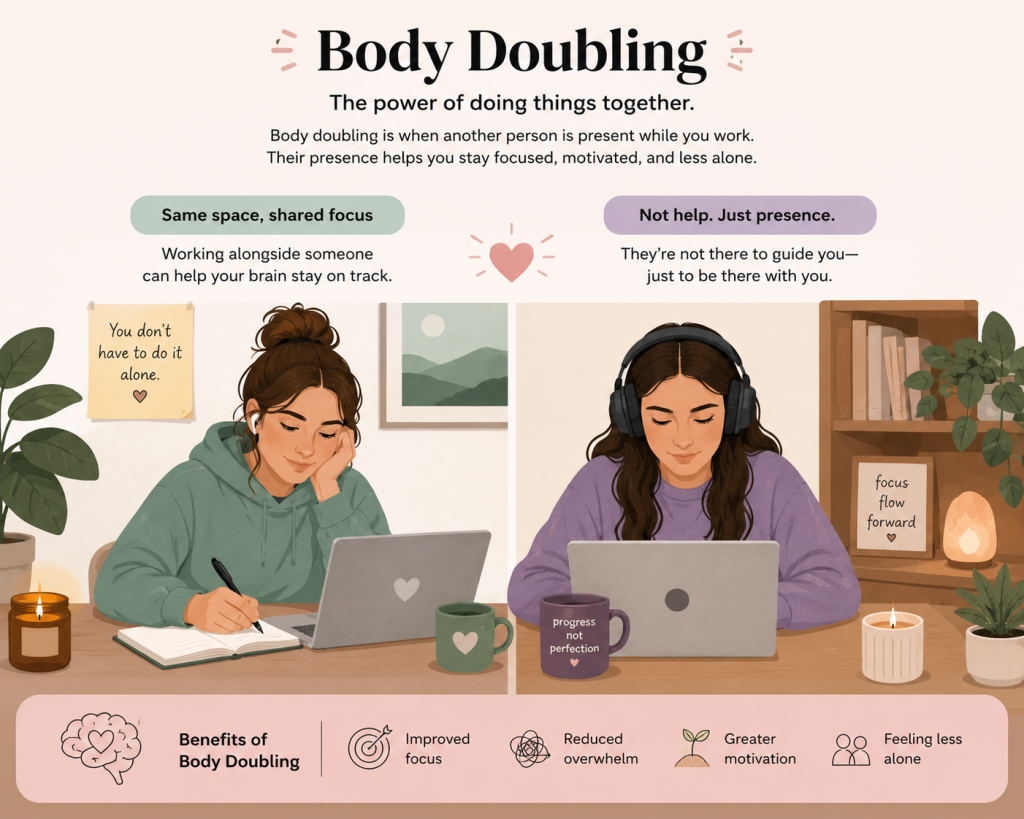
You have been sitting in front of the task for an hour. The document is open. The deadline is real. Nothing is happening. Then someone comes to sit with you — a friend, a partner, a coworker — and isn't even helping, just present in the same space. And something shifts. The task that was inaccessible ten minutes ago becomes accessible. You start.
This is body doubling. And for women with ADHD, it is not a trick or a crutch. It is one of the most reliably effective and most underused accommodations available.
What Body Doubling Is
Body doubling is the practice of having another person physically or virtually present while you work. The other person doesn't need to help with the task. They don't need to monitor you or provide accountability in any active sense. They simply need to be there — working on their own thing, reading, present on a video call in the background.
Their presence changes something in the ADHD nervous system that makes initiation and sustained attention significantly more accessible.
Why Body Doubling Works
The exact mechanism isn't fully established, but several explanations have support:
Regulated nervous system states are contagious. Being near another regulated, engaged person helps the ADHD nervous system co-regulate — moving from the dysregulated state that produces freeze or distraction toward a more settled state that makes task engagement possible. This is the same principle as co-regulation in early childhood: the presence of a calm other calms the self.
Social awareness activates a different attention mode. The ADHD brain in a social context allocates attention differently than the ADHD brain alone. Awareness of another person's presence introduces a mild social signal that can anchor the attention in ways that internal intention cannot.
The witness effect. Knowing that someone can see you — even peripherally, even someone who isn't watching — activates a different behavioral mode. This is not shame-based accountability; it is the natural behavioral shift that comes with social presence. The work becomes slightly more real because someone else is in the room.
External regulation for an internally dysregulated system. ADHD involves difficulty with self-regulation — including the self-regulation required to initiate and sustain focus on a demanding task. External regulation (another person's presence, another person's rhythm, another person's attention to their own work) provides scaffolding that the internal system isn't providing reliably.
What Body Doubling Looks Like in Practice
Body doubling doesn't require a formal arrangement or a specific type of person. Common forms include:
Working alongside a friend or partner at home. They're doing their own thing. You're doing yours. The shared space is enough.
Working in a coffee shop or library. The presence of other working people creates a diffuse body doubling effect — you are in a space where others are focused, and that signals focus.
Virtual body doubling. A video call with someone who is working on their own task. The camera on, the mutual awareness of being seen, is often sufficient. Many ADHD women use services specifically designed for virtual body doubling, or arrange ongoing sessions with friends.
Working on a call. Some ADHD women keep a phone or video call running in the background while working — not talking, just connected. The ambient presence of another person is enough to shift the state.
Study halls and co-working spaces. Structured environments where the expectation is that everyone is working create a collectively held attention that supports individual attention.
Accountability calls. A brief check-in at the start and end of a work session — stating what you're going to do, then reporting what you did — provides a light form of social presence that many ADHD women find effective.
Who Body Doubling Works For
Body doubling doesn't work the same way for everyone. Some ADHD women find it transformative — it is the single accommodation that makes tasks that otherwise feel impossible become routine. Others find it helpful in some contexts but not others. A small number find that social presence increases distraction rather than focus.
For women who are also autistic (AuDHD), social presence carries additional sensory and cognitive load — the body doubling effect may be more available in virtual or anonymous settings (coffee shop, library) than in intimate ones. What works is individual, and worth experimenting with.
Body Doubling Is Not Dependency
This is important: needing another person's presence to work is not weakness, immaturity, or inability to function independently. It is using an external scaffold for a self-regulation system that needs it.
Every person uses external scaffolding for self-regulation. Neurotypical people use to-do lists, office environments, schedules, ambient music, and dozens of other external supports without anyone calling it dependency. Body doubling is one of those supports — calibrated to how the ADHD nervous system actually works.
The goal is not to overcome the need for body doubling. It is to recognize it as a legitimate accommodation and to build it into your life in sustainable ways.
Using Body Doubling Without Shame or Dependence
Self-Awareness means recognizing when body doubling is what's needed — when the freeze or the distraction is not a focus problem to be pushed through, but a co-regulation problem that an external presence would address. Naming this accurately changes what you reach for.
Self-Compassion means releasing the shame of needing someone else present to do what others seem to do alone. Needing scaffolding is not failure. It is accurate self-knowledge.
Self-Accommodation means proactively building body doubling into your life — scheduling work sessions with a friend, finding a coffee shop that works, setting up virtual sessions, creating the external conditions that make focus accessible rather than waiting for it to appear on its own.
Self-Advocacy means being able to explain this need to partners, colleagues, and employers — and to ask for environments and arrangements that support it. Working from home with ADHD can be harder when isolation removes external structure and social cues. Naming that need and building support around it is advocacy.
Self-Care recognizes that building body doubling into your routine is an act of care for your nervous system — not an accommodation to feel guilty about, but a legitimate and effective tool that deserves to be used without apology.
Frequently Asked Questions
Body doubling is having another person present — physically or virtually — while you work. The person doesn't need to help with the task; their presence may make it easier for some people to begin, stay with a task, or feel less alone while working. Many adults with ADHD describe body doubling as useful, but direct research on the strategy itself is still limited.
The most supported explanations involve co-regulation (another person's regulated presence helps the ADHD nervous system regulate), social attention (awareness of being in a shared space activates a different attentional mode), and external scaffolding (another person's presence provides the structure that the ADHD self-regulation system doesn't provide reliably internally).
No. Virtual body doubling — a video call with someone working on their own task — is reported by many ADHD adults as equally effective. The key is the mutual awareness of presence, not physical proximity. Many ADHD women use dedicated virtual body doubling services, ongoing arrangements with friends, or open video calls for this purpose.
No. It is an external scaffold for a self-regulation system that needs external support. This is not categorically different from using a to-do list, working in an office environment, or using any other external structure to support function. Body doubling is a legitimate, effective accommodation — not a workaround to be ashamed of or overcome.
The simplest version: ask a friend or partner to work alongside you, whether in person or via video call. For more structured options, there are online platforms specifically designed for ADHD body doubling, where you join a session with other people working independently. Many ADHD women also create ongoing body doubling arrangements with friends on a reciprocal basis.
You do not have to be able to work alone in order to be capable. You just have to know what your nervous system needs — and be willing to give it that.
Continue Exploring
- ADHD in Women — the complete picture
- ADHD Task Switching
- ADHD Burnout Recovery
- ADHD and Clutter
- Self-Accommodation for ADHD
- Dopamine and ADHD
If you are a woman with ADHD building a life that actually works with your nervous system rather than against it, neurodivergent-affirming therapy can help. I offer therapy in North Carolina and South Carolina. Reach out at kristenlynnmcclure@gmail.com or find me on Psychology Today.
Ready to Work Together?
If what you've read here feels familiar, I'd love to hear from you. I work with women with ADHD across North Carolina and South Carolina via secure telehealth — from wherever you are in either state.
