ADHD and Postpartum Depression: When the Fourth Trimester Breaks You Open
By Kristen McClure, MSW, LCSW | Neurodivergent-affirming therapy for women

You wanted to feel joy. You were prepared for exhaustion. What you were not prepared for was this: the flatness, the intrusive thoughts, the rage that comes from nowhere, the sense of being stranded inside your own life watching yourself not be the mother you thought you would be.
The postpartum period can place unusually heavy demands on attention, working memory, sleep, emotional regulation, sensory tolerance, and daily organization. For a woman with ADHD, those demands may intensify existing difficulties at the same time that postpartum depression or anxiety can add another layer of distress. Understanding the whole picture can make it easier to recognize when additional support is needed.
Why ADHD May Increase Vulnerability to Postpartum Depression
The postpartum period involves a dramatic and rapid hormonal shift. After delivery, estrogen and progesterone — which have been elevated throughout pregnancy — drop sharply. For most women, this hormonal crash is challenging. For women with ADHD, it is often destabilizing in ways that go well beyond ordinary baby blues.
As you know from the hormones page, estrogen directly supports dopamine signaling in the prefrontal cortex — the brain region responsible for attention, executive function, emotional regulation, and impulse control. Rapid hormonal changes after birth may affect mood, cognition, sleep, and ADHD symptoms, but research has not established a single estrogen-to-dopamine mechanism that explains postpartum changes in women with ADHD. Sleep disruption, physical recovery, feeding demands, prior mental-health history, support, medication changes, and the abrupt increase in executive demands can all contribute.
The result is a layered experience that many clinical frameworks do not fully capture.
Postpartum ADHD symptoms may intensify at the exact time when daily demands are highest. Executive function is under more pressure. Sleep is broken. Sensory overload may increase. Emotional regulation becomes harder to access.
At the same time, postpartum depression and postpartum anxiety can add another layer of distress. Mood may drop. Worry may become more intense. Small tasks may feel unmanageable.
And all of this is happening during one of the biggest identity transitions of your life.
You are not only caring for a baby. You are also adjusting to a changed body, changed routines, changed relationships, changed sleep, and a changed sense of yourself.
For ADHD women, the postpartum period can become difficult not because one single thing is wrong, but because several systems are under strain at the same time.
The Numbers Are Higher Than Anyone Tells You
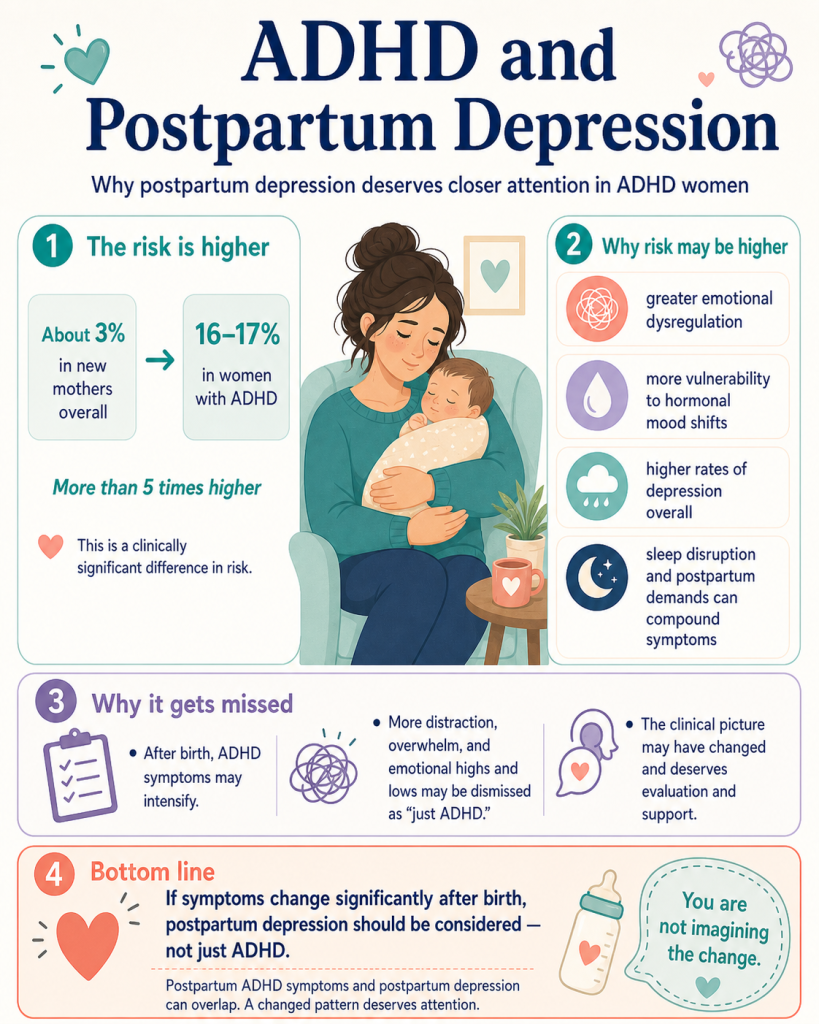
Postpartum depression is common in the general population. CDC data indicate that about 1 in 8 women with a recent live birth report postpartum depressive symptoms. A 2026 systematic review of 10 studies found that women with ADHD had a higher risk of perinatal depression than women without ADHD, with reported odds ratios ranging from about 1.8 to 2.63. The review also noted substantial variation across studies and a need for stronger research. Read the systematic review.
Postpartum anxiety can also complicate this period, but ADHD-specific postpartum-anxiety research is less developed than the depression literature. Clinically, it is still important to ask about anxiety, intrusive worry, panic attacks, sleep, and changes in functioning rather than assuming that every increase in overwhelm is simply ADHD.
What is consistent in the research is that ADHD is associated with greater emotional dysregulation, more vulnerability to hormonal mood shifts, and higher rates of anxiety and depression generally. All of those factors compound in the postpartum period.
It is also worth noting that postpartum depression is frequently underdiagnosed in women with ADHD. When existing ADHD symptoms intensify dramatically after birth — the distraction, the overwhelm, the emotional =highs and lows — they are sometimes attributed to "just ADHD" rather than recognized as a changed clinical picture that warrants evaluation and support.
What ADHD Postpartum Depression Actually Looks Like
Postpartum depression in women with ADHD often does not look exactly like the clinical picture described in textbooks, because it is layered with the specific features of the ADHD experience.
The executive function collapse can be dramatic. Tasks that were already challenging — managing schedules, keeping track of information, initiating necessary actions — become nearly impossible. New mothers with ADHD and PPD frequently describe feeling like they cannot think, cannot plan, cannot remember anything, cannot start anything. This is not laziness. It is the ADHD executive function system under severe neurochemical stress.
Emotional dysregulation often intensifies. The irritability and rage that are part of postpartum depression look somewhat different in ADHD — they can be sudden, intense, and deeply shameful in the context of new parenthood, where cultural expectations demand patience and warmth. The gap between who you thought you would be and who you are experiencing yourself as can be devastating.
Intrusive thoughts — unwanted, distressing mental images or fears about harm to the baby — are more common in postpartum depression than is widely known, and women with ADHD are not protected from them. These thoughts are ego-dystonic: they feel horrifying precisely because they are completely opposite to what you want. They are not a sign of intention or danger. They are a symptom of a stressed nervous system that warrants professional support.
Rejection sensitive dysphoria can also spike in this period. The perceived judgment of partners, family members, pediatricians, or other parents — real or imagined — can trigger intense emotional pain that feels impossible to regulate.
Sleep Deprivation as a Neurological Crisis
For women with ADHD, sleep deprivation in the newborn period is not just exhausting. It is a neurological crisis. Sleep is essential for dopamine regulation, executive function, emotional processing, and impulse control — all of the functions that are already compromised in ADHD. Extended sleep deprivation in a brain that already runs a neurochemical deficit is a compounding catastrophe.
This is not an argument for sleep training at any particular age. It is an honest clinical acknowledgment that the newborn period requires more support for women with ADHD than the standard advice accounts for. Getting help — nighttime help, daytime help, any help that allows sleep — is not a parenting failure. It is a neurological necessity.
What Helps
Postpartum depression in women with ADHD responds to treatment. The clinical tools that are most useful include:
Medication. Medication can be an important part of postpartum-depression treatment. Decisions about antidepressants, ADHD medication, breastfeeding, and postpartum dose changes should be individualized with the prescribing clinician because benefits, risks, infant exposure, and prior treatment response vary. If you were already on ADHD medication before pregnancy, the conversation with your prescriber after delivery is worth having quickly — the postpartum period may be when you need more support, not less. Some women require medication adjustments in the postpartum period as hormone levels shift.
Therapy. Working with a therapist who understands both postpartum depression and ADHD is not always easy to find, but it is worth seeking. The specific combination of postpartum shame, ADHD shame, and identity disruption that many women experience in this period benefits from a clinical relationship that can hold all of it rather than addressing each piece in isolation.
Practical support. The postpartum period is not meant to be navigated in isolation, and that is especially true for women with ADHD. Identifying who in your life can provide concrete, consistent support — and being able to ask for it — is part of the clinical work, not an afterthought.
Hormonal evaluation. In some cases, particularly where mood symptoms are severe, the question of hormonal support in the postpartum period is worth raising with your OB or midwife.
Supporting ADHD During Postpartum Depression
Self-Awareness
Recognizing postpartum ADHD symptoms as part of a clinical pattern can change how you understand what is happening.
This is not evidence that you are a bad mother. It is not proof that something is wrong with who you are.
Postpartum depression, postpartum anxiety, and ADHD can overlap in ways that make daily life much harder. Hormonal changes, broken sleep, executive function demands, sensory overload, and emotional dysregulation can all compound at the same time.
Understanding that pattern gives you information to work with. It helps you see that the problem is not your character. The problem is the load on your nervous system.
Self-Compassion
The postpartum period can carry a lot of shame for ADHD women.
You may have expected to feel differently. You may compare yourself to other mothers. You may wonder why basic tasks feel so hard. You may feel guilty for feeling overwhelmed, irritable, numb, anxious, or disconnected.
Self-compassion means telling the truth about what you are carrying without turning it into self-blame.
This does not replace clinical care. It helps reduce the shame that can keep ADHD women from asking for support.
Self-Accommodation
The postpartum period often requires more support and accommodation, not less.
This may mean lowering expectations, simplifying routines, reducing nonessential tasks, accepting help earlier, using external reminders, limiting visitors, preparing food that is easy to eat, and building in recovery time wherever possible.
For ADHD women, postpartum accommodations are not extra. They are part of making daily life more manageable when executive function, sleep, hormones, and emotional regulation are all under strain.
Self-Advocacy
Self-advocacy means telling your OB, midwife, therapist, psychiatrist, or primary care provider the full picture.
That includes ADHD symptoms, postpartum depression symptoms, postpartum anxiety symptoms, sleep disruption, intrusive thoughts, emotional dysregulation, irritability, rage, overwhelm, or any change that feels significant.
Many postpartum screening tools do not fully capture how ADHD women may present. Symptoms can be missed when they are dismissed as “just ADHD,” “normal new mom stress,” or “hormones.”
You may need to ask directly for a more thorough assessment and support plan.
Self-Care
In the postpartum period, self-care needs to be basic and realistic.
Sleep support, regular food, water, medication follow-up, movement when possible, reduced isolation, and practical help with the baby and household all matter.
This is not about a perfect routine. It is about reducing the strain on a nervous system that is already carrying a lot.
For ADHD women navigating postpartum depression or postpartum anxiety, self-care works best when it is built into support from other people, not treated as one more thing to manage alone.
Frequently Asked Questions
Yes. Women with ADHD have elevated risk for postpartum mood disorders compared to the general population. The reasons for the increased risk are probably multifactorial. Hormonal changes, sleep loss, prior mood or anxiety disorders, medication changes, physical recovery, social support, and the sudden increase in executive and caregiving demands may all contribute. The specific statistics vary across studies, but the elevated risk is consistent.
The postpartum estrogen drop reduces dopamine availability in the prefrontal cortex — the brain region most central to executive function and attention regulation. This is the same region affected by ADHD. The result is that every ADHD symptom can intensify significantly in the weeks and months after birth, independent of and alongside postpartum depression. Sleep deprivation, which is a given in the newborn period, compounds this further by depleting the neurochemical resources the ADHD brain already has in limited supply.
The core treatments — SSRIs, therapy, practical support — are the same. But the clinical picture needs to account for the ADHD dimension. This means evaluating whether ADHD medication needs to be resumed or adjusted, recognizing that the emotional dysregulation and executive collapse may be partly ADHD-driven, and working with providers who understand both conditions rather than treating each in isolation.
This is a question for your prescriber, who can weigh the specific medications you are considering and your individual clinical situation. What is true is that this decision deserves a real conversation — not a default to "don't take anything" without weighing the risks of untreated ADHD against the data on infant exposure. Lactmed and similar resources provide evidence-based information that can support an informed conversation with your provider.
They can be difficult to distinguish because they overlap significantly in presentation — fog, emotional dysregulation, inability to function, sleep disruption. A useful distinguishing question is whether there is persistent low mood and anhedonia (core features of depression) alongside the executive function collapse, or whether the primary experience is overwhelm, hyperreactivity, and inability to initiate. In practice, they often co-occur and benefit from being treated together.
Continue Exploring
- ADHD and Hormones in Women
- ADHD and PMDD
- ADHD Emotional Dysregulation in Women
- Rejection Sensitive Dysphoria and ADHD
- ADHD Burnout in Women
- ADHD and Anxiety in Women
- ADHD and Depression in Women
- ADHD and Pregnancy
- ADHD and the Menstrual Cycle
If you are in North Carolina or South Carolina and looking for a neurodivergent-affirming ADHD therapist, reach out to kristenlynnmcclure@gmail.com or find Kristen on Psychology Today.
Ready to Work Together?
If what you've read here feels familiar, I'd love to hear from you. I work with women with ADHD across North Carolina and South Carolina via secure telehealth — from wherever you are in either state.
