ADHD and Anxiety in Women: Symptoms, Overlap & What Helps
By Kristen McClure, MSW, LCSW | Neurodivergent-affirming therapy for women
You've spent years working on your anxiety. You've done the CBT worksheets, practiced the breathing techniques, maybe tried a few different therapists. And the anxiety has never fully gone away. It comes back when things get busy, when a relationship feels uncertain, when you miss a deadline or forget something important. You've started to wonder whether something deeper is going on — whether the anxiety is actually the whole story.
For many women, it isn't.
Anxiety is real. The dread in your chest, the racing thoughts at 2 a.m., and the sense that you are one mistake away from a problem deserve to be taken seriously. Sometimes anxiety is a separate condition. Sometimes it develops around the very real demands and consequences of living with unrecognized ADHD. Often, both are present. Understanding the full picture can change what treatment needs to address.
I've worked with women for over three decades as a licensed clinical social worker, specializing in ADHD in women. The pattern I see most often is not a woman who walks in knowing she has ADHD. It's a woman who has been managing anxiety for most of her adult life, who is exhausted, who has tried everything, and who is starting to wonder why nothing has ever quite worked. When ADHD is correctly understood, everything else tends to make more sense.
How ADHD and Anxiety Overlap
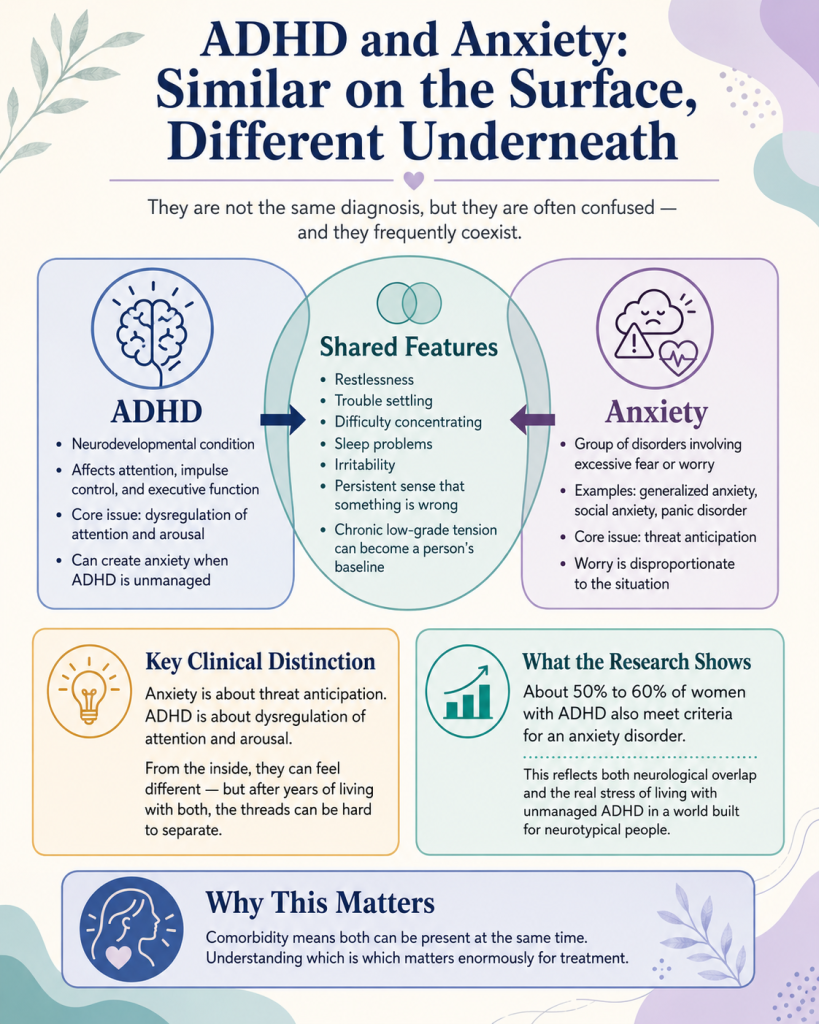
ADHD and anxiety are not the same diagnosis. But they share so many surface features that they are routinely confused — sometimes by clinicians, often by the women living with them.
Both can produce restlessness and an inability to settle. Both can look like trouble concentrating. Both can cause sleep problems, irritability, and a persistent feeling that something is wrong. Both create a kind of chronic low-grade tension that women learn to call their baseline.
ADHD is a neurodevelopmental condition that affects attention, impulse control, arousal, and executive functioning. Anxiety disorders involve persistent fear, worry, physical arousal, or avoidance that causes significant distress or interference. Repetitive worry is also not the same thing as OCD; intrusive obsessions and compulsions have a different clinical pattern and may need separate assessment. The feared outcome does not have to be imaginary. A woman can have realistic reasons to expect criticism, mistakes, missed deadlines, or social misunderstanding and still develop an anxiety disorder around those experiences. ADHD and anxiety can feel very similar from the inside, especially after years of living with both.
Anxiety disorders are common in adults with ADHD, and large studies have found particularly high rates of internalizing conditions such as anxiety and depression among women with ADHD. The exact percentages vary across studies and samples. Some of the overlap reflects co-occurring conditions, and some anxiety develops around the repeated stress, uncertainty, correction, and consequences that can come with unrecognized or unsupported ADHD.
Comorbidity means both can be present simultaneously. Understanding which is which matters enormously for treatment.
Anxiety as a Response to Unaddressed ADHD
When ADHD goes unidentified, many women compensate. They work harder, stay later, check things repeatedly, and build elaborate systems to manage forgetting, losing things, and misjudging how long tasks take. Over time, they may become braced for the next mistake, missed deadline, or moment when the system stops working.
That kind of bracing can become anxiety. It may be an understandable response to repeated experiences of forgetting, being corrected, running late, disappointing people, or being misunderstood. For some women, the fear is not irrational. Their history has taught them that mistakes and misunderstandings can have real consequences.
Clinicians sometimes describe this as anxiety that is secondary to ADHD: worry and vigilance that develop around the lived consequences of ADHD rather than appearing independently. It may show up around deadlines, social situations, tasks that have gone badly before, or the effort of trying to hold too much information in mind at once. That does not make the anxiety less real. It helps explain what is feeding it.
Many women spend years in therapy addressing anxiety, depression, or chronic stress without ever identifying what's underneath. The late ADHD diagnosis experience — finally getting the right name for what has been happening — often brings profound relief — not because the challenges disappear, but because the explanation finally fits. The anxiety that was a mystery becomes legible.
When Anxiety Is Tied to ADHD — and When It Needs Its Own Treatment
The useful question is not whether the anxiety is "real." It is what is maintaining it and what treatment needs to address.
When a co-occurring anxiety disorder is present, it may need direct treatment. Depending on the diagnosis and the person, that can include cognitive behavioral therapy, exposure-based approaches, acceptance-based therapy, medication, or a combination. ADHD should still be part of the formulation so treatment does not assume that every fear, avoidance pattern, or concentration problem comes from anxiety.
When anxiety is being maintained by untreated or unsupported ADHD, anxiety treatment alone may not be enough. If the daily sources of uncertainty remain — missed information, time blindness, task paralysis, sensory overload, or repeated social misunderstandings — the nervous system still has reasons to stay on alert.
When ADHD is contributing to the anxiety, treating the ADHD can reduce some of the conditions that keep anxiety going. Better task support, accommodations, clearer systems, therapy, and ADHD medication may reduce daily uncertainty or overload for some women. Medication response varies, and ADHD medication is not an anxiety treatment in itself. If significant anxiety remains, it deserves its own assessment and treatment.
Therapy also looks different when the clinician understands the context. Standard anxiety treatment often asks whether a feared outcome is likely or whether a threat appraisal is distorted. That can be useful, but it can miss something important for neurodivergent women: some fears are grounded in experience. A woman may have been criticized for lateness, excluded socially, misunderstood in relationships, or repeatedly corrected at work. Treatment can still address avoidance, rumination, and chronic threat monitoring without asking her to pretend those experiences never happened.
For social anxiety in ADHD women especially, fear of judgment may be realistic. The work may include building accommodations, communication strategies, self-trust, and ways to recover from actual misunderstanding alongside any anxiety-focused treatment.
Both can coexist. Many women with ADHD also have an anxiety disorder that needs direct treatment. At the same time, ADHD should not disappear from the formulation simply because anxiety is present. Treatment is more useful when it addresses each part of the picture rather than assuming one diagnosis explains everything.
What This Looks Like in Women Specifically
ADHD in women is often missed because the most familiar stereotype is still the visibly hyperactive, disruptive boy. Many women have less externally obvious hyperactivity, develop strong compensation strategies, or appear organized while using a great deal of effort to stay that way. Anxiety can become the more visible part of the picture.
This presentation makes ADHD easy to miss — and anxiety easy to blame. A woman who is high-functioning, articulate, and clearly intelligent does not look like someone with a neurological difference. When she describes constant overthinking, difficulty completing tasks, sensitivity to criticism, and a pervasive sense of being behind, the diagnostic reflex for many clinicians is anxiety, perfectionism, or depression.
Women with ADHD are also more likely to internalize their struggles. Rather than acting out, they blame themselves. The anxiety they carry often has a specific flavor: shame. The shame of not being able to do what everyone else seems to do without effort. Shame at the gap between their intentions and their follow-through. Shame that has accumulated across decades of trying and not quite managing.
Anxiety that is strongly tied to shame, performance, and fear of disappointing people may need a different emphasis than generalized worry alone. For many women, understanding ADHD shame and the years of comparison behind it can reduce self-blame and make the anxiety easier to understand.
Hormonal changes can add another layer. Estrogen and progesterone interact with brain systems involved in attention, mood, and cognition, and newer research is beginning to suggest that ADHD symptoms can shift across the menstrual cycle and other reproductive transitions. Anecdotally, some women also notice changes in anxiety at particular hormonal stages. Tracking the timing can help show whether there is a repeatable pattern.
Working With ADHD-Related Anxiety
With ADHD-related anxiety, the useful starting point is to identify what the anxiety is responding to, reduce unnecessary friction or uncertainty where possible, and make sure any co-occurring anxiety disorder receives direct treatment.
Frequently Asked Questions
ADHD does not automatically cause an anxiety disorder, but living with unsupported ADHD can create very real worry and vigilance. Forgetting important things, misjudging time, struggling to start tasks, being corrected repeatedly, or not knowing when your capacity will run out can all make a person more anxious. ADHD and an anxiety disorder can also occur together.
They can look similar. Both can involve restlessness, concentration problems, sleep difficulty, irritability, and overwhelm. ADHD is a neurodevelopmental condition with symptoms that begin in childhood, even if they were not recognized then. Anxiety may be a separate disorder, a response to ADHD-related demands, or both. A careful assessment looks at childhood history, triggers, timing, functional patterns, and what happens when support is added.
Anxiety disorders are common in adults with ADHD, and women with ADHD often report substantial internalizing distress. There is probably no single explanation. Anxiety may be a separate co-occurring condition, or it may be shaped by years of masking, overpreparing, forgetting, criticism, social misunderstanding, shame, sleep problems, sensory overload, and the effort required to compensate. Hormonal changes may add another layer for some women.
It can help when ADHD-related uncertainty, overload, or executive-function demands are contributing to the anxiety. Medication, accommodations, therapy, and practical ADHD support may reduce some of those pressures. But anxiety does not always disappear when ADHD is treated. A co-occurring anxiety disorder may still need its own evidence-based treatment.
No. Neurodivergent women may have a real history of being corrected, excluded, misunderstood, or judged. That history can make fear of future judgment understandable. Therapy can address avoidance, rumination, and chronic threat monitoring while also taking realistic social risk seriously and helping the person build accommodations, communication strategies, and self-trust.
Living with anxiety that never fully resolves is exhausting. If you've been treating anxiety for years and something still doesn't fit — if you recognize yourself in what's described here — it may be worth exploring whether ADHD in women is part of the picture. ADHD burnout and anxiety often arrive together after years of overcompensating; rejection sensitive dysphoria can look identical to social anxiety from the outside.
I work with adult women across North Carolina and South Carolina through neurodivergent-affirming telehealth therapy. I have more than 30 years of clinical experience and specialize in ADHD in women, including late diagnosis, anxiety, masking, burnout, and the hidden effort involved in appearing to cope.
Continue Exploring
- ADHD in Women — the complete picture
- Rejection Sensitive Dysphoria in ADHD
- ADHD and Hormones in Women
- ADHD and Nighttime Anxiety
- ADHD and Cortisol in Women
- ADHD Burnout vs Depression
- ADHD and Shame
- ADHD and Panic Attacks
- ADHD and Bipolar Disorder in Women
If you're in North Carolina or South Carolina and looking for neurodivergent-affirming therapy for ADHD and anxiety, contact me about availability.
Ready to Work Together?
If ADHD and anxiety are tangled together for you, I provide neurodivergent-affirming therapy for women in Charlotte and throughout North Carolina and South Carolina via secure telehealth.
