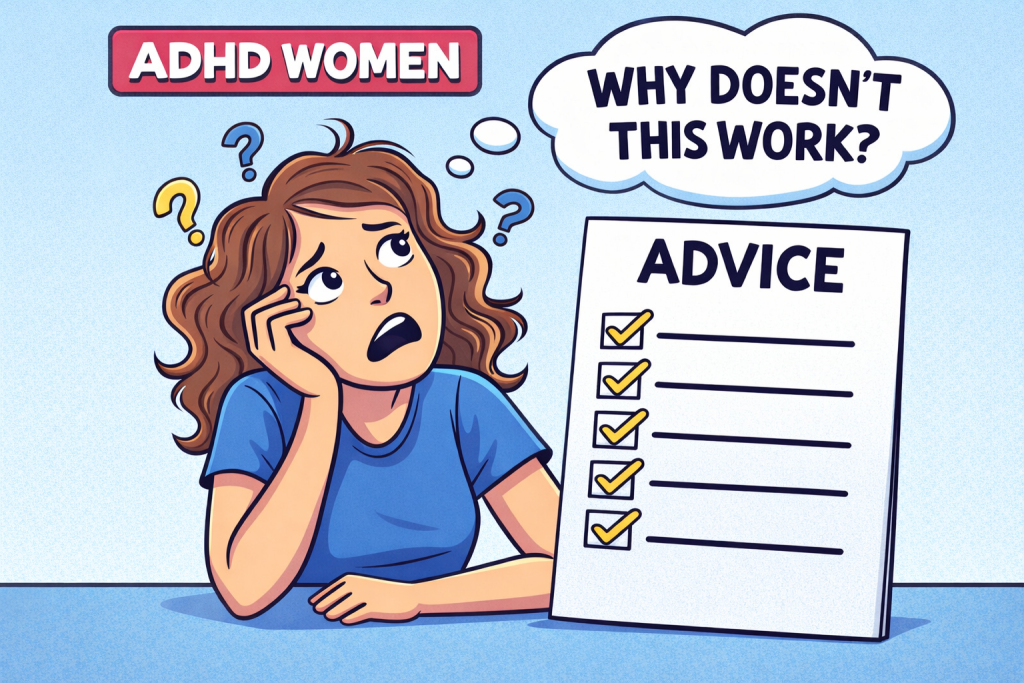
Many ADHD women follow sleep advice carefully and still struggle to sleep.
- They limit screens.
- They try to keep routines.
- They go to bed earlier.
- They want rest.
When sleep does not improve, the experience often leads to frustration, self-blame, or the belief that something is being done incorrectly.
In many cases, the problem is not effort or consistency.
The problem is that most sleep advice is built on assumptions that do not match how ADHD nervous systems function under long-term demand.
This article explains why common sleep advice often fails ADHD women, and how sleep difficulty is shaped by arousal, timing, sensory processing, and biological factors.
Most Sleep Advice Assumes Arousal Turns Off Easily in ADHD
Standard sleep recommendations assume that alertness naturally decreases at night.
This includes advice such as:
• go to bed earlier
• relax before sleep
• follow a calming routine
• power down the mind
For many ADHD women, arousal does not decrease simply because the day ends.
Attention systems, threat monitoring, and cognitive engagement often remain active well into the night. When advice focuses only on behavior, it misses the underlying state of the nervous system.
Sleep requires a reduction in arousal, not just a change in habits.
Habit-Based Models Do Not Account for Initiation Differences
Much sleep advice relies on habit formation.
This assumes that once a routine is established, the body will follow it automatically.
ADHD nervous systems often struggle with:
• task initiation
• time awareness
• transitions between states
• consistency under stress
When routines collapse, the issue is often interpreted as a lack of discipline. In reality, initiation difficulty is a well-documented neurological feature of ADHD.
Advice that relies on habit strength alone tends to fail when initiation systems are already under strain.
Arousal and Exhaustion Can Exist at the Same Time
Many ADHD women are deeply exhausted at night and still feel alert.
This is confusing and often interpreted as resistance to sleep.
Exhaustion reflects depleted energy.
Sleep requires reduced alertness.
When arousal remains elevated due to stress, masking, or long-term demand, exhaustion does not reliably lead to sleep. Advice that assumes tiredness will naturally produce sleep does not address this mismatch.
If you want a deeper explanation of this pattern, see
[Why sleep is so hard for ADHD women even when they are exhausted].
Sleep Timing Is Often Biological in ADHD, Not Behavioral
Common sleep guidance assumes that bedtime can be chosen.
For many ADHD women, sleep timing is shaped by circadian rhythm differences, including delayed melatonin release and later biological night.
Going to bed before biological sleep readiness often increases:
• frustration
• alertness
• conditioned stress around bedtime
Advice that ignores biological timing can unintentionally make sleep harder rather than easier.
This pattern is explored further in
[Delayed sleep timing in ADHD women and delayed sleep phase syndrome].
Cognitive Load Is Often Deferred Until Night
During the day, many ADHD women manage high cognitive and emotional demands.
At night, when external pressure decreases, the brain often begins processing what was postponed earlier.
This can include:
• unresolved decisions
• emotional material
• unfinished planning
Advice that encourages forcing mental quiet without addressing deferred load often backfires. The brain becomes more active when it senses unfinished work.
Sensory Fit Is Rarely Addressed in Sleep Advice
Most sleep advice focuses on behavior rather than sensory experience.
Many ADHD women have heightened sensitivity to:
• light
• sound
• temperature
• fabric texture
• pressure
A bedroom that looks appropriate may not feel regulating. If the sensory environment is mismatched, sleep initiation and maintenance are disrupted regardless of routine quality.
Repeated Advice Failure Conditions Alertness
When sleep advice fails repeatedly, the bed can become associated with effort and frustration.
Over time:
• alertness increases near bedtime
• anxiety rises when lying down
• the body anticipates difficulty
This creates conditioned arousal. Advice that emphasizes trying harder reinforces the association rather than resolving it.
Research consistently shows that sleep problems in adults with ADHD are common and often compounded by stress and misattribution.
Advice Often Ignores Hormonal Variability in ADHD Women
Many sleep recommendations assume stable physiology.
ADHD women often experience sleep disruption related to:
• menstrual cycle phases
• perimenopause
• hormonal fluctuation
When sleep varies across the month or lifespan, advice that assumes consistency can feel invalidating. Variability in sleep does not indicate inconsistency or failure. It reflects biological influence.
You can read more about this in
[How hormones affect sleep in ADHD women].
Why Effort-Based Sleep Advice Increases Shame
When advice is framed as something that should work if followed correctly, repeated difficulty leads to self-blame.
Many ADHD women already carry histories of:
• being told to try harder
• being labeled inconsistent
• internalizing failure narratives
Sleep advice that focuses on discipline reinforces these patterns rather than supporting regulation.
A More Useful Frame
When sleep advice repeatedly fails, the pattern provides information.
It suggests that sleep difficulty is not a habit problem.
A more useful approach asks:
• What keeps arousal elevated at night?
• What timing supports biological sleep readiness?
• What sensory conditions reduce alertness?
• What reduces cognitive load before bed?
These questions shift sleep support away from effort and toward accommodation.
If you want to explore practical supports without routine pressure, see
[What actually helps ADHD sleep: supports, not routines].
How This Blog Fits Into the ADHD & Sleep Cluster
This post explains why common sleep advice fails ADHD women.
Related posts explore:
• why exhaustion does not reliably lead to sleep
• chronic nighttime arousal in ADHD women
• delayed sleep timing
• hormonal influences on sleep
• sensory processing and sleep
• evidence-based research on ADHD sleep problems
Understanding why advice fails reduces self-blame and makes it easier to identify supports that align with how the system functions.
Find more pages on Sleep
Understanding Delayed Sleep Phase Syndrome (DSPS) and Its Connection to ADHD
Parenting and Sleep: How it Hurts ADHD Women
Why Is Sleep So Hard for ADHD Women Even When They Are Exhausted?
→ Part of the sleep cluster: Why Sleep Is So Hard for Women With ADHD
