ADHD and Impulsivity in Women: When Your Brain Acts Before You Decide
By Kristen McClure, MSW, LCSW | Neurodivergent-affirming therapy for women
What Impulsivity Is in ADHD
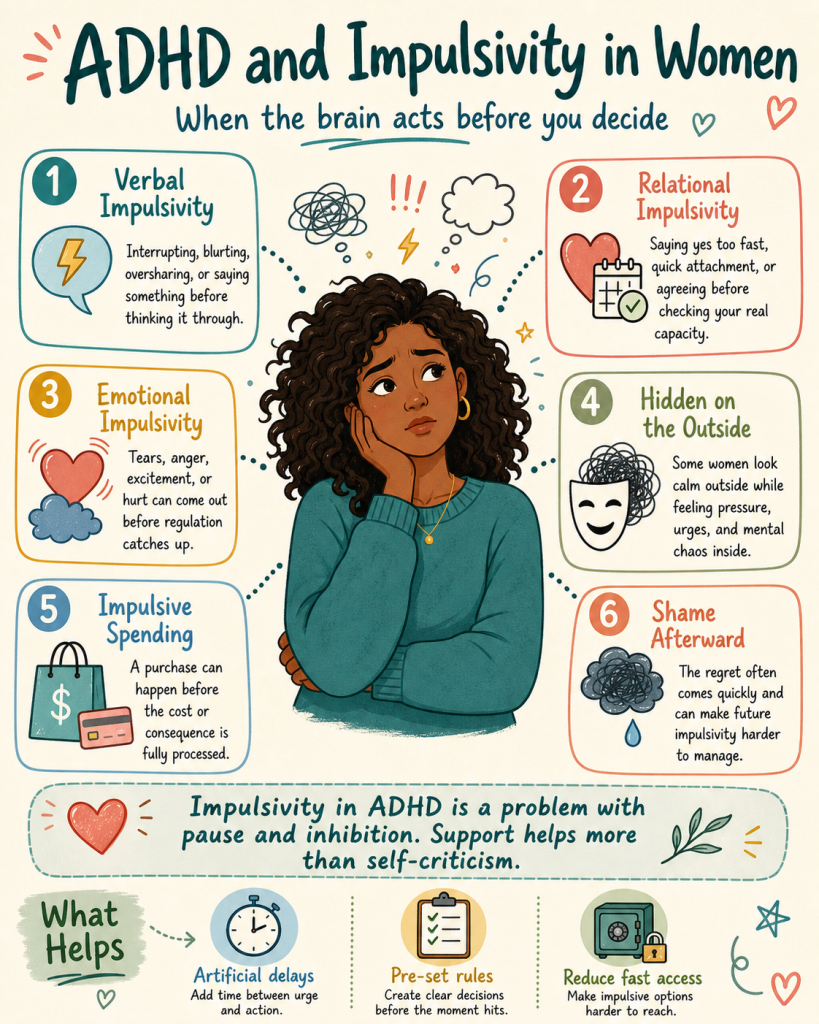
Impulsivity is difficulty with inhibitory control. Inhibitory control is the brain’s ability to pause an impulse long enough to think, redirect, or stop.
For many people, there is a small gap between impulse and action.
In ADHD, that gap can be much shorter. Sometimes it can feel like there is no gap at all.
This is not a motivation problem. It is not about wanting to act impulsively or not caring about the result.
The impulse can move into action before the evaluative pause has time to happen. The question, “Is this what I want to do?” may not arrive until after the text is sent, the words are out, the purchase is made, or the yes has already been given.
Impulsivity in ADHD can show up in several ways:
- Verbal impulsivity: speaking before evaluating, interrupting, blurting, oversharing
- Behavioral impulsivity: acting before thinking, physical impulsivity, risk-taking
- Emotional impulsivity: emotional responses that come out before regulation has happened
- Cognitive impulsivity: acting on the first solution instead of comparing options
- Financial impulsivity: spending before the cost or consequence has been fully processed
How Impulsivity Looks Different in Women
ADHD hyperactivity and impulsivity can look different in women than the classic presentation many clinicians were trained to notice.
For many women, impulsivity is more often:
Verbal
Talking too much. Interrupting. Oversharing. Saying something that was meant to stay internal.
The impulsivity may come out through language more than through physical restlessness.
Relational
Impulsive commitment to people, relationships, and situations.
This can look like quick attachment, an intense new friendship, a relationship entered before there is enough information, or saying yes to plans that a calmer version of you would have declined.
Emotional
Emotional impulsivity can be especially visible in ADHD women.
The anger, tears, enthusiasm, defensiveness, or hurt may arrive at full force before regulation has had time to catch up.
Hidden on the Outside
Some women learn early to suppress impulsive expression.
The outside may look calm. Inside, there may be racing thoughts, strong urges, emotional pressure, or quick regret.
Suppressing it can take a lot of energy.
Impulsivity Is Not Weakness
Many ADHD women carry shame about impulsivity.
You may have been told you lack self-control, are irresponsible, are immature, or do not think before you act. Over time, the repeated experience of doing something and then regretting it can make that story feel true.
But impulsivity is a difference in inhibitory control.
The pause that other people expect may not be reliably available in the moment. Often, regret arrives quickly. Sometimes it arrives before the action is even fully complete.
That does not mean impulsivity has no consequences. It does.
It means the consequences are not proof that you are careless or immature. They are signs that your brain may need more external support for a pause it does not always create internally.
The Shame-Impulsivity Cycle
Shame can make impulsivity worse.
Shame and stress can make pausing and evaluating harder in the moment. In ADHD, inhibitory control involves multiple interacting brain networks and processes, so it is more accurate to think of impulsivity as a regulation difficulty that can become harder under emotional load rather than as one part of the brain simply failing.
So the more shame builds around impulsivity, the harder impulse control can become.
More self-criticism usually does not create better control. It often adds more pressure to a system that is already strained.
Reducing shame is not the same as ignoring consequences. It helps make repair and change more possible.
Impulsivity and Risk
ADHD is associated with higher risk-taking.
This is not because ADHD people do not understand risk. Often, they do understand it. The problem is that the action may happen before risk evaluation has time to fully engage.
This can show up in spending, relationships, health decisions, driving, work decisions, or safety choices.
Risk can also be regulating for some ADHD nervous systems. When daily life feels understimulating, risky or intense activities may create the activation the brain is seeking.
That does not make the risk harmless. It helps explain why the pull can feel so strong.
What Actually Helps
Advice like “think before you act,” “take a breath,” or “count to ten” assumes the pause is available.
For ADHD, the pause may need to be built outside the moment.
Artificial Delays
Create waiting periods before important decisions.
This may include:
- a 24-hour rule before responding to emotional messages
- a waiting period before purchases
- saying, “I will get back to you,” instead of answering immediately
- adding extra steps before spending money
These delays create the pause your brain may not create on its own.
Reducing Access
For financial impulsivity, reduce the number of fast pathways from impulse to action.
This may include:
- removing saved payment information
- unsubscribing from promotional emails
- using cash for categories where spending gets impulsive
- deleting shopping apps from your phone
- keeping credit cards less accessible
The point is to add friction.
Pre-Committed Rules
Make rules when your brain is calm.
For example:
- “I do not respond to emotional texts right away.”
- “I do not make purchases over a certain amount without waiting.”
- “I do not agree to plans until I check my calendar.”
- “I write the response first, then send it later.”
The rule holds the decision when in-the-moment evaluation is harder.
Medication
ADHD medication can help some women with impulsivity by supporting the brain systems involved in inhibition, attention, and regulation.
For many women, medication does not make them feel robotic. It gives them more access to the pause.
Repair Practices
Impulsivity can cause real harm. A sent message, a sharp comment, a fast yes, or a financial decision may need repair.
Having a repair practice helps reduce the shame cycle.
Repair may include returning to the conversation, naming what happened, taking responsibility, and making a plan for next time.
Repair is not the same as spiraling in shame. It is accountability with a path forward.
What Helps With ADHD Impulsivity
Notice the Moment Before You Act
Self-awareness means understanding impulsivity as an inhibition difference, not a character trait.
It also means learning your own patterns.
Where does impulsivity show up most?
- speech
- spending
- relationships
- emotional reactions
- decisions
- work
- commitments
It also means noticing what makes impulsivity worse: depletion, emotional activation, understimulation, stress, poor sleep, or sensory overload.
Separate Impulsivity From Character
Self-compassion means loosening the shame around impulsivity.
You may regret what happened. You may wish you had paused sooner, spoken differently, waited longer, or made another choice.
But regret does not mean the old story is accurate: that you are irresponsible, immature, careless, or out of control.
Impulsivity is a nervous system pattern. It needs support, structure, and repair.
Add Friction Before High-Stakes Decisions
Self-accommodation means building supports around the part of the brain that does not always pause reliably.
This may include:
- waiting periods
- spending friction
- written rules
- fewer fast-access temptations
- scripted responses
- planned pauses
- repair routines
These are practical supports.
Make Support Explicit
Self-advocacy means being able to explain what helps you slow down.
This may include asking for written communication, clear expectations, time to respond, or a chance to review decisions before agreeing.
It can also mean saying:
- “I need a pause before I answer.”
- “I make better decisions when I can see it in writing.”
- “I am working on slowing down my responses.”
- “Please do not treat an immediate yes as final until I have checked my capacity.”
Lower the Load That Makes Pausing Harder
Self-care matters because depletion worsens impulsivity.
Sleep, food, movement, sensory regulation, adequate stimulation, medication support, and recovery time all affect impulse control.
A strained nervous system has less access to inhibition. Supporting the body supports the pause.
Frequently Asked Questions
Impulsivity in ADHD is a difference in inhibitory control. The gap between impulse and response is often much shorter, and sometimes it feels like there is no gap at all. The pause that helps a person stop, think, and evaluate does not always show up in time. The action may happen before the question “Do I want to do this?” has fully formed.
Verbal impulsivity works the same way as other forms of impulsivity in ADHD. The comment, question, or reaction may come out before the brain has had time to check timing. This is not the same as not caring about the other person. It is difficulty holding the thought long enough to wait.
Financial impulsivity in ADHD is driven by the combination of reduced inhibitory control and dopamine-seeking. The purchase provides a rapid activation response in a nervous system that may be chronically underactivated. The decision happens before the evaluation completes. Building friction into spending pathways — logged-out accounts, cooling-off periods, cash-only categories — creates external inhibition for an internal system that isn't providing it
Yes, it often does. Stimulant medication can improve inhibitory control by supporting prefrontal dopamine function. For many ADHD women, medication helps reduce verbal, behavioral, and financial impulsivity.
Repair is one of the most useful skills after an impulsive moment. This means going back to the person or situation, naming what happened clearly, and doing what you can to make it right. The point is not to perform shame or give a dramatic apology. The point is to take responsibility, repair the impact, and move forward more cleanly.
The action happened before you decided to take it. That is the actual thing. And it is something a nervous system does — not something that defines what kind of person you are.
Continue Exploring
- ADHD in Women — the complete picture
- Rejection Sensitive Dysphoria
- ADHD Anger in Women
- ADHD and Money
- Dopamine and ADHD
- ADHD and Shame
If you are a woman with ADHD navigating the aftermath of impulsivity — in relationships, in spending, in speech — neurodivergent-affirming therapy can help. I offer telehealth therapy in North Carolina and South Carolina. Reach out at kristenlynnmcclure@gmail.com or find me on Psychology Today.
Ready to Work Together?
If what you've read here feels familiar, I'd love to hear from you. I work with women with ADHD across North Carolina and South Carolina via secure telehealth — from wherever you are in either state.
