ADHD and Anger in Women: When Your Emotions Hit Before Your Brain Catches Up
By Kristen McClure, MSW, LCSW | Neurodivergent-affirming therapy for women
ADHD Anger in Women: Why It Happens and What Helps
You may not think of yourself as an angry person.
But something happens. A comment lands wrong. A plan changes. A need goes unmet again. Before you have had time to think it through, the anger is already there.
Then comes the aftermath. The shame. The replaying. The apology that does not fully explain what happened. The question: Why did I react like that?
For many women with ADHD, anger is part of emotional dysregulation. It is connected to how quickly emotions rise, how strongly they register in the nervous system, and how hard it can be to pause before reacting.
ADHD is not only about attention. It also affects emotional regulation. Anger is one of the most common and painful parts of that experience, but it is often misunderstood.
ADHD and Emotional Regulation
The ADHD brain is not only an attention brain. It is also an emotional brain.
Emotional dysregulation is common in adults with ADHD. It can affect daily life, relationships, work, parenting, and self-trust.
In many people, there is a small pause between an emotional trigger and an emotional response. That pause gives the brain time to evaluate what happened and choose a response.
In ADHD, that pause can be much shorter. Sometimes it can feel absent. The emotion rises quickly, and the response follows before there is time to sort it out.
The anger may not feel chosen. It may feel like it erupts.
What ADHD Anger Looks Like in Women
Women with ADHD are not always described as angry. They are more often described as sensitive, reactive, dramatic, intense, or “too emotional.”
Women are also often taught that anger is unacceptable, especially when they are expected to be agreeable, calm, helpful, or emotionally available to others. Because of this, ADHD anger may be hidden, turned inward, or followed quickly by shame. The anger may be treated as a personal failure instead of a sign that the nervous system is overwhelmed.
Many ADHD women work hard to hide anger. They may suppress it, mask it, or turn it inward. But anger is still there, and it often shows up in patterns that are easy to misread.
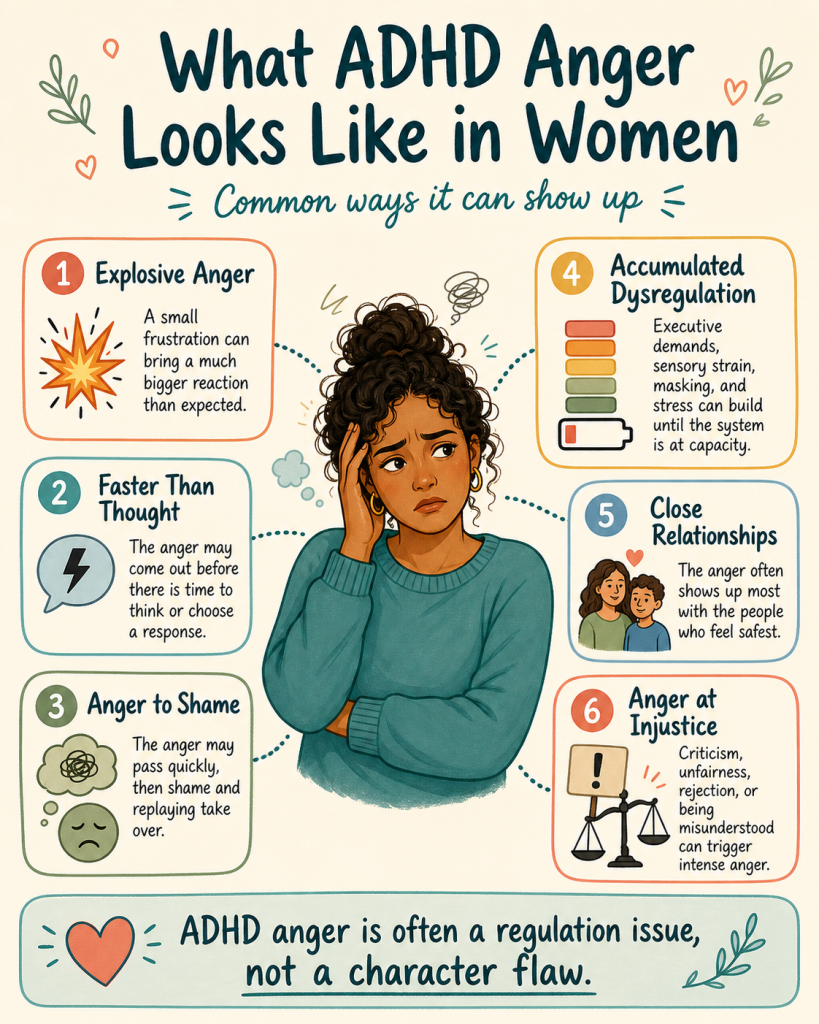
Explosive Anger That Feels Out of Scale
A small frustration may lead to a response that feels much larger than the situation.
A dish left out. A plan changed. A repeated interruption. One more unexpected demand.
The visible trigger may look small. The internal buildup may not be small.
Anger That Arrives Faster Than Thought
Some ADHD women describe saying something, sending something, or reacting before they have had time to decide what they want to do.
The regret may come quickly. But in the moment, the anger moved faster than the part of the brain that could slow it down.
The Anger-to-Shame Pipeline
For many ADHD women, anger does not last as a steady state.
There may be a flash of anger, an expression of it, and then a collapse into shame.
The anger was real. The shame is also real. Both can happen in the same cycle.
Anger as Accumulated Dysregulation
ADHD brains often work harder than they appear to be working.
Executive demands, sensory input, emotional processing, masking, and constant self-monitoring all use regulation capacity. When that capacity is low, emotional containment is often the first thing to go.
Anger may be a sign that the nervous system is at capacity.
Anger in Close Relationships
The people who see the anger most are often the people closest to you: partners, children, family members, or trusted friends.
This can happen because you have spent the day containing, masking, and managing yourself in other settings. By the time you are home or with safe people, there may be very little regulation capacity left.
Anger at Injustice
Many ADHD women have a strong response to unfairness, criticism, rejection, or being misunderstood.
This response is not irrational. It may be neurologically amplified. Rejection sensitivity can make perceived criticism or unfairness feel threatening, and anger may come up quickly in response.
Why ADHD Can Produce Anger
ADHD anger is often connected to nervous system regulation, not character.
Prefrontal Cortex Underactivation
The prefrontal cortex helps with impulse control, emotional regulation, and the pause between feeling and acting.
In ADHD, this system may be less available or slower to engage. The brain’s braking system may not come online quickly enough in the moment.
Dopamine and Emotional Regulation
Dopamine is involved in attention, motivation, reward, and emotional regulation.
When dopamine regulation is inconsistent, the brain may have more difficulty modulating emotional responses. This can make anger rise quickly and feel harder to interrupt.
Rejection Sensitivity
Rejection sensitivity is an intense emotional response to real or perceived criticism, rejection, failure, or disapproval.
For many ADHD women, anger is one possible response to that emotional pain. The response can arrive quickly and with force.
Sensory and Regulatory Depletion
A depleted nervous system is more reactive.
When the ADHD nervous system has been managing too much sensory input, too many decisions, too many social demands, or too little recovery, emotional tolerance drops. Anger may appear when the system has no room left.
Working Memory Gaps
Working memory challenges can make it harder to hold emotional context in mind.
You may not consciously remember every small frustration that has built up across the day or week, but your nervous system may still be carrying it. A reaction that looks disproportionate may reflect accumulated stress that has not been fully processed.
The Shame Layer
Most ADHD women who struggle with anger are not only struggling with the anger. They are also struggling with what happens afterward.
Shame can show up quickly:
- Why did I say that?
- Why did I react so strongly?
- Why can I not control this?
- What is wrong with me?
Shame often leads to more self-monitoring. More self-monitoring takes more regulation capacity. When regulation capacity is already low, the cycle can continue.
Reactivity leads to shame. Shame increases threat and self-monitoring. Threat and self-monitoring increase depletion. Depletion makes future reactivity more likely.
Understanding the source of anger does not erase responsibility for repair. But shame-based approaches usually do not help ADHD emotional regulation. Shame is itself dysregulating.
ADHD Anger Is Different From Aggression
ADHD-related anger is often reactive, fast, and followed by regret.
It is usually not planned, sustained, or satisfying. Many ADHD women who struggle with anger feel distressed by it. They do not want to hurt people. They do not want to lose control.
This does not mean other people are not affected. They may be hurt by the words, tone, or reaction. That pain needs care and repair.
The mechanism still matters. Anger that comes from regulatory depletion and ADHD-related dysregulation needs different support than anger that comes from control, intimidation, or planned harm.
What Actually Helps
Being told to calm down usually does not help. Being shamed does not help. Trying harder to control anger without addressing the underlying regulation problem often does not help either.
What helps is understanding the pattern and supporting the nervous system before it reaches the point of eruption.
Accurate Diagnosis and ADHD Treatment
Many women do not understand their anger until they understand their ADHD.
Medication can help some ADHD women with emotional regulation by supporting the brain systems involved in impulse control, attention, and emotional modulation.
Some women notice changes in anger and emotional steadiness before they notice changes in focus.
Understanding Your Depletion Triggers
ADHD anger often increases when regulation capacity is low.
Common triggers include:
- end-of-day exhaustion
- hunger
- poor sleep
- overstimulation
- too many transitions
- repeated interruptions
- social masking
- unresolved conflict
- rejection sensitivity
Recognizing the pattern helps you intervene earlier, before anger reaches the point of eruption.
Reducing Overall Regulatory Demand
When anger is connected to depletion, reducing depletion helps.
This may mean building in transition time, reducing sensory load, simplifying routines, lowering unnecessary demands, or creating more recovery time after high-effort situations.
The work is not only controlling anger in the moment. It is reducing the conditions that make anger more likely.
Repair
Repair is the practice of returning to the relationship after a dysregulated moment.
Repair may include naming what happened, taking responsibility for harm, clarifying what was happening internally, and making a plan for next time.
Repair is not excessive apologizing. It is reconnection and accountability without a shame spiral.
Therapy That Understands ADHD
Anger work is more effective when the ADHD picture is included.
Therapy can help with emotional regulation skills, shame, relationship repair, communication, sensory awareness, and recognizing early signs of dysregulation.
For ADHD women, treating anger without understanding ADHD often misses the larger pattern.
Working With Anger and Emotional Regulation in ADHD
Notice What Comes Before Anger
Self-awareness means understanding what tends to come before anger.
This may include depletion, sensory overload, rejection sensitivity, hunger, lack of sleep, accumulated frustration, or too many demands without recovery.
The purpose is not to monitor yourself harshly. It is to understand the conditions that make regulation harder.
Separate Anger From Shame
Self-compassion means reducing the shame attached to being “too reactive,” “too intense,” or “too much.”
ADHD anger is not a character flaw. It is a regulation event in a nervous system that needs support.
Compassion does not remove accountability. It helps create the conditions where accountability and change are possible.
Reduce Predictable Overload
Self-accommodation means building supports that reduce anger triggers before the system is overloaded.
This may include:
- protecting sleep
- eating regularly
- reducing end-of-day demands
- using sensory supports
- building in transition time
- taking recovery breaks after high-demand situations
- using written communication when verbal conflict escalates too quickly
These supports reduce the pressure that often leads to anger.
Say What You Need Earlier
Self-advocacy means being able to explain what helps you regulate.
This may include telling a partner, therapist, prescriber, or family member:
- “I need time before I respond.”
- “I can talk about this better in writing.”
- “I am getting flooded and need a pause.”
- “I want to repair this, but I need a few minutes to settle first.”
Self-advocacy also means asking for environments, schedules, and communication patterns that do not push your nervous system past capacity every day.
Build Recovery In
Self-care means taking the body seriously as part of emotional regulation.
Sleep, food, movement, sensory regulation, medication support, rest, and recovery time all affect anger.
A regulated nervous system is less likely to become reactive. For ADHD women, basic care is not separate from emotional regulation. It is part of the foundation.
Frequently Asked Questions
Many adults with ADHD have difficulty regulating emotional responses, but the pattern varies and is not explained by one brain region or one mechanism. Anger may become harder to regulate when emotional intensity combines with overload, stress, sleep loss, sensory strain, anxiety, past rejection, or other individual factors. It is neurological, not characterological.
Not always. ADHD-related anger can range from irritability and a short fuse to intense explosive episodes. It is usually reactive and rapid — appearing faster than conscious thought — and followed by genuine regret. The intensity often reflects not just the trigger but the accumulated regulatory demand the nervous system is already carrying.
Most women with ADHD experience immediate shame following an anger episode — which is actually evidence that the anger wasn't acceptable to them either. The shame is painful and often creates a cycle: shame is dysregulating, dysregulation increases reactivity, reactivity produces more shame. Understanding the neurological basis of ADHD anger does not eliminate accountability, but it does offer a path out of the shame cycle.
For many women with ADHD, appropriate medication significantly reduces emotional reactivity — including anger. Stimulant medications improve prefrontal regulation, which is the system that was creating the gap problem. This is not guaranteed for everyone, and medication alone is rarely sufficient — but it is often a meaningful piece of the picture.
Yes — particularly therapy that addresses both the ADHD and the emotional regulation layer together. Approaches that work with the shame cycle, build awareness of personal depletion patterns, and support repair in relationships tend to be more effective than approaches that treat the anger as a behavior problem to be controlled.
The anger is not who you are. It is what happens when a nervous system under pressure runs out of regulation. Understanding that changes what you reach for — not to excuse it, but to actually change it.
Continue Exploring
- ADHD in Women — the complete picture
- Rejection Sensitive Dysphoria
- ADHD and Shame
- ADHD Impulsivity in Women
- ADHD Emotional Dysregulation
- How Hormones Amplify ADHD Symptoms
If you are a woman with ADHD working with emotional reactivity and the shame that follows, neurodivergent-affirming therapy can help. I offer telehealth therapy in North Carolina and South Carolina. Reach out at kristenlynnmcclure@gmail.com or find me on Psychology Today.
Ready to Work Together?
If what you've read here feels familiar, I'd love to hear from you. I work with women with ADHD across North Carolina and South Carolina via secure telehealth — from wherever you are in either state.
