ADHD Understimulation and Boredom in Women: Signs and What Helps
By Kristen McClure, MSW, LCSW | Neurodivergent-affirming therapy for women
Other people seem to tolerate waiting. They may be able to just sit still or wait in line. They don't seem to be suffering. For you, the same waiting feels like something that needs to stop immediately. The restlessness rises. You reach for your phone,start a different task, or reach for something to eat. . The boredom isn't just unpleasant — it's physically uncomfortable in a way that ordinary boredom doesn't account for.
This is the ADHD nervous system encountering understimulation — and the response is neurologically driven, not chosen.
For many women with ADHD, boredom is not just a lack of interest. It can feel physically uncomfortable, emotionally urgent, and difficult to tolerate because the ADHD nervous system often needs more stimulation to stay regulated. In women, this can be especially confusing because the restlessness may be internalized, masked, or misread as anxiety, depression, irritability, laziness, or relationship dissatisfaction.
Why ADHD and Boredom Are a Painful Combination
People with ADHD appear, on average, to be more prone to boredom than people without ADHD. A 2026 meta-analysis found a moderate association between ADHD and boredom across 18 mostly correlational studies. Researchers are still working out why. Attention control, working memory, reward sensitivity, task demands, and difficulty sustaining engagement may all play a role; the evidence does not support reducing the experience to a simple dopamine deficit.
Boredom for the ADHD brain is not merely dull. It is a state of neurological deficit. The brain is registering a need — not for entertainment, but for the level of activation it requires to function — and it is generating behavior aimed at meeting that need. The restlessness, the phone-reaching, the compulsive novelty-seeking: these are not weakness or poor discipline. They are the nervous system doing what nervous systems do when a need isn't met.
This is why ADHD boredom feels urgent. The urgency is not about the importance of the alternative activity. It is about the unpleasantness of the deficit state.
What Does Understimulation Feel Like in ADHD?
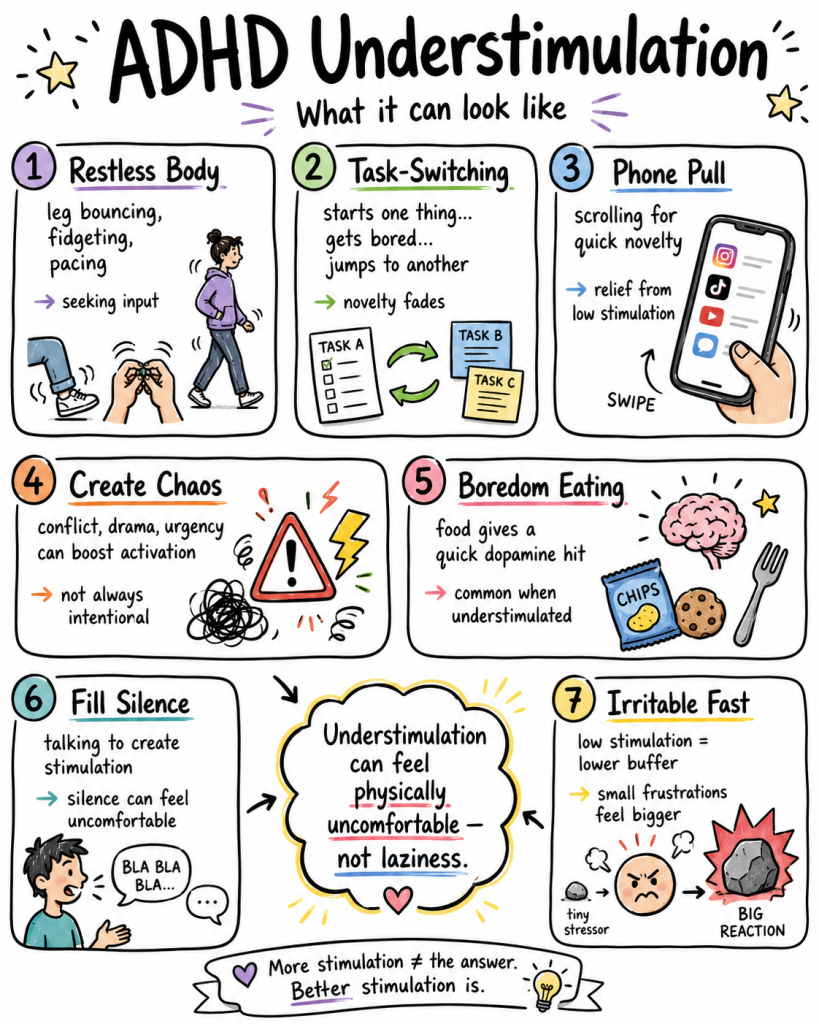
Physical restlessness.
The inability to stay still when there is insufficient stimulation. Leg-bouncing, fidgeting, pacing, repositioning — all attempts to provide proprioceptive input that partially substitutes for cognitive stimulation.
Constant task-switching.
Starting one thing, noticing it has become boring, starting something else. The switch is not decision-driven — it is driven by the drop in activation that follows when novelty fades.
Compulsive phone use.
Social media, news feeds, videos — all sources of rapid, low-cost novelty that temporarily address the understimulation state. The compulsive quality is significant: it's not that you want to be on your phone. It's that the state you were in before the phone was physiologically uncomfortable.
Creating chaos.
Some ADHD women generate their own stimulation through conflict, drama, crisis, or urgency — not intentionally, but because those states provide the activation the nervous system needs. Noticing this pattern is important.
Eating when bored.
Some people notice themselves reaching for food when they are bored or seeking stimulation. ADHD is associated with higher rates of some disordered-eating and overeating patterns, but the pathways are complex and can involve impulsivity, emotion regulation, reward, habit, hunger, medication effects, and context. It is too simple to describe eating as correcting a neurological dopamine deficit.
Talking to fill silence.
Providing verbal stimulation in response to an understimulation state — the conversation partner may experience it as inability to tolerate silence; from the inside, silence is actively uncomfortable.
Irritability and low frustration tolerance in understimulated states.
When the activation level is low, the regulatory system has less buffering capacity. Mild frustrations feel larger. The combination of boredom and irritability is a common ADHD experience that is often misread as anxiety or mood problems.
The Understimulation–Overstimulation Cycle
One of the paradoxical features of ADHD is the rapid transition between understimulation and overstimulation. The ADHD nervous system seeks stimulation when it is too low — and then can move quickly into overwhelm when stimulation exceeds its threshold.
This cycle is particularly visible in daily life: a boring task produces restlessness and phone-reaching → the phone provides stimulation that escalates → eventually the nervous system hits sensory overwhelm → shutdown or meltdown follows. The two ends of the cycle look like different problems. They are the same problem: a nervous system with a narrow window of optimal stimulation and limited ability to self-regulate to that window.
Understimulation and Emotional Dysregulation
Boredom and low engagement can also affect mood. Some people with ADHD describe becoming restless, irritable, frustrated, or agitated when a situation feels painfully unengaging. Research links boredom proneness with ADHD and with difficulties in attention and emotion regulation, but it does not show that these reactions come from a moment-to-moment dopamine deficit in the prefrontal cortex.
This is relevant for relationships, because the people in an ADHD woman's life often encounter her at her most dysregulated — at home, in the routine moments, in the environments where external stimulation is lowest. Understanding that emotional dysregulation is correlated with understimulation state, not with character, changes how both parties can respond.
Novelty, Interest, and ADHD Engagement
There is an important distinction between boredom tolerance (being able to stay with low-stimulation tasks) and stimulation need (the neurological requirement for a baseline activation level). ADHD involves a genuinely higher stimulation threshold — the amount of environmental input required before the nervous system can function well.
This is not something to be overcome. It is a feature of the nervous system that requires accommodation. The question is not "how do I learn to be less bothered by boredom?" — the question is "how do I build my environment and life so that my stimulation needs are being adequately met?"
What Helps
Build stimulation into low-stimulation tasks.
Music, podcasts, background noise, white noise, and physical movement (walking while on a call, standing desk, fidget tools) add stimulation to tasks that don't provide their own. This is accommodation, not cheating.
Understand your personal stimulation profile.
What types of stimulation help you activate without pushing into overwhelm? What environments are chronically under- or over-stimulating? This self-knowledge is the foundation of effective accommodation.
Consider ADHD treatment when symptoms are getting in the way.
ADHD medication can improve core ADHD symptoms for many people, and some studies have also found reductions in boredom proneness during stimulant treatment. That does not mean boredom is simply a dopamine deficit or that medication is a treatment for understimulation itself. Medication decisions should be individualized with a qualified prescriber.
Design work and daily life for stimulation access.
Working environments that include background music, other people working (body doubling), varied tasks, or visible progress can sustain activation better than isolated, static, silent environments.
Recognize the cycle.
When restlessness, irritability, or compulsive phone use arrives, check whether the prior state was understimulation. Naming the state as understimulation — rather than labeling it as anxiety, bad mood, or poor character — opens different responses.
Appropriate stimulation-seeking is not a problem.
Fidgeting, moving while thinking, having background noise, taking novelty breaks, and other stimulation-seeking behaviors should not be pathologized. They are the nervous system maintaining functional activation level. Providing appropriate channels is better than suppressing the behavior.
Supporting ADHD Boredom With Less Shame and More Strategy
The goal is not to force yourself to tolerate boredom the way other people seem to. The goal is to understand what your nervous system is asking for and respond with less shame and more strategy. For women with ADHD, this matters because boredom is often misread as laziness, immaturity, irritability, lack of gratitude, or inability to “just be present.” It can be more useful to understand boredom as a nervous-system signal — and helps you build a life that works with your brain instead of against it.
Self-Awareness starts with naming the experience accurately. What you have been calling boredom may actually be ADHD understimulation: a state where your brain does not have enough input to stay regulated, focused, or emotionally steady.
When you recognize understimulation, the question changes from “What is wrong with me?” to “What kind of stimulation does my nervous system need right now?”
Self-Compassion means releasing the shame that often comes with needing more stimulation than other people.
Many women with ADHD judge themselves for feeling restless during ordinary life — meetings, chores, parenting routines, quiet evenings, slow conversations, or repetitive work. Needing more engagement or variety in some situations does not make you demanding, shallow, selfish, or bad at adulthood. It can be useful information about the conditions that make attention and participation easier for you.
Self-Accommodation turns that understanding into practical support.
Instead of trying to complete boring tasks through willpower alone, you build in stimulation on purpose: music while cleaning, podcasts during errands, walking during phone calls, body doubling for admin tasks, visual timers, fidget tools, task rotation, novelty breaks, or working in spaces with gentle background energy. These are not shortcuts. They are accommodations for an ADHD nervous system.
Self-Advocacy means being honest about your stimulation needs in relationships, work, and daily life.
You might explain that silence can feel draining rather than restful, that movement helps you listen, that certain routines need variety, or that you work better with structure, accountability, or background sound. Advocacy is not asking other people to manage your ADHD for you. It is giving them accurate information so you can function with less conflict and more support.
Self-Care means treating stimulation as a real nervous-system need, not an optional reward you only get after everything else is done.
A chronically understimulated ADHD brain often becomes irritable, impulsive, shut down, or emotionally reactive. Caring for yourself includes building enough healthy stimulation into your day — movement, novelty, connection, creativity, sensory input, rest, and medication or therapy support when appropriate — so your brain is not constantly fighting to stay online.
This is the heart of neurodivergent-affirming care: you stop treating ADHD boredom as a personal failure and start treating it as information.
Your need for stimulation is not something to shame, suppress, or outgrow. It is something to understand, accommodate, and advocate for.
Frequently Asked Questions
Research suggests that people with ADHD are, on average, more prone to boredom, although individuals vary widely. Boredom may feel especially difficult when attention is hard to sustain or a task offers little interest, novelty, meaning, or feedback. Restlessness, novelty-seeking, or irritability can be part of that experience, but research has not established one underlying mechanism that explains it for everyone.
Understimulation and emotional dysregulation are connected in ADHD. When dopamine levels are low — as they are during understimulation — the prefrontal cortex has less regulatory capacity. Mild frustrations feel larger, emotional responses have less buffering, and irritability rises. The boredom-to-irritability pipeline is neurological, not characterological.
The ADHD nervous system isn't calibrated for stillness and low stimulation in the way neurotypical nervous systems can be. Stillness in ADHD is an active struggle — the nervous system is generating behavior to raise its activation level. Physical restlessness, movement, and stimulation-seeking are the nervous system's adaptive response to an intolerable deficit state, not failure to have enough self-control.
Chronic boredom and the flat quality of understimulation can look like depression — and sometimes develops into secondary depression when the environment is chronically under-stimulating. The distinction matters: ADHD understimulation responds to stimulation and novelty; depression responds to depression treatment. Many women with ADHD have been treated for depression when the underlying driver was untreated ADHD with chronic understimulation.
The most accurate framing: "My brain requires more stimulation to function normally than most people's. It's not impatience — it's a neurological need. When I'm understimulated, I become physically uncomfortable and dysregulated in ways I don't fully control. Accommodating that need — background noise, physical movement, varied tasks — helps me function significantly better."
Not necessarily worse for every woman, but it may be more hidden, internalized, or misread. Many women with ADHD mask restlessness through overworking, people-pleasing, scrolling, emotional eating, or staying constantly busy.
ADHD brains often need novelty, interest, and stimulation. Relationship boredom may reflect nervous-system understimulation, not lack of love. The goal is to add novelty and honest communication rather than shame yourself or create conflict for stimulation.
Yes, chronic understimulation can feel flat, heavy, or hopeless. The distinction is that ADHD boredom often improves with stimulation, interest, novelty, or movement, while depression may persist across situations and usually needs clinical treatment.
Boring tasks can lower stimulation below the ADHD brain’s functional threshold. When that happens, emotional regulation can become harder, and irritation may rise quickly.
Your need for stimulation is not a character flaw. It is a neurological feature that can be understood, accommodated, and built around — so that you stop fighting your own brain and start working with it.
Continue Exploring
- ADHD in Women — the complete picture
- Dopamine and ADHD
- ADHD Hyperfocus — the Opposite of Boredom
- ADHD Impulsivity — Boredom-Driven
- ADHD Creativity
- Movement and the ADHD Brain
- ADHD and Money — Boredom Spending
If you are a woman with ADHD managing understimulation, boredom intolerance, and the dysregulation that comes with it, neurodivergent-affirming therapy can help. I offer telehealth therapy in North Carolina and South Carolina. Reach out at kristenlynnmcclure@gmail.com or find me on Psychology Today.
Ready to Work Together?
If what you've read here feels familiar, I'd love to hear from you. I work with women with ADHD across North Carolina and South Carolina via secure telehealth — from wherever you are in either state.
