ADHD and Task Switching: Why Transitions Cost More Than They Should
By Kristen McClure, MSW, LCSW | Neurodivergent-affirming therapy for women
You are in the middle of something. Not even something important — you could be writing an email, reading an article, or cooking — and someone needs you to shift to something else. The shift happens. You move to the new thing. But something got lost in the transition, and it takes longer than it should to get back to functional. The original thing is harder to return to, and there is a low-level friction and irritability that you can't quite name.
Multiply this across a day that requires hundreds of small transitions, and by evening you are exhausted in a way that doesn't correspond to anything you can point to.
This is task-switching cost in ADHD. It is one of the most chronically draining aspects of ADHD in a world designed for the neurotypcial brain and one of the least discussed.
What Task Switching Is
Task switching means moving your brain from one activity to another.
It is not as simple as “just stopping one thing and starting the next.” Your brain has to:
🔵 stop focusing on what it was doing
🔵 let go of the old task
🔵 remember what the new task requires
🔵 get your attention and energy pointed in the new direction
For many neurotypical brains, this shift can happen fairly automatically.
For ADHD brains, switching tasks often takes more effort. The brain may need more time, more structure, or a clear transition cue before it can fully move into the next task. This is why interruptions, sudden changes, or moving between different kinds of work can feel so mentally tiring.
.
Here are some reasons why ADHD people struggle with task switching:
Working memory load.
Switching tasks requires your brain to unload the current context — the task, place, thought, next step, and purpose your brain was holding — and load a new one.
For ADHD brains, this can be hard because working memory, the brain’s short-term holding space, often has limited capacity and does not always hold information steadily.
The task you were in the middle of may not survive the switch intact.
When you come back, you may have lost your place, your thought, your next step, your focus, or your momentum.
This means your brain may have to rebuild the context before you can continue.
Attention inertia.
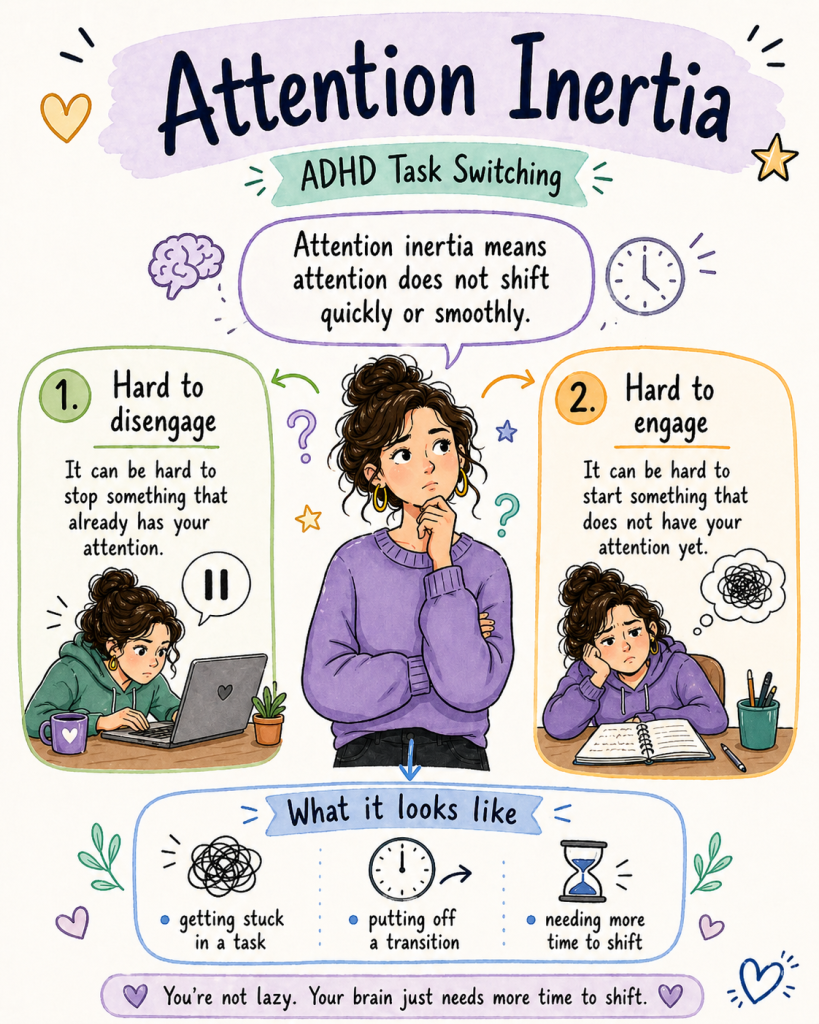
ADHD brains can have strong attention inertia, which means attention does not always shift quickly or smoothly.
It can be hard to disengage from something that already has your attention, and it can also be hard to engage with something that does not have your attention yet.
Transitions require your brain to break out of one attentional state — one focus mode — and enter another.
That shift takes executive effort.
Loss of activation.
A task may finally have activation, meaning your brain has enough energy, interest, urgency, or structure to keep going.
You may have flow, focus, or momentum.
An interruption can break that activation.
When this happens, the transition does not only cost the time of the switch itself. It also costs the time it takes to get re-activated.
For ADHD brains, re-achieving flow, focus, or momentum is not always quick or guaranteed.
Executive overhead.
Every transition creates executive overhead, or extra mental work before the brain can continue.
Your brain has to handle several microdecisions: what was I doing, where did I stop, what was I about to do next, what is the priority now, and how do I restart?
These microdecisions may seem small, but they create real cognitive load.
For ADHD brains, this extra executive load can be tiring, especially when working memory is already stretched.
What This Looks Like Day to Day
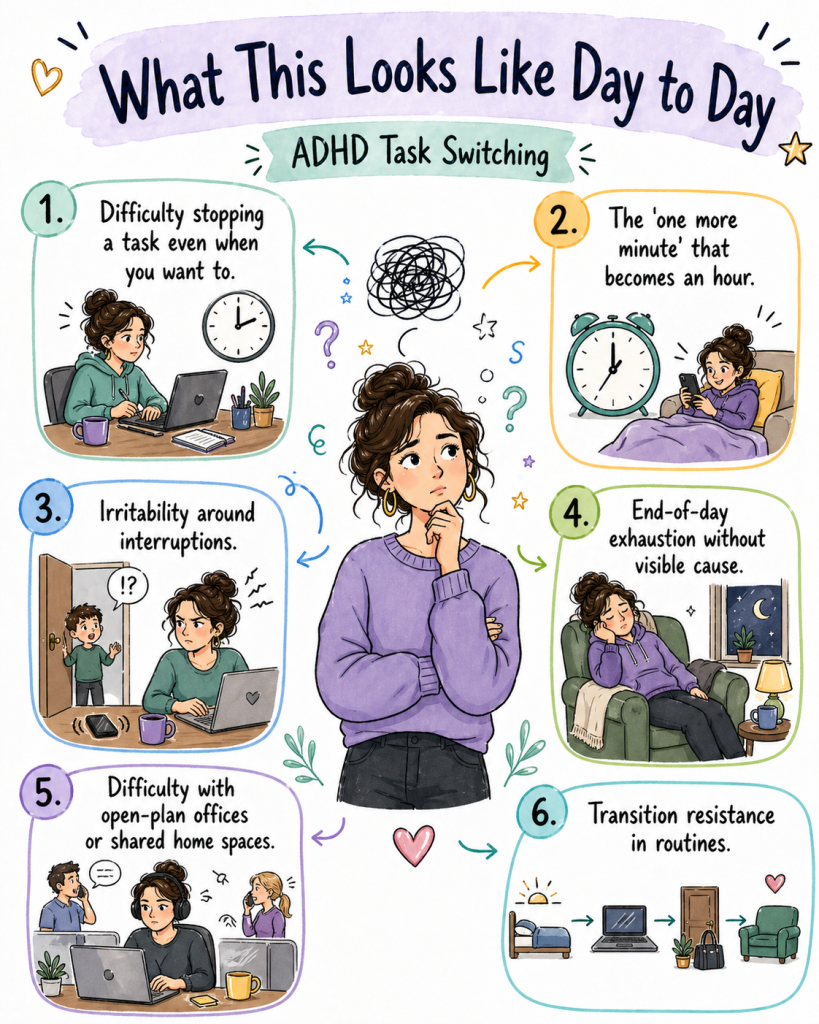
Difficulty stopping a task even when you want to.
Difficulty leaving something mid-task is often attention inertia and the accurate knowledge that stopping will create a switching cost.
The ADHD brain that resists a transition may be making a rational calculation: If I stop now, it may take a lot of effort to come back, find my place, and regain momentum.
The "one more minute" that becomes an hour.
When attention is fully engaged, disengaging requires executive effort that may not be available yet.
Transitions do not always happen when they are scheduled to happen. They often happen when the nervous system is ready, which may be much later than planned.
Irritability around interruptions.
Being interrupted mid-task carries real costs for ADHD brains.
The irritability that follows is partly about the lost work and partly about the regulatory cost of the switch itself.
Partners, children, or coworkers may see the reaction as disproportionate because the interruption looks small from the outside. Internally, the cost can be much higher.
End-of-day exhaustion without visible cause.
A day with frequent task switching can be exhausting for an ADHD brain, even if no single task was especially demanding.
The switching costs accumulate. By evening, the brain may have used up much of its regulatory reserve, meaning the energy needed to manage attention, emotion, and transitions.
Difficulty with open-plan offices or shared home spaces.
Environments with frequent interruption, such as open-plan offices, households with children, or shared workspaces, create ongoing task-switching costs.
ADHD brains often cannot absorb these costs as easily as neurotypical brains. The result may be more fatigue, irritability, lost focus, or difficulty getting work done.
Transition resistance in routines.
Getting started in the morning, moving from one activity to the next, ending the workday, and shifting into home mode all require task switching.
These routine transitions carry the same cost as other transitions.
Resistance to transitions is often part of how ADHD executive function works. It is not a personality trait.
Task Switching vs. Multi-Tasking
Multi-tasking means trying to do two tasks at the same time. Nobody does this especially well, ADHD or not. What looks like multi-tasking is usually rapid task-switching.
For ADHD brains, this often becomes rapid, shallow task-switching: briefly engaging with several things without staying with any one task long enough to reach depth. The result can be a lot of visible activity with limited completion.
This pattern is often misread as productivity or busyness. It is better understood as a response to activation difficulty. Starting something new may be easier than sustaining something already started, so multiple new starts accumulate.
Understanding this changes the intervention. The goal is not simply to manage multi-tasking. The goal is to build systems that reward depth, follow-through, and completion over constant new starts.
What Helps
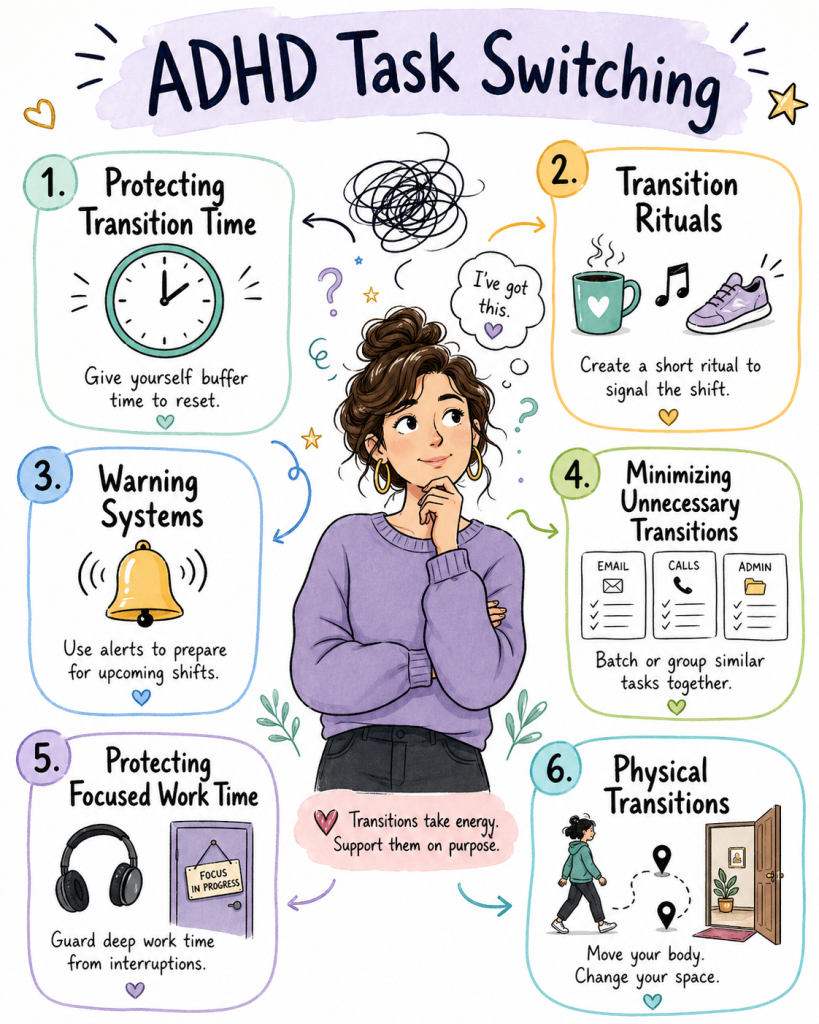
Protecting transition time.
If tasks take 20 minutes each, schedule 25. The extra 5 minutes is transition time — closing one context and opening another. Building transition time into the schedule rather than assuming transitions are instant makes plans actually work.
Transition rituals.
Brief, consistent rituals that signal the brain a transition is coming — a short walk, closing the laptop, making tea, a specific piece of music — provide the runway that helps the ADHD nervous system shift contexts without the abrupt cost of an unannounced switch.
Warning systems.
External alarms 5-10 minutes before a required transition are the equivalent of giving the ADHD brain a heads-up rather than a surprise. The nervous system needs transition time; building it into the schedule is accommodation.
Minimizing unnecessary transitions.
Task batching — grouping similar tasks together, minimizing context switches across a work session — reduces total switching cost. One long stretch of email followed by one long stretch of writing is less costly than alternating.
Protecting focused work time.
A work environment with frequent interruption is not just unpleasant for ADHD — it is a genuine performance problem. Advocating for uninterrupted work periods, using a closed door or signals to communicate "not available," or using headphones as a social signal are legitimate workplace accommodations.
Physical transitions to mark cognitive transitions.
The body can help signal the brain. Getting up, moving to a different physical space, going outside briefly — physical location changes are more effective cognitive transitions for ADHD than trying to switch contexts while sitting in the same place.
Making Task Switching Easier With ADHD
Self-Awareness
means understanding that transition resistance and switching difficulty are executive function features of ADHD — not stubbornness, not laziness, not rudeness. Naming the switching cost as neurological changes what you reach for when transitions are hard.
Self-Compassion
means releasing the shame of the day-end exhaustion you can't fully explain, of the irritability when interrupted, of the "one more minute" that became an hour. These are not character failures. They are the predictable output of a nervous system that pays a real cost for every transition.
Self-Accommodation
means designing your day to minimize unnecessary transitions, build in transition time and rituals, protect focused work periods from interruption, and use physical movement to support cognitive switching. This is building your life around your actual neurological profile.
Self-Advocacy
means being able to name transition cost to partners, employers, and family — explaining that interruptions are not neutral, that you need transition runway rather than abrupt shifts, and asking for environments and scheduling that reduce the daily switching load.
Self-Care
recognizes that a day of high-frequency transitions is a high-cost day for your nervous system regardless of how the individual tasks went — and that building in recovery time after high-transition days is not laziness but appropriate maintenance.
Frequently Asked Questions
Interruptions in ADHD carry a real cost: the current context may be lost from working memory, the activation built up in the task is broken, and the switch itself requires executive effort. The irritability that follows is partly a stress response to a genuine loss. It often feels disproportionate from the outside because the internal cost is higher than the interruption appears to justify.
ADHD attention has strong inertia — once engaged, disengaging requires executive effort. This is the same mechanism that makes starting hard and stopping hard. The brain doesn't switch contexts quickly or cleanly; it needs transition runway. Expecting rapid switching is expecting something ADHD doesn't provide reliably.
A day of frequent small transitions is an exhausting day for an ADHD brain. Each switch costs working memory, executive effort, and re-activation time. The total switching cost across a high-transition day can deplete the regulatory system even when no individual task was demanding. This is a real neurological cost, not psychosomatic tiredness.
The more effective approach is reducing unnecessary switching rather than improving the switching mechanism. Task batching, transition time buffers, warning systems before required switches, and protecting uninterrupted work periods all reduce total switching cost. Transition rituals help the brain shift contexts more smoothly. The goal is building an environment that accommodates the switching cost rather than demanding the brain stop having it.
Starting a new task is a small initiation event that can provide activation and novelty. Sustaining a task through to completion requires consistent engagement without the novelty hit of a new start. For the ADHD brain, starting is often easier than sustaining — so starts accumulate. Building systems that reward completion (visible progress tracking, accountability, specific finishing conditions) and reduce the novelty-seeking drive (adequate overall stimulation) helps shift the pattern.
Every transition costs something for your brain that doesn't cost the same for others. Designing around that — rather than demanding the same rapid switching neurotypical workplaces assume — is not asking for special treatment. It is asking for an accurate accommodation.
Continue Exploring
- ADHD in Women — the complete picture
- ADHD Time Management
- ADHD Decision Fatigue
- ADHD Burnout in Women
- ADHD Sensory Overload
- ADHD Hyperfocus
- ADHD Body Doubling
If you are a woman with ADHD navigating the daily exhaustion of transitions and the environments that demand them, neurodivergent-affirming therapy can help. I offer telehealth therapy in North Carolina and South Carolina. Reach out at kristenlynnmcclure@gmail.com or find me on Psychology Today.
Ready to Work Together?
If what you've read here feels familiar, I'd love to hear from you. I work with women with ADHD across North Carolina and South Carolina via secure telehealth — from wherever you are in either state.
