ADHD and Dopamine: Why Your Brain Chases What It Can't Sustain
By Kristen McClure, MSW, LCSW | Neurodivergent-affirming therapy for women
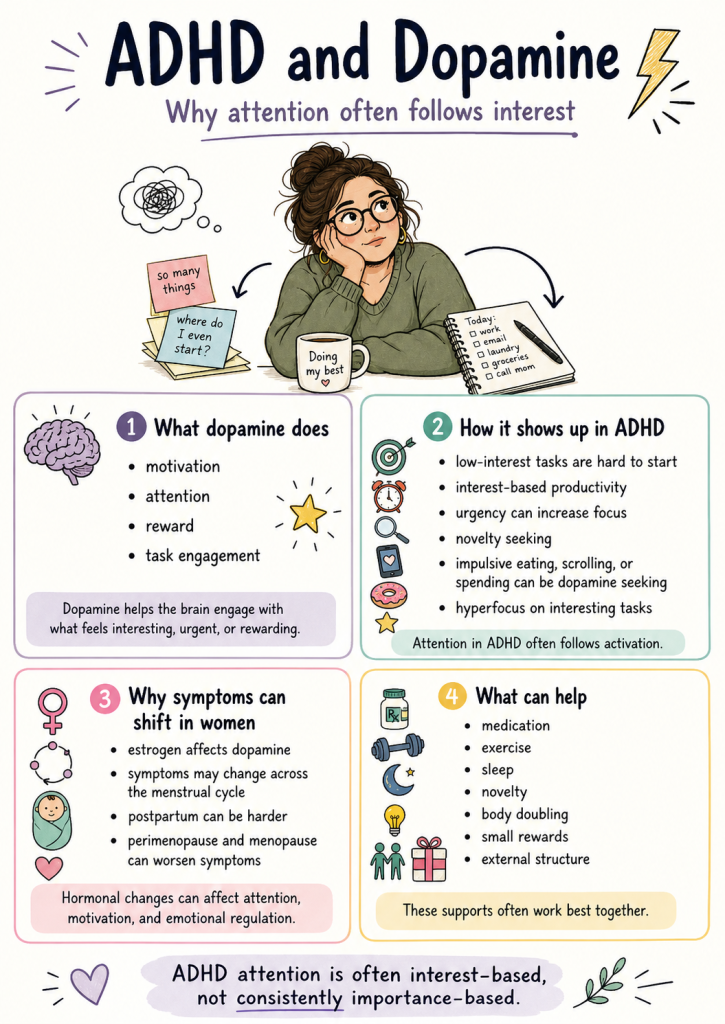
You know the feeling: the project that is finally interesting, the conversation you cannot stop, the task you started at midnight that you cannot put down.
You also know the other feeling: the flat, unreachable quality of everything that matters but does not interest you. The inability to start the thing you need to do. The pull toward anything that offers stimulation, relief, or novelty, even when you know it is not what you meant to be doing.
This is part of the dopamine dynamic in ADHD. Understanding it can explain the behavior and change how you respond to it.
What Dopamine Actually Does
What Dopamine Actually Does in ADHD
Dopamine is a neurotransmitter involved in motivation, reward, attention, and movement. It is often described as the “pleasure chemical,” but that is too simple. Dopamine is also involved in anticipation, salience, and the motivation to pursue something.
Dopamine helps the brain register:
- this matters
- pay attention
- move toward this
- this is worth effort
It helps something feel worth doing before the reward arrives. It also supports sustained effort through tasks that are not immediately stimulating, especially when the payoff is delayed, the task is tedious, or nothing external is making it interesting.
In ADHD, dopamine signaling works differently. This does not mean ADHD is simply “low dopamine.” ADHD involves differences in brain networks and neurotransmitter systems that support attention, motivation, reward, and executive function.
The ADHD Dopamine Difference
ADHD is associated with differences in dopamine and norepinephrine signaling, especially in brain systems involved in attention, motivation, reward, and executive function.
In daily life, this can mean the motivation signal is less consistent and more dependent on external activation.
The Motivation Signal Is Unreliable
Many ADHD women cannot reliably start and sustain tasks based only on importance, intention, or future consequences.
The task may matter. The person may care. The nervous system still may not generate enough activation to begin.
Interest, novelty, urgency, challenge, or emotional relevance often creates more activation than importance alone.
Interest Drives ADHD Attention
In ADHD, attention often follows interest.
This is why ADHD is sometimes described as interest-based attention rather than only an attention deficit. The attention may be available, but it is more likely to attach to what activates the brain’s motivation and reward systems.
Hyperfocus and Flatness in ADHD
When something activates the ADHD brain because it is novel, interesting, emotionally relevant, or urgent, attention can become intense, sustained, and immersive.
When it does not activate the system, the same person may struggle to start.
That variability is part of ADHD. It is not explained by caring, character, or willpower.
Novelty Seeking as ADHD Regulation
When the nervous system feels flat, bored, or under-stimulated, the ADHD brain may seek novelty to increase activation.
This can show up as scrolling, switching tasks, starting new projects, changing channels, researching something new, or looking for stimulation.
The brain is trying to change its state.
How ADHD and Dopamine Show Up Day to Day
Procrastination on Important but Uninteresting Tasks
ADHD procrastination is often less about not knowing what matters and more about not having enough activation to begin.
Knowing, caring, and acting are separate processes.
Interest-Based Productivity
An ADHD woman may work for hours on something interesting and then feel unable to start something equally important that does not activate her attention.
The productivity is real. The selectivity is neurological.
The ADHD Urgency Fix
Deadlines often create activation.
This is why last-minute work can become a common ADHD pattern. The pressure finally gives the nervous system enough stimulation to move.
The work may get done, but the process can be exhausting and hard to sustain.
Impulsivity as Dopamine Seeking
Some impulsive behaviors in ADHD are tied to dopamine seeking.
This can include spending, eating, sex, substances, novelty, risk, or sudden changes in plans.
The behavior may provide a fast dopamine shift for an under-activated nervous system. Understanding the mechanism does not remove responsibility, but it changes what needs support.
Difficulty With Delayed Rewards
When the reward is far away, the motivation signal may be weak.
A small immediate reward can feel more compelling than a large future reward, even when the person understands the consequences.
This is a nervous system issue, not a lack of insight.
Emotional Dysregulation and Low Activation
Low-activation states can come with irritability, flatness, low frustration tolerance, and difficulty regulating emotion.
Emotional dysregulation in ADHD is partly connected to executive functioning. It can also be affected by a nervous system that is under-activated, depleted, or unable to buffer stress well.
Hyperfixations and Special Interests
Some topics or activities strongly activate the ADHD brain.
These can become hyperfixations or special interests. They may feel absorbing, motivating, and satisfying in a way routine tasks often do not.
For many ADHD women, this is what engagement feels like when there is enough activation.
Why Women With ADHD Are Particularly Affected by Dopamine Changes
Estrogen affects dopamine availability and dopamine receptor sensitivity. This has important implications for ADHD women across the lifespan.
ADHD and Monthly Cycle Fluctuations
ADHD symptoms may worsen in the luteal phase, the week or so before menstruation, when estrogen drops.
Concentration, motivation, emotional regulation, and frustration tolerance may be stronger at some points in the cycle and much harder premenstrually.
This is a biological pattern.
ADHD and Postpartum Dopamine Changes
After delivery, estrogen drops sharply.
For ADHD women, this can reduce dopamine support during a period that already includes sleep disruption, sensory demands, emotional load, and major life changes.
This is one reason the postpartum period can be especially hard.
ADHD, Perimenopause, Menopause, and Dopamine
As estrogen declines across perimenopause and menopause, dopamine support can also decline.
Many ADHD women who previously managed through medication, structure, masking, or compensation notice that their symptoms become harder to manage during perimenopause.
This can include more executive dysfunction, lower stress tolerance, more emotional reactivity, and medication feeling less effective.
Understanding the dopamine-hormone connection can help make these changes feel less random and easier to address.
Dopamine Regulation in ADHD: What Actually Helps
The aim is not to chase more dopamine all day.
What helps is creating more consistent support so the nervous system does not have to depend only on crisis, novelty, pressure, or stimulation to function.
ADHD Medication and Dopamine
Stimulant medications increase dopamine and norepinephrine activity in the brain. They do not give the brain dopamine directly.
Methylphenidate and amphetamines work somewhat differently, but both affect the availability and activity of dopamine and norepinephrine.
For many ADHD women, medication is one of the most direct supports for dopamine-related ADHD symptoms.
Exercise and ADHD Dopamine Support
Aerobic exercise is one of the better-supported non-medication supports for ADHD.
Movement can affect dopamine, norepinephrine, mood, sleep, and baseline activation. Even moderate, consistent movement may help the ADHD nervous system function with more stability.
Novel Environments and Body Doubling
Changing environments can provide enough novelty to support task initiation.
Body doubling, or having another person present while working, can provide social activation and structure.
These are accommodations. They help create the conditions the ADHD brain often needs to begin and stay engaged.
Micro-Rewards and Interest Supports
Low-interest tasks often need added activation.
This may include small rewards, a timer, music, a more interesting location, a game-like element, or connecting the task to something emotionally meaningful.
The task itself may not generate enough activation. The support around the task can help.
Sleep, Stress, and Physical Regulation
Sleep loss, chronic stress, pain, hunger, and physical depletion all affect the nervous system.
For ADHD women, physical regulation is part of ADHD care. Sleep, food, movement, sensory support, and recovery time affect executive functioning and emotional regulation.
Reducing Shame Around Interest-Based Attention
Shame uses energy.
When ADHD women spend large amounts of energy fighting the way their nervous system works, there is less capacity left for problem-solving.
Understanding the dopamine pattern can make it easier to design around it instead of relying on self-criticism.
How the Empowerment Model Addresses ADHD Dopamine
Self-Awareness and ADHD Dopamine
Self-awareness means learning how dopamine affects your attention, motivation, and emotional state.
It helps you notice when the problem is low activation rather than lack of character or willpower.
Instead of “I am lazy,” the more accurate statement may be, “I am in a low-activation state, and this task does not have enough interest, urgency, or structure to help me begin.”
That gives you something practical to work with.
Self-Compassion and Interest-Based Attention
Self-compassion means reducing the moral judgment around interest-based attention.
Difficulty starting an important but uninteresting task does not mean you do not care. It often means your nervous system is not generating enough activation for that task.
The work you do well in your areas of interest still counts. It is not less valid because it came more easily.
Self-Accommodation for ADHD Motivation
Self-accommodation means building systems that work with the ADHD dopamine pattern.
This may include:
scheduling harder tasks when you have more energy
adding novelty to routine work
using body doubling
changing environments
creating external structure
breaking tasks into smaller starts
using micro-rewards
reducing reliance on internal motivation
Many ADHD women function better when the system is designed for their actual brain instead of an idealized version of consistency.
Self-Advocacy for ADHD Support Needs
Self-advocacy means being able to explain what helps your attention and follow-through.
This may include conversations with employers, partners, colleagues, or providers about structure, flexibility, task design, deadlines, medication access, or environmental needs.
It also means recognizing when an environment requires constant steady output in a way that does not fit your nervous system.
Self-Care and the ADHD Nervous System
Self-care means treating the dopamine system as part of the body.
Sleep, movement, food, stress load, sensory input, pain, and hormonal shifts all affect ADHD symptoms.
Taking care of the body supports the neurological systems that shape attention, motivation, and emotional regulation day to day.ogical infrastructure that determines how your ADHD functions day to day.
Frequently Asked Questions
ADHD involves differences in dopamine signaling in brain systems that support attention, motivation, reward, and executive function. In daily life, this can make the motivation signal less consistent and more dependent on external activation, such as interest, novelty, urgency, challenge, or emotional relevance. This helps explain why low-interest tasks can feel difficult to start, even when they matter, while interesting tasks can pull attention in strongly and become hard to stop.
This is the core of interest-based attention in ADHD. Attention often follows activation, and activation is shaped by interest, novelty, urgency, challenge, and emotional relevance. When a task activates the ADHD brain, focus can be intense and sustained. When it does not, focus cannot always be generated by willpower alone. The variability is neurological, not a motivation problem.
Estrogen affects dopamine availability and receptor sensitivity, so ADHD symptoms can shift when estrogen shifts. Many ADHD women notice changes across the menstrual cycle, postpartum, perimenopause, and menopause. Symptoms that feel manageable at one hormonal stage may become much harder at another. During perimenopause, declining estrogen can make previously managed ADHD symptoms more difficult to regulate.
Yes. Impulsive eating is common in ADHD in part because food can provide quick dopamine activation for a nervous system that is under-activated, stressed, or depleted. This does not mean ADHD adults can simply stop using food this way. The drive is neurological. Understanding it as regulation behavior, rather than weak willpower, changes the support needed.
Exercise is one of the best-supported non-medication supports for ADHD. Aerobic movement can affect dopamine and norepinephrine activity and may reduce ADHD symptoms. Sleep quality, novelty, new experiences, social connection, music, and completing small tasks can also support activation through small reward signals. These supports can help, but they usually do not replace medication for moderate-to-severe ADHD. They tend to work best as part of a broader treatment plan.
The dopamine difference is not something to overcome. It is something to understand deeply enough to build around — and to stop blaming yourself for.
Continue Exploring
- ADHD in Women — the complete picture
- Hormones and the Dopamine Connection
- ADHD Boredom and Understimulation
- ADHD and Money — Dopamine Spending
- ADHD Impulsivity
- Exercise and the ADHD Brain
- Revenge Bedtime Procrastination
- ADHD and Alcohol in Women
- ADHD and Rebound Relationships
If you are a woman with ADHD navigating the motivation gaps, the interest-based attention, and the relationship between your nervous system and your daily life, neurodivergent-affirming therapy can help. I offer telehealth therapy in North Carolina and South Carolina. Reach out at kristenlynnmcclure@gmail.com or find me on Psychology Today.
Ready to Work Together?
If what you've read here feels familiar, I'd love to hear from you. I work with women with ADHD across North Carolina and South Carolina via secure telehealth — from wherever you are in either state.
