ADHD and CPTSD in Women: When Trauma and Neurodivergence Overlap
By Kristen McClure, MSW, LCSW | Neurodivergent-affirming therapy for women
The hypervigilance never fully switches off. You read the room before you enter it. You monitor tone of voice for early warning signs. You brace for the reaction before the reaction comes. And separately — or maybe connected, you're not sure — you lose time, forget things, can't start the task, feel your emotions in a way that seems outsized and hard to explain.
ADHD and trauma-related conditions can occur together, and their effects can sometimes be hard to separate. Research is much stronger for ADHD with PTSD than specifically for ADHD with ICD-11 Complex PTSD (CPTSD), so it is important not to assume that trauma is part of every ADHD story or that every overlapping symptom has the same cause.

What CPTSD Is
Complex Post-Traumatic Stress Disorder (CPTSD) differs from standard PTSD in its source and its scope. PTSD can follow single or repeated traumatic events. CPTSD is an ICD-11 diagnosis that includes the core PTSD symptoms plus persistent difficulties with emotion regulation, negative self-concept, and relationships. It is often associated with prolonged or repeated trauma, especially interpersonal trauma — often trauma that occurred in relationships of dependency or power imbalance: childhood abuse or neglect, domestic violence, chronic emotional abuse, environments of ongoing unpredictability or threat.
CPTSD includes the core PTSD features — hypervigilance, avoidance, intrusive memories — and adds additional dimensions that reflect the impact of sustained trauma on identity and relationship:
- Persistent difficulties with emotional regulation
- Negative self-concept: deep beliefs about being defective, worthless, permanently damaged, or fundamentally different from others
- Difficulties with relationships: either avoiding closeness or becoming hyperattached; difficulty trusting; difficulty feeling safe
- Altered consciousness: dissociation, emotional numbing, memory gaps
- A sense of meaninglessness or hopelessness about the future
These are not personality traits. They are adaptations to circumstances that were genuinely dangerous or harmful — and they persist because the nervous system doesn't automatically know when the danger has passed.
CPTSD vs ADHD in Women: Overlap and Co-Occurrence
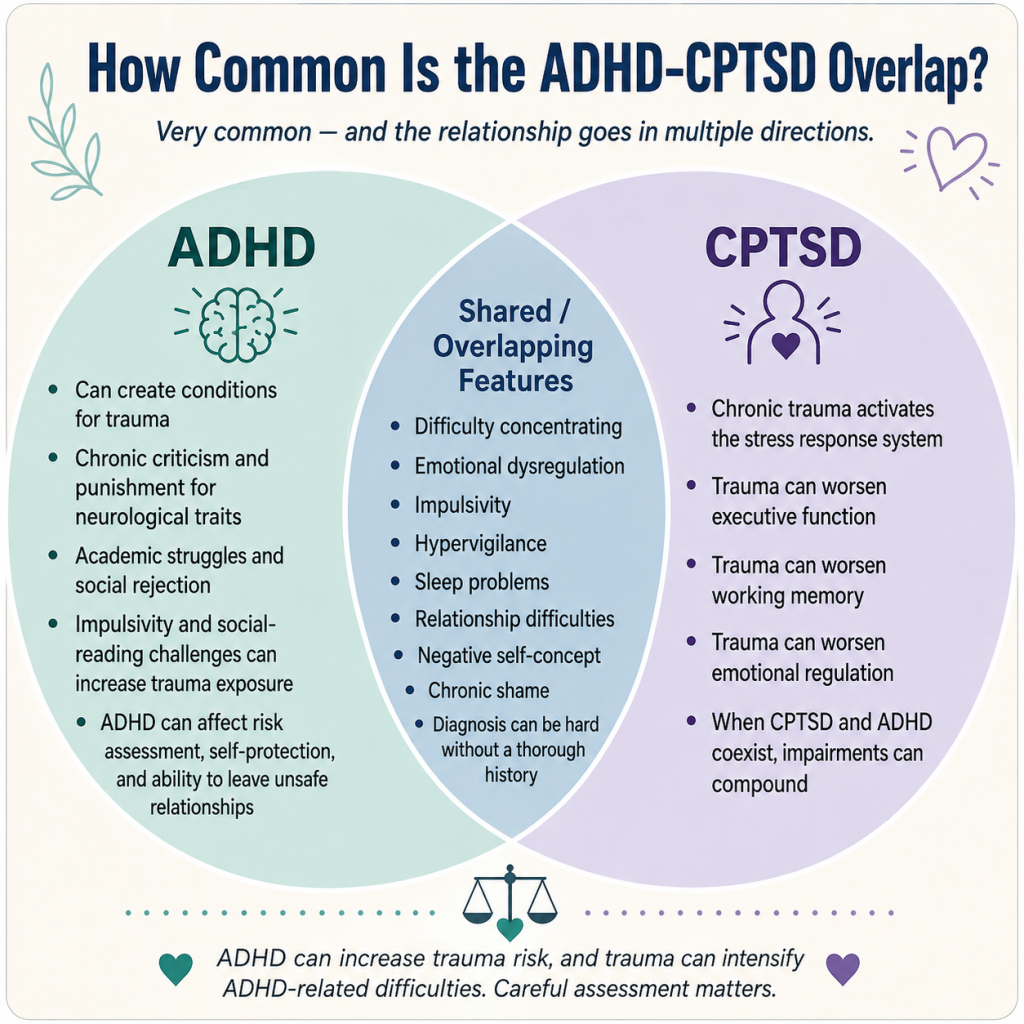
They can co-occur, but the exact rate of ADHD with CPTSD is not well established. Most of the available research examines ADHD with PTSD rather than ICD-11 CPTSD specifically.
ADHD can shape experiences of stress and adversity.
Children with ADHD can experience repeated criticism, punishment, academic difficulty, or social rejection when their needs are misunderstood. Those experiences can affect stress, shame, and self-concept. They can be harmful without assuming that every difficult ADHD childhood meets criteria for trauma or CPTSD.
ADHD is associated with higher rates of some adverse experiences and PTSD.
Studies find an association between ADHD and later PTSD, and some research suggests higher exposure to adverse experiences. The reasons are likely multiple and can include social context, co-occurring conditions, impulsivity, discrimination, relationship experiences, and access to support. An ADHD diagnosis by itself does not explain why someone experiences abuse or why leaving a harmful relationship may be difficult.

Trauma-related symptoms can add to ADHD-related difficulty.
Trauma-related symptoms can affect concentration, working memory, sleep, arousal, and emotion regulation. When ADHD and PTSD or CPTSD are both present, those difficulties can overlap and interact, but the combined pattern varies by person and should not be assumed to follow one predictable course.
They share overlapping symptoms that make diagnosis genuinely difficult.
Both ADHD and CPTSD involve: difficulty concentrating, emotional dysregulation, impulsivity, hypervigilance, sleep problems, relationship difficulties, negative self-concept, and chronic shame. Without a thorough history and skilled assessment, it is easy to misattribute CPTSD symptoms to ADHD, or ADHD symptoms to trauma — and miss the full picture.
Why Trauma May Be Missed in Women With ADHD
Childhood with undiagnosed ADHD is often traumatic.
Girls with ADHD are less likely to be identified and more likely to receive their ADHD traits as personal failings. The child who is told constantly that she is not trying hard enough, that she needs to pay attention, that she's irresponsible, that she ruins things — even when these messages come from caring parents and teachers — is experiencing chronic emotional harm. Over time, this accumulates into a self-concept that looks a great deal like the negative self-belief dimension of CPTSD.
Masking can carry a significant psychological cost.
The sustained effort of concealing ADHD-related differences — such as suppressing movement, performing attentiveness, managing emotional expression, or presenting as more organized than you feel — can be exhausting and can contribute to disconnection from your own needs. That experience may overlap with trauma-related difficulties for some people, but masking by itself does not establish CPTSD.
Relationships are a risk area.
Some women with ADHD report relationship patterns shaped by impulsivity, rejection sensitivity, executive-function demands, prior experiences, or difficulty noticing their own needs while focused on others. These factors may interact with relationship risk, but ADHD does not cause abuse and does not explain why someone stays in a harmful relationship. CPTSD requires a trauma history and a clinical pattern that extends beyond relationship difficulty alone.
The shame is self-generated as well as received.
ADHD shame and CPTSD shame interact. The woman who already believes she is defective receives external harm in a context that confirms that belief, making it harder to recognize the harm as harm rather than as evidence of deserving it.
What ADHD-CPTSD Looks Like
When ADHD and CPTSD coexist, the presentation is complex and often confusing to everyone, including the person living it.
Emotional flashbacks without memory. Pete Walker's framework of emotional flashbacks describes states of acute shame, overwhelm, or fear that arrive without a clear narrative memory — just the felt sense of an earlier threatened self. For women with ADHD and CPTSD, these states can be misidentified as emotional dysregulation from ADHD alone, leading to treatment that addresses regulation without addressing the trauma underneath.
Hypervigilance and attention to the environment. Trauma-related hypervigilance is organized around threat detection. ADHD can also involve distractibility, sensory sensitivity, or difficulty filtering competing input. In real life these experiences can overlap, and a clinician usually needs the person's history, triggers, and broader symptom pattern rather than one behavior to tell them apart.
Feeling frozen or unable to act. Trauma-related shutdown, dissociation, anxiety, executive-function difficulty, overwhelm, and task initiation problems can all produce a similar experience of being stuck. The trigger can offer clues, but there is no simple rule that reliably separates an “ADHD freeze” from a trauma response based on the situation alone.
Difficulty trusting treatment. Women with CPTSD have often been harmed in relationships of power imbalance — which includes therapeutic relationships gone wrong. The suspicion that can come into new therapeutic relationships isn't resistance; it's adaptation. A clinician who understands this approaches the relationship accordingly.
Treatment Considerations
Assessment of both matters. When ADHD and a trauma-related condition are both present, treatment usually works best when neither is ignored. Which needs attention first — or whether they are addressed together — depends on current safety, symptoms, functioning, treatment goals, and the person's preferences.
Treatment sequencing is individualized. Some people need more stabilization and trauma-focused support before intensive trauma processing. Others may benefit from ADHD accommodations, medication management, executive-function support, or practical changes at the same time. There is no single sequence that fits everyone.
Shame may need direct attention. Negative self-concept is part of CPTSD, and many adults with ADHD also carry shame related to years of criticism, misunderstanding, or repeated difficulty. For some people, therapy needs to address those beliefs alongside practical supports, emotion regulation, and trauma symptoms rather than treating shame as an afterthought.
Trauma-informed ADHD treatment. Any ADHD-focused work — including ADHD coaching, executive function support, or accommodation planning — that doesn't account for the trauma history is likely to activate shame rather than build skills. The clinician who says "just use a planner" to someone with CPTSD and ADHD is missing that every organizational failure is triggering a deeply held belief about being unfixable.
Supporting ADHD and CPTSD Together
Self-Awareness means developing the capacity to notice internal states — emotional flashbacks, hypervigilance, freeze — and begin to identify their sources. This requires the kind of self-knowledge that CPTSD often disrupts, and it builds gradually through safe therapeutic relationship.
Self-Compassion is the therapeutic antidote to the shame-based self-concept that both ADHD and CPTSD produce. The practices developed by researchers like Kristin Neff — treating oneself as one would treat a beloved friend, recognizing common humanity in suffering, allowing painful feelings without suppressing or exaggerating them — are evidence-based supports for both trauma recovery and ADHD-related shame.
Self-Accommodation takes on additional meaning when CPTSD is present: it includes not just executive supports but also emotional regulation supports, titrated exposure to demands that trigger trauma responses, and permission to pace therapeutic work based on capacity rather than external timeline.
Self-Advocacy for women with ADHD and CPTSD often begins with advocating for accurate diagnosis. This means finding a clinician who assesses for both, who understands how they interact, and who doesn't mistake CPTSD for ADHD personality or ADHD for trauma response without looking carefully at both.
Self-Care at its most fundamental is safety — physical, relational, and environmental. For women with CPTSD, self-care begins with addressing the conditions that are ongoing sources of threat or harm. This is prior to and foundational for any other self-care.
Frequently Asked Questions
Yes, and it is common. The two conditions overlap at high rates for multiple reasons: ADHD creates vulnerability to traumatic experiences and environments, childhood with undiagnosed ADHD often involves chronic relational harm that produces CPTSD, and they share overlapping neurological pathways. When both are present, each one affects the expression and treatment of the other.
The two can look very similar — both involve emotional dysregulation, concentration difficulties, shame, relationship challenges, and sleep problems. Some distinguishing features of CPTSD: the presence of a prolonged trauma history, emotional flashbacks (intense affective states without narrative memory that feel like an earlier self), deep negative beliefs about the self that feel factual rather than cognitive, and hypervigilance that is specifically threat-focused rather than sensory-attentional. A thorough clinical evaluation by a clinician familiar with both is the most reliable path to accurate diagnosis.
Not automatically, but chronic criticism, repeated failure, social rejection, and misunderstanding of a child's neurological traits — without support or accurate explanation — can produce a CPTSD-like profile over time. The distinction between "CPTSD from relational childhood harm" and "ADHD-related shame and negative self-concept" is clinically meaningful, and a thorough history can help differentiate. Many women with ADHD have features of both.
Effective treatment typically integrates trauma-focused therapy (such as EMDR, IFS, or trauma-focused CBT) with ADHD-informed support. The therapy must be neurodivergent-affirming — it cannot approach ADHD as a deficit to be corrected, because that replicates the very experiences that often contributed to the trauma. The therapist needs to understand both conditions and how they interact, and needs to be comfortable moving between them based on what the person needs in any given phase of treatment.
They are related but not identical. ADHD shame develops primarily from chronic feedback that translates neurological differences into character failings. CPTSD shame can include this and also involves shame that is more relational — the internalization of harm received in dependent relationships. In practice, the two types of shame often compound each other. Addressing shame at both levels — the neurodivergent shame and the relational trauma shame — is part of the work.
You are not broken. You are a person with a nervous system that was shaped by genuine difference and genuine difficulty, in environments that often didn't understand either. Understanding what actually happened — neurologically and relationally — is where healing begins.
Continue Exploring
- ADHD in Women — the complete picture
- ADHD and Anxiety
- ADHD and Shame
- ADHD Burnout in Women
- ADHD Masking in Women
- ADHD and Gaslighting
- Late ADHD Diagnosis in Women
I work with women navigating the intersection of ADHD and trauma, including complex PTSD, with a neurodivergent-affirming approach. If you are in North Carolina or South Carolina, reach out at kristenlynnmcclure@gmail.com or find me on Psychology Today.
Ready to Work Together?
If what you've read here feels familiar, I'd love to hear from you. I work with women with ADHD across North Carolina and South Carolina via secure telehealth — from wherever you are in either state.
