ADHD and Perfectionism: When Nothing Is Ever Good Enough
By Kristen McClure, MSW, LCSW | Neurodivergent-affirming therapy for women

It should not be this hard to send the email. You've written it six times. You've reread it four times. You know it's fine — you can see that it's fine — and yet something keeps you from pressing send. What if the wording is wrong? What if you sound abrupt? What if they misunderstand? You keep reading it, looking for the thing that will make it safe to release.
Or maybe it's not the email. Maybe it's the report, the conversation, the decision, the creative project that never gets finished because finished means it can be judged and it will never be as good as it could theoretically be.
If you have ADHD and perfectionism, you are likely exhausted in a specific way — not the exhaustion of someone who has done too much, but the exhaustion of someone who has held everything too tightly for too long, waiting to feel certain enough to let go.
Is Perfectionism a Symptom of ADHD?
Perfectionism can be easy to miss in ADHD because the cultural image of ADHD is impulsive, unfinished, and scattered. But some women with ADHD describe perfectionistic overcompensation, people-pleasing, and intense self-monitoring, especially after years of criticism, masking, or trying to prevent mistakes from being noticed.
It is not about standards. It is about protection.
Shame-driven perfectionism. For many women with ADHD, perfectionism developed as a response to years of being criticized, corrected, and found wanting. If I do it perfectly, there is nothing to criticize. If I am excellent enough, maybe I can compensate for all the ways I'm not. Perfectionism is armor — and in women who have spent years feeling like their natural way of being is the wrong way, it is armor that makes sense.
Rejection Sensitive Dysphoria. Some ADHD women describe criticism or disapproval as unusually intense and hard to recover from. The term rejection sensitive dysphoria (RSD) is often used for this experience, although it is not a formal diagnosis. Perfectionism reduces the surface area for criticism. A piece of work that is perfect (or as close as humanly possible) cannot be judged. The perfectionism is not about the work. It is about managing the anticipated pain of negative evaluation.
All-or-nothing thinking. The ADHD brain tends toward extremes — a trait that is often described as rigidity but is more accurately about how the brain processes value and reward. Something is either interesting or unbearable. A task is either done right or not worth doing. This binary makes the middle ground of "good enough" feel genuinely impossible, because good enough reads as not good enough.
Compensatory overeffort. Many ADHD women are aware, on some level, that their process is less reliable than others'. They forget things. They lose time. They miss things they should have caught. Perfectionism attempts to compensate for this by making the outcome good enough that the process is irrelevant. The problem is that compensatory overeffort is not sustainable, and it never fully relieves the anxiety that drives it.
The fear of starting without a guaranteed endpoint. ADHD task initiation difficulties are well-documented. What is less discussed is the role perfectionism plays in blocking starting: if the task cannot be done perfectly — if there is any uncertainty about whether the outcome will be adequate — starting feels dangerous rather than just difficult. The perfect standard becomes the reason the task never begins.
Two Types of Perfectionism in ADHD Women
Not all perfectionism in ADHD looks the same. In my work, I use two practical patterns to help women notice where perfectionism interferes:
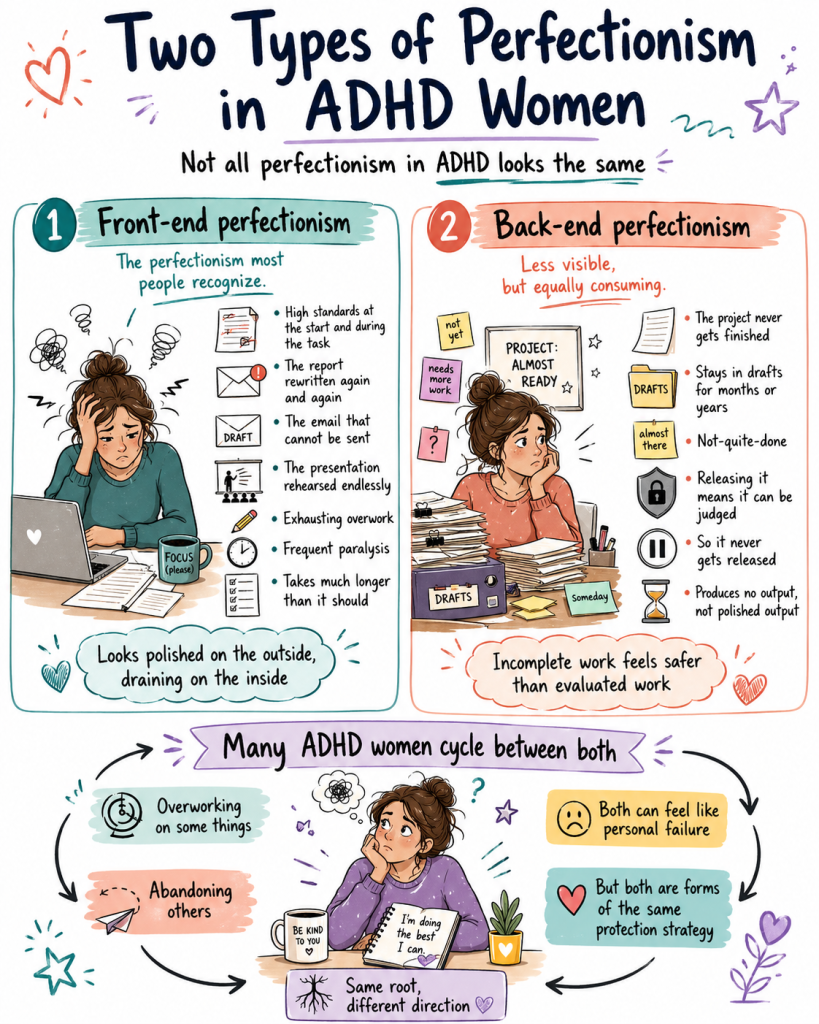
Front-end perfectionism is the kind most people recognize — intense standards applied at the start and throughout a task. The report that is rewritten many times. The email that can't be sent. The presentation rehearsed until the perfectionist is the only one who thinks it's inadequate. Front-end perfectionism produces exhausting overwork, frequent paralysis, and output that takes far longer than it should given its quality.
Back-end perfectionism is less visible but equally consuming. It is the project that never gets finished, the piece that sits in drafts indefinitely, the work that is "almost ready" for months or years. Here, the perfectionism doesn't produce polished output — it produces no output. Because releasing work means it can be judged, it never gets released. The work stays in a permanent state of not-quite-done, protected from evaluation by remaining incomplete.
Many ADHD women cycle between both — overworking on some things, abandoning others, and experiencing both as evidence of the same underlying problem, when they are actually expressions of the same protection strategy in different directions.
What Perfectionism Costs
Time. The amount of time spent on any given output is disproportionate to the improvement achieved. Each revision produces marginally less return and marginally more anxiety. The hours spent optimizing to the last five percent come at the expense of other things that needed doing.
Starting. Perfectionism makes initiation harder by raising the stakes of beginning. If the task must be done perfectly, and there is no certainty of perfection, there is no safe moment to start. The paralysis before the blank page is often not laziness or disinterest. It is perfectionism blocking entry.
Finishing. The finished thing can be judged. The unfinished thing cannot. Many women with ADHD-driven perfectionism live with a trail of abandoned projects — not because they lost interest, but because finishing meant exposing the work to evaluation that might confirm their worst fears.
Joy. When anything you do is measured against an impossible standard, it is difficult to experience satisfaction in what you actually produced. The work is always not quite enough. The moment of completion — if it arrives — is not relief but anxiety about what comes next.
Relationships. Perfectionism applied to relationships produces its own exhaustion — the impossibility of tolerating mess, uncertainty, or the normal friction of other people. It can also produce self-concealment: if I let people see the real version, the imperfect, struggling, behind-the-scenes version, the relationship might not survive.
Perfectionism Is Not the Same as High Standards
This distinction matters.
High standards are flexible, calibrated, and driven by genuine investment. A person with high standards can tell the difference between a high-stakes situation that warrants extra effort and a low-stakes situation where good enough is genuinely sufficient. They can finish things, release things, accept feedback without crisis.
Perfectionism is rigid, driven by fear, and applied indiscriminately. The perfectionist cannot calibrate — everything requires the same impossible standard because the point is not excellence but protection. Perfectionism says any flaw is a threat. High standards say how much does this actually matter?
Many ADHD women have been praised for their perfectionism — told it is a strength, a sign of care, evidence of investment. This makes it harder to recognize the cost. The praise is for the output. No one sees what it took to produce it.
What Actually Helps
Recognizing perfectionism as a protection strategy, not a personality trait.
It developed in a context where it made sense. Understanding that context — and asking whether that protection is still necessary in the present — is the beginning of working with it rather than being run by it.
Tolerating the discomfort of "good enough."
This is not about lowering standards. It is about building a relationship with completion and release — a practice of finishing and letting go that slowly teaches the nervous system that the feared outcome does not always arrive. Each finished thing that survives contact with reality expands the range of what feels safe to release.
Separating self-worth from output.
The perfectionism that is shame-driven conflates the quality of the work with the value of the person. These need to be separated. A flawed piece of work does not reveal something fundamental about who you are. It reveals that you are human and that you made something.
Addressing the underlying RSD.
If perfectionism is driven by fear of rejection and criticism, treating the perfectionism without addressing the RSD treats the symptom without the cause. The discomfort of potential disapproval needs to be worked with directly, not just managed by making the work better.
Making starting safe.
For ADHD perfectionism that blocks initiation, the work is in lowering the threshold for beginning. This might look like explicitly declaring something a draft, a first attempt, or a throwaway. It might look like body doubling to make starting feel less exposing. It might look like time-boxing: I will work on this for 20 minutes and then stop, regardless of where it is. The goal is not to perfect the product but to make the process survivable.
Working With ADHD Perfectionism
Self-Awareness
means learning to recognize perfectionism as it operates — noticing the specific forms it takes, the triggers that activate it, the difference between genuinely high-stakes situations and situations where the stakes feel high because the nervous system says they are.
Self-Compassion
addresses the shame underneath the perfectionism. When the terror of being found wanting can be met with kindness rather than more effort, the urgency of the perfectionism decreases. This is not a quick fix. It is a gradual shift in how you relate to the possibility of imperfection.
Self-Accommodation
involves designing your environment and processes to reduce the activation perfectionism produces. This includes setting time limits on tasks, creating structures that make completion the default, using accountability partners or body doubling to make finishing less exposing, and explicitly defining "done enough" before beginning a task rather than trying to determine it while in the middle.
Self-Advocacy
means being able to tell the people in your life — partners, colleagues, managers — that your process takes more internal energy than it looks like from the outside, and that accommodations that reduce the stakes of starting and finishing are genuinely helpful, not indulgent.
Self-Care
supports the baseline conditions that make the perfectionist drive less relentless. A depleted, sleep-deprived, overwhelmed nervous system has less capacity to tolerate the discomfort of imperfection. The more resourced you are, the more access you have to the part of yourself that knows good enough is real.
Frequently Asked Questions
Yes. Perfectionism is not a diagnostic symptom of ADHD, but it can occur alongside ADHD. The cultural image of ADHD as disorganized and impulsive can miss people who respond to repeated mistakes, criticism, uncertainty, or inconsistent performance by trying to control outcomes more tightly. For some people, years of criticism, correction, fear of mistakes, or sensitivity to disapproval can make perfectionistic strategies feel protective. That pattern can coexist with ADHD without being a defining feature of ADHD itself.
Not exactly, though they can look similar. OCD perfectionism is driven by obsessive thought patterns and compulsive behavior that relieves anxiety — checking, redoing, seeking reassurance — in a repetitive loop. ADHD perfectionism is driven more by shame, RSD, and all-or-nothing thinking, and tends to produce paralysis or over-effort rather than the compulsive checking cycle of OCD. However, OCD and ADHD do co-occur, and when both are present the perfectionism can be particularly intense and complex.
Back-end perfectionism is one of the most common but least recognized forms of ADHD perfectionism. The incomplete project is protected from judgment. If it's never finished, it can never be evaluated, and the fear of discovering the worst about yourself is never realized. This is not laziness or loss of interest — it is perfectionism operating at the finish line rather than the starting line.
The goal is not to stop caring about quality but to build a different relationship to imperfection — one where imperfection is manageable rather than catastrophic. This involves addressing the underlying shame and RSD that drive the perfectionism, practicing tolerating the discomfort of "done," and gradually expanding the situations where you can release work without certainty that it's flawless. This is therapy work, not a tips-and-tricks problem.
Yes. Stress activates the nervous system's threat detection system, which increases RSD sensitivity and makes the possibility of criticism or failure feel more acute. Under stress, the threshold for "safe enough to release" rises, and the perfectionism intensifies. This is why women with ADHD often notice their perfectionism is worst precisely when they have the least time to accommodate it — the high-stakes deadline, the difficult relationship period, the moment of genuine exhaustion.
Perfectionism is not evidence of high standards. It is evidence of a nervous system that learned, at some point, that imperfection was not safe. That is a history worth understanding — and worth moving past.
Continue Exploring
- ADHD in Women — the complete picture
- ADHD and Shame
- ADHD and Self-Esteem
- ADHD Burnout in Women
- ADHD Masking in Women
- ADHD Decision Fatigue
If you are a woman with ADHD whose perfectionism is getting in the way of your life — your work, your relationships, your ability to simply finish things — neurodivergent-affirming therapy can help. I work with women in North Carolina and South Carolina. Reach out at kristenlynnmcclure@gmail.com or contact me about therapy.
Ready to Work Together?
If what you've read here feels familiar, I'd love to hear from you. I work with women with ADHD across North Carolina and South Carolina via secure telehealth — from wherever you are in either state.
