ADHD and Demand Avoidance: When "Just Do It" Is the Wrong Advice
By Kristen McClure, MSW, LCSW | Neurodivergent-affirming therapy for women
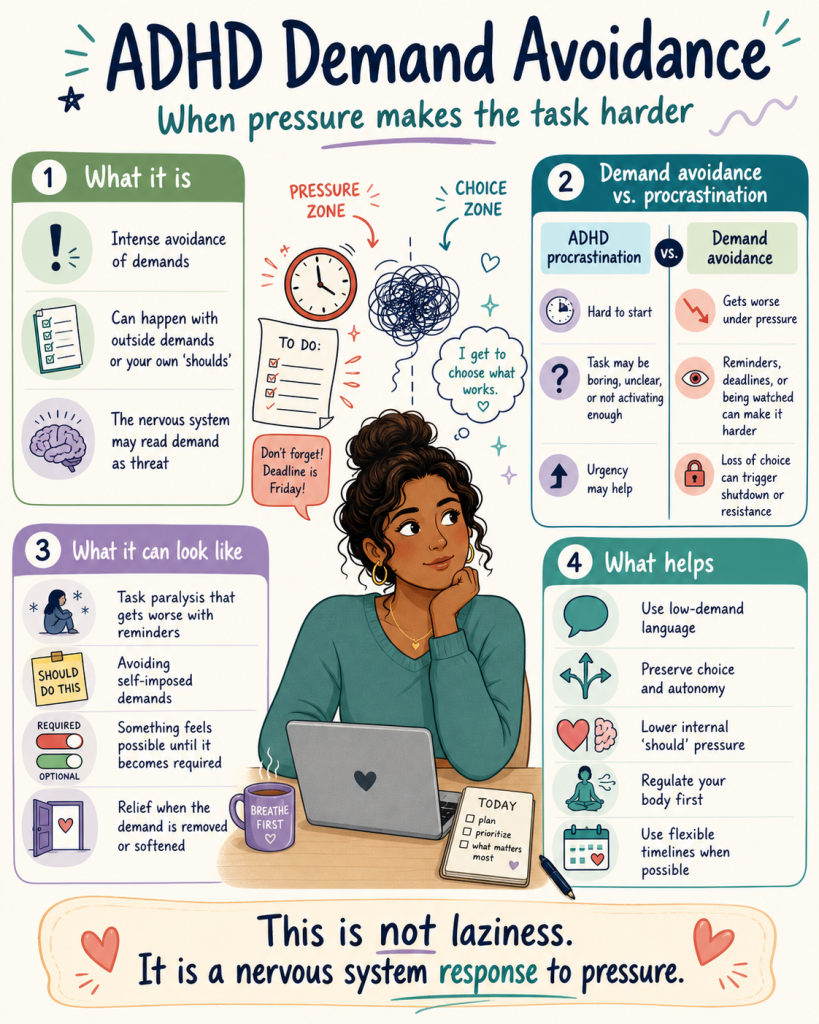
It isn't that you don't want to do it. It isn't that you don't understand why it needs to happen. The task is sitting there, the deadline is real, the intention was genuine — and something in your nervous system is generating an opposition that has nothing to do with your conscious choices. The more the demand presses, the harder the task becomes. Someone tells you that you have to do it, and suddenly doing it feels impossible. You remind yourself of the consequences, and somehow that makes it worse.
This might be demand avoidance. In ADHD women demand avoidance can be one of the most confusing and least discussed parts of how the nervous system responds to pressure.
What Is Demand Avoidance in ADHD?
Demand avoidance is an intense avoidance of demands and expectations, including the demands you place on yourself.
It is not laziness. It is not simple defiance.
For many ADHD women, demand avoidance is an autonomic nervous system response to a perceived loss of control or autonomy. The demand may come from another person, a deadline, a schedule, a task list, or your own “should.”
Once the demand registers as pressure, the nervous system may respond as if something threatening is happening. Compliance no longer feels neutral. It feels like being trapped, controlled, or forced.
That is why pushing harder often does not help.
The demand itself has become part of the stress response.
Demand avoidance exists on a spectrum.
A related but contested term is Pathological Demand Avoidance, or PDA. It is most often discussed in autism contexts, but it is not an established diagnosis. A 2026 systematic review found the research base small, inconsistent, and at high risk of bias, so PDA should not be treated as a settled endpoint on a simple demand-avoidance continuum. Read the 2026 systematic review.
But demand avoidance does not only appear in PDA.
Milder forms of demand avoidance can also show up in ADHD, especially in ADHD women with anxiety, trauma histories, or long histories of masking.
The mechanism is nervous-system based.
The demand registers as a threat. The avoidance is the nervous system trying to protect itself.
It is not a rational choice.
Demand Avoidance vs. Procrastination
ADHD procrastination is usually about task initiation.
The task may be boring, unclear, overwhelming, repetitive, or not stimulating enough to create an activation signal. With the right support — interest, urgency, body doubling, novelty, or a clearer first step — the task may become easier to start.
Demand avoidance has more of a nervous system quality.
The task may feel possible at first. Then pressure gets added. Someone reminds you. A deadline gets closer. Someone is waiting, watching, or expecting something from you.
And suddenly the task feels harder, not easier.
That is one of the main differences.
ADHD procrastination may improve with urgency. Demand avoidance often gets worse with urgency.
The key question is:
Does the avoidance get worse when pressure, reminders, or observation increase?
If yes, demand avoidance may be part of the picture, either alongside ADHD procrastination or instead of it.
Why Demand Avoidance Is More Pronounced in Some Women with ADHD
Several factors can make demand avoidance more pronounced in ADHD women.
Autonomy and control may have become part of how you regulate.
For some ADHD women, having control over their environment has been one of the only reliable ways to feel safe or steady. This can be especially true for women with trauma histories, chronic criticism, or high-control environments.
When a demand removes that sense of control, even a reasonable demand can register as a threat.
Masking can build up over time.
Many ADHD women have spent years forcing themselves to comply with expectations their nervous systems were not built to manage easily: sit still, stay quiet, focus on command, be agreeable, keep up, do not react, do not need too much.
Over time, that kind of forced compliance can create a real nervous system cost.
Demand avoidance in adulthood may be part of the nervous system pushing back after years of having to override itself.
Anxiety can make the response stronger.
Anxiety increases threat sensitivity. A demand that another person might experience as neutral can feel much bigger in a nervous system that is already on alert.
This does not mean the person is overreacting on purpose.
It means the demand is landing in a nervous system that is already braced.
AuDHD can add another layer.
Demand avoidance may be especially pronounced in AuDHD women — women who are both autistic and ADHD.
Pathological Demand Avoidance, or PDA, is most often discussed in autism contexts, but the construct remains debated and is not a formal diagnosis. ADHD traits can overlap with demand avoidance, and one adult study found a strong association between self-reported ADHD traits and higher PDA questionnaire scores. That does not establish PDA as an ADHD subtype or prove a single underlying mechanism.
In these cases, demand avoidance may be more persistent, more intense, and more disruptive to daily life.
What Demand Avoidance Looks Like in Women
Demand avoidance can show up in everyday tasks, work, relationships, and even things you want to do.
Task paralysis that gets worse with reminders
The task has been on the list for weeks.
Every time you tell yourself you have to do it, it feels more impossible. When a partner, coworker, or supervisor follows up, the pressure increases. Instead of helping you start, the reminder makes your nervous system brace harder.
Avoidance of self-imposed demands
Demand avoidance is not only about other people pressuring you.
Your own “should” can become a demand too.
“I should exercise.”
“I should call her back.”
“I should have done this already.”
For many ADHD women, internal demands can create the same avoidance response as external ones. The nervous system responds to the pressure, not just the source of it.
Collapse when expectations become clear
Something may feel possible when it is optional.
Then it becomes required, scheduled, assigned, or expected, and the whole task changes. The activity you were doing freely can become aversive once it turns into an obligation.
Resentment when choice is removed
Being told when, how, or in what order to do something can create strong resistance, even when you were already planning to do it.
The content of the demand may not be the issue.
The loss of choice may be what triggers the response.
Difficulty with highly monitored work structures
Some ADHD women do well with independence but shut down under close supervision.
Being watched, timed, corrected, evaluated, or repeatedly checked on can increase demand pressure. The result may look like underperformance, but the issue is not lack of ability.
It is the nervous system response to pressure, observation, and reduced autonomy.
Relief when demands are removed or modified
When a deadline is extended, an expectation is dropped, or someone stops asking, the relief may feel physical.
That relief is useful information.
It shows that the nervous system was not simply avoiding the task. It was bracing against the demand attached to it.
What Helps
What Helps With Demand Avoidance
The strategies that help with standard ADHD procrastination can sometimes make demand avoidance worse.
More pressure, tighter deadlines, more reminders, more accountability, or more urgency may not help if the nervous system is already reading the task as a threat.
The more useful approach is to reduce the demand quality of the task.
Use low-demand language
The words you use can change how the task lands in your nervous system.
“I have to get this done” may increase pressure.
“I’m going to try this for five minutes and see what happens” may feel more possible.
This is not pretending the demand does not exist. It is reducing the pressure enough that your nervous system can approach the task.
Preserve choice where you can
Demand avoidance often gets worse when choice is removed.
Whenever possible, keep some part of the task flexible: when you do it, how you do it, where you start, how long you work, or what order you use.
Even a small amount of choice can reduce the threat response.
This is why demand avoidance often improves in flexible environments and gets worse in rigid ones.
Lower the internal “should” pressure
The “I should” voice is also a demand.
“I should have done this already.”
“I should be able to handle this.”
“I should not need this much support.”
That pressure can make avoidance stronger.
Part of the work is learning to notice when the internal demand is rising and deliberately lowering it. This can take time, and it is often work that happens in therapy.
Regulate your body before trying to start
Demand avoidance is a nervous system response, so body-based support can help.
Movement, breathing, sensory regulation, grounding, stepping outside, changing rooms, stretching, or lowering stimulation may reduce the arousal enough to make approach possible.
The point is not to calm down perfectly.
The point is to help your nervous system feel less trapped before you try to begin.
Do not add pressure to the pressure
Shame makes demand avoidance worse.
When you judge yourself for avoiding, the task gains another demand: now you have to do the task and stop being avoidant.
That compounds the problem.
Understanding the mechanism does not make the task disappear. But it gives you a better place to start than self-criticism.
Use longer timelines and explicit flexibility
Demand avoidance often improves when the task has more room around it.
A soft deadline, a partial completion option, a flexible starting point, or permission to do the task in more than one sitting can reduce the demand charge.
Rigid timelines may be necessary sometimes. But when everything is urgent, fixed, and monitored, the nervous system has fewer ways to stay regulated.
What Helps With ADHD Demand Avoidance
Self-awareness means learning to tell the difference between ADHD procrastination and demand avoidance.
With demand avoidance, the avoidance often has a nervous system quality. It gets worse with pressure, reminders, observation, or loss of choice. The task may not only feel hard to start. It may feel threatening, trapping, or impossible once it becomes a demand.
Naming this accurately changes the support you need.
You are not just procrastinating.
Your nervous system may be responding to perceived threat, pressure, or loss of autonomy.
Self-Compassion
Self-compassion means reducing the shame that often builds around demand avoidance.
There may be tasks that did not get done. Deadlines that passed. Messages that were not answered. People who felt disappointed or confused.
Shame often adds another demand: the demand to stop struggling, explain yourself perfectly, or become the kind of person who can simply push through.
That usually does not help.
The avoidance was a protective response. That does not mean there are no consequences. It means shame is not the best tool for changing the pattern.
Self-Accommodation
Self-accommodation means creating lower-demand conditions where possible.
This may include flexible timelines, more choice, fewer unnecessary reminders, less monitoring, clearer options, and task framing that preserves autonomy.
This is not about avoiding all demands.
It is about recognizing that your nervous system responds to demand pressure in a specific way. When the environment allows for more choice and less pressure, functioning may improve.
Self-Advocacy
Self-advocacy means being able to explain your relationship with demands to the people who need to understand it.
This may include partners, employers, supervisors, therapists, or medical providers.
You may need to ask for more flexibility, more autonomy, less monitoring, clearer expectations, or a different kind of support.
For many ADHD women, high-pressure environments do not increase functioning. They increase shutdown, resistance, resentment, or avoidance.
Being able to name that pattern can help you ask for support that is more likely to work.
Self-Care
Self-care means noticing the cost of living under constant demand pressure.
A nervous system that is always bracing against demands is a stressed nervous system.
Reducing the overall demand load, protecting choice where you can, building in recovery time, and creating spaces where you are not constantly being watched, timed, corrected, or evaluated are not indulgent.
They are part of maintaining the conditions that help you function
Frequently Asked Questions
Demand avoidance in ADHD is an intense avoidance of demands and expectations — including self-imposed ones — driven by an autonomic nervous system response to perceived loss of control. It differs from standard ADHD procrastination in that it typically worsens under increased pressure rather than responding to urgency. It is common in ADHD, particularly in women with anxiety, trauma histories, or AuDHD presentations.
PDA is most commonly discussed in autism contexts, but it is not a formal diagnosis and the research base remains limited and contested. ADHD traits may overlap with demand avoidance, but that does not establish PDA as an ADHD subtype. Milder demand avoidance that doesn't meet full PDA criteria is common in ADHD independently. The underlying mechanism — autonomic response to demand that creates avoidance — exists on a spectrum.
Demand avoidance is not about wanting or not wanting. It is about the nervous system's response to perceived demand pressure. When a task becomes an obligation — when it must be done, on a specific timeline, in a specific way — the autonomic threat response can make approach feel impossible even when the task was entirely appealing as a free choice. The wanting and the avoidance coexist because they come from different neurological systems.
The key marker is what happens when pressure increases. With ADHD procrastination, urgency often helps — the deadline approaching creates the activation signal that allows initiation. With demand avoidance, urgency makes it worse. If adding pressure, reminders, or observation increases paralysis rather than reducing it, demand avoidance is likely part of the picture.
Yes — particularly therapy that works with the autonomic nervous system dimension, addresses the shame layer, and supports building self-knowledge about your personal demand thresholds and triggers. Therapy that focuses on accountability and motivation without addressing the underlying autonomic mechanism is less helpful and can make demand avoidance worse.
The avoidance is not the problem. It is the nervous system's answer to a problem. Understanding the actual problem — loss of autonomy, threat response, accumulated coercion — is where the work begins.
Continue Exploring
- ADHD in Women — the complete picture
- Rejection Sensitive Dysphoria
- ADHD Freeze Response
- AuDHD — ADHD and Autism
- ADHD Burnout in Women
- ADHD Masking in Women
- Self-Accommodation for ADHD
If you are a woman with ADHD who recognizes the demand avoidance pattern — the paralysis that worsens under pressure, the resentment of obligation, the relief when demands lift — neurodivergent-affirming therapy can help. I offer telehealth therapy in North Carolina and South Carolina. Reach out at kristenlynnmcclure@gmail.com or find me on Psychology Today.
Ready to Work Together?
If what you've read here feels familiar, I'd love to hear from you. I work with women with ADHD across North Carolina and South Carolina via secure telehealth — from wherever you are in either state.
