ADHD and Bipolar Disorder in Women: Understanding the Overlap
By Kristen McClure, MSW, LCSW | Neurodivergent-affirming therapy for women
Two conditions. Overlapping symptoms. Very different treatments. And a history of women being diagnosed with one when they have the other — or being told they have one when they actually have both.
ADHD and bipolar disorder are genuinely distinct diagnoses. They are also frequently confused, frequently co-occurring, and frequently undertreated in women specifically — because both conditions present differently in women than the clinical frameworks were designed to recognize.
Getting the distinction right matters enormously. The wrong diagnosis doesn't just fail to help — it can actively cause harm.
What ADHD and Bipolar Disorder Share
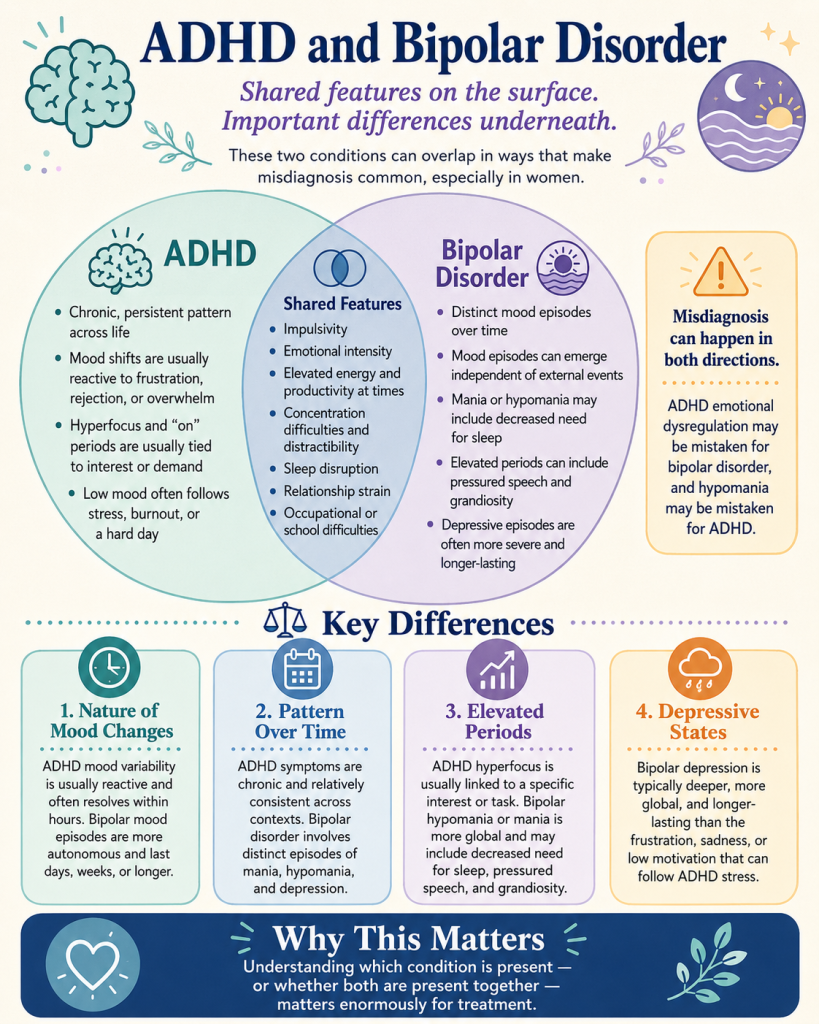
At first glance, ADHD and bipolar disorder overlap in ways that make them easy to confuse:
Both can produce impulsivity — making decisions without full consideration of consequences, acting before thinking, difficulty waiting. Both can produce emotional intensity — feelings that arrive with force, that are difficult to modulate, that affect behavior and relationships significantly. Both can produce periods of elevated energy and productivity where the person feels capable, creative, and activated. Both can produce concentration difficulties and distractibility. Both can affect sleep patterns, relationships, and occupational functioning.
This surface-level overlap leads to misdiagnosis in both directions. Women with ADHD are sometimes diagnosed with bipolar disorder, particularly when emotional dysregulation and impulsivity are prominent features. Women with bipolar disorder are sometimes diagnosed with ADHD, particularly when hypomanic periods look like ADHD hyperfocus and energy.
The Key Differences
Despite the overlap, there are meaningful clinical distinctions.
The nature of mood changes. ADHD-related emotional shifts are often more situational and tied to triggers such as frustration, rejection, overload, or rapid changes in demand. Bipolar disorder is characterized by distinct mood episodes that represent a more sustained change from a person's usual baseline. Duration, trigger pattern, sleep, energy, behavior, and the person's longer-term history all matter; timing alone is not enough to distinguish the two.
The pattern over time. ADHD symptoms are generally persistent and chronic — present across the lifespan, consistent across contexts. Bipolar disorder involves distinct episodes of mania, hypomania, and depression with intervening periods that may look quite different.
The quality of elevated periods. ADHD hyperfocus is usually tied to a particular activity or interest and does not, by itself, represent a mood episode. Hypomanic or manic episodes involve a broader change from the person's usual baseline and may include decreased need for sleep, increased activity or talkativeness, racing thoughts, inflated self-confidence or grandiosity, and increased risk-taking. The full pattern and duration matter more than any single symptom.
Depressive episodes. A bipolar depressive episode is a sustained mood episode that meets criteria for depression and represents a change from the person's usual functioning. ADHD can also be accompanied by low motivation, frustration, demoralization, or co-occurring depression, so severity alone does not reliably distinguish the two.
Why Both Are Frequently Missed in Women
Some research has found rapid cycling more often in women with bipolar disorder than in men, and mixed features are also clinically important in women. These patterns can make diagnosis more complicated because symptoms may not resemble a simple alternating pattern of depression and mania. They still need to be evaluated as mood episodes rather than assumed to be ADHD-related emotional shifts.
Women with ADHD — especially those with significant emotional dysregulation and rejection sensitivity — may appear to have mood cycling because their emotional responses are intense and frequent. This can lead to bipolar misdiagnosis.
The result: many women spend years on the wrong medication or in the wrong treatment framework, not because their clinician was incompetent, but because both conditions are genuinely complex in women's presentations, and because thorough assessment takes time and information that isn't always collected.
When Both Are Present
ADHD and bipolar disorder do co-occur. Research estimates that somewhere between 10–20% of people with bipolar disorder also have ADHD. When both are present, functional impairment is typically more severe than either alone would produce.
Treatment sequencing matters when both conditions are present. Clinical guidance generally recommends establishing adequate mood stabilization before adding medication for ADHD. Stimulants are not automatically contraindicated, but the risks and benefits depend on the individual, the stability of the bipolar disorder, the medication used, and careful monitoring for mood changes.
This is one of the clearest arguments for thorough, careful assessment before medication decisions are made.
The Misdiagnosis Trap
One possible diagnostic error is that ADHD-related impulsivity, emotional reactivity, or periods of intense focus are interpreted as evidence of bipolar disorder without enough attention to the lifelong pattern of ADHD symptoms. If ADHD is missed, treatment may not address the attention and executive-function difficulties that remain. A careful longitudinal history helps reduce this risk.
The reverse diagnostic error is also possible: episodic changes in energy, sleep, activity, or attention related to bipolar disorder can be mistaken for ADHD. Because ADHD medication decisions are different when bipolar disorder is also present, clinicians need to assess whether attention and impulsivity symptoms are lifelong and persistent or mainly occur during mood episodes.
Both patterns are avoidable with thorough assessment that considers the longitudinal course of symptoms, family history, the quality and duration of mood changes, and the response to treatment.
What Helps With Accurate Diagnosis and Care
Track Patterns Over Time
Tracking your symptoms over time — not just their presence but their pattern, duration, triggers, and relationship to external events — is genuinely useful clinical information. Mood and energy journals, even informal ones, can provide data that helps clarify whether symptoms follow an ADHD reactive pattern or a bipolar episodic pattern.
Let Go of the Shame of Misdiagnosis
Being misdiagnosed — sometimes for years — is a painful experience that leaves many women distrustful of clinical systems, confused about their own experience, and carrying the shame of treatments that didn't work. Accurate diagnosis is a form of respect for your experience. You deserve care that is based on who you actually are.
Support Both Conditions in Daily Life
Whether the diagnosis is ADHD, bipolar disorder, or both, self-accommodation — building structure, managing sleep, reducing unnecessary load, supporting emotional regulation — serves both conditions. Sleep in particular is a critical stabilizer for mood and cognition across both diagnoses.
Ask for Care That Distinguishes the Two
If you have concerns about the accuracy of your diagnosis — if treatment isn't producing the expected response, if the diagnostic picture doesn't feel complete — advocating for a second opinion or a more thorough evaluation is appropriate. You have the right to a clinician who takes your full history seriously.
Protect Sleep and Daily Stability
Sleep is a universal stabilizer for both conditions. Exercise supports mood regulation. Reducing substance use (which can trigger mood episodes and worsen ADHD) matters significantly. These are not small recommendations — they are foundational to whatever clinical treatment plan exists.
Frequently Asked Questions
Yes. Research estimates that 10–20% of people with bipolar disorder also have ADHD. When both are present, the combination typically produces more significant functional impairment than either condition alone. Treatment requires careful sequencing — usually mood stabilization before stimulant medications are introduced — and close monitoring.
Key distinctions include: the duration and autonomy of mood changes (ADHD-related emotional shifts are often situational and tied to triggers, while bipolar disorder involves more sustained episodes that represent a clear change from the person's usual baseline); the pattern over time (ADHD is chronic and consistent, bipolar involves distinct episodes); and the quality of elevated periods (ADHD hyperfocus is task-tied, bipolar hypomania involves global elevation with decreased sleep need and often grandiosity).
The emotional dysregulation and rejection sensitivity that are common in ADHD can look like rapid mood cycling — particularly to clinicians who don't take a careful developmental history. Women with ADHD may have frequent intense emotional responses that are misread as mood episodes rather than reactive, short-duration ADHD-related emotional intensity.
Research suggests that ADHD and bipolar disorder co-occur at higher rates than chance, and that women with ADHD may be at somewhat elevated risk. The precise rates vary across studies. What is clear is that co-occurrence is common enough that both possibilities should be considered in clinical assessment when symptoms suggest either condition.
Stimulant medications used for ADHD can trigger hypomanic or manic episodes in people with unrecognized bipolar disorder. This is one of the clinical risks of misdiagnosis. It is also one of the reasons that stimulant prescriptions should be preceded by careful assessment that considers bipolar disorder, and monitored closely after initiation.
Getting the right diagnosis is not a small thing. It determines what treatment you receive, what explanation you are given for your experience, and what kind of support becomes available to you.
If treatment has not worked as expected, if the diagnostic picture has never fully felt accurate, if important questions remain unanswered — those instincts are worth taking seriously. Accurate care is available. It requires the right assessment and the right clinician.
Continue Exploring
- ADHD in Women — the complete picture
- ADHD and Depression in Women
- ADHD and Emotional Dysregulation
- Rejection Sensitive Dysphoria
- ADHD Burnout vs Depression
- ADHD and Anxiety in Women
- ADHD and Sleep
- ADHD Self-Accommodation
- Late ADHD Diagnosis in Women
I specialize in neurodivergent-affirming therapy for women with ADHD across North Carolina and South Carolina via telehealth, including complex presentations and co-occurring conditions. Learn more about working with me.
Ready to Work Together?
If what you've read here feels familiar, I'd love to hear from you. I work with women with ADHD across North Carolina and South Carolina via secure telehealth — from wherever you are in either state.
