
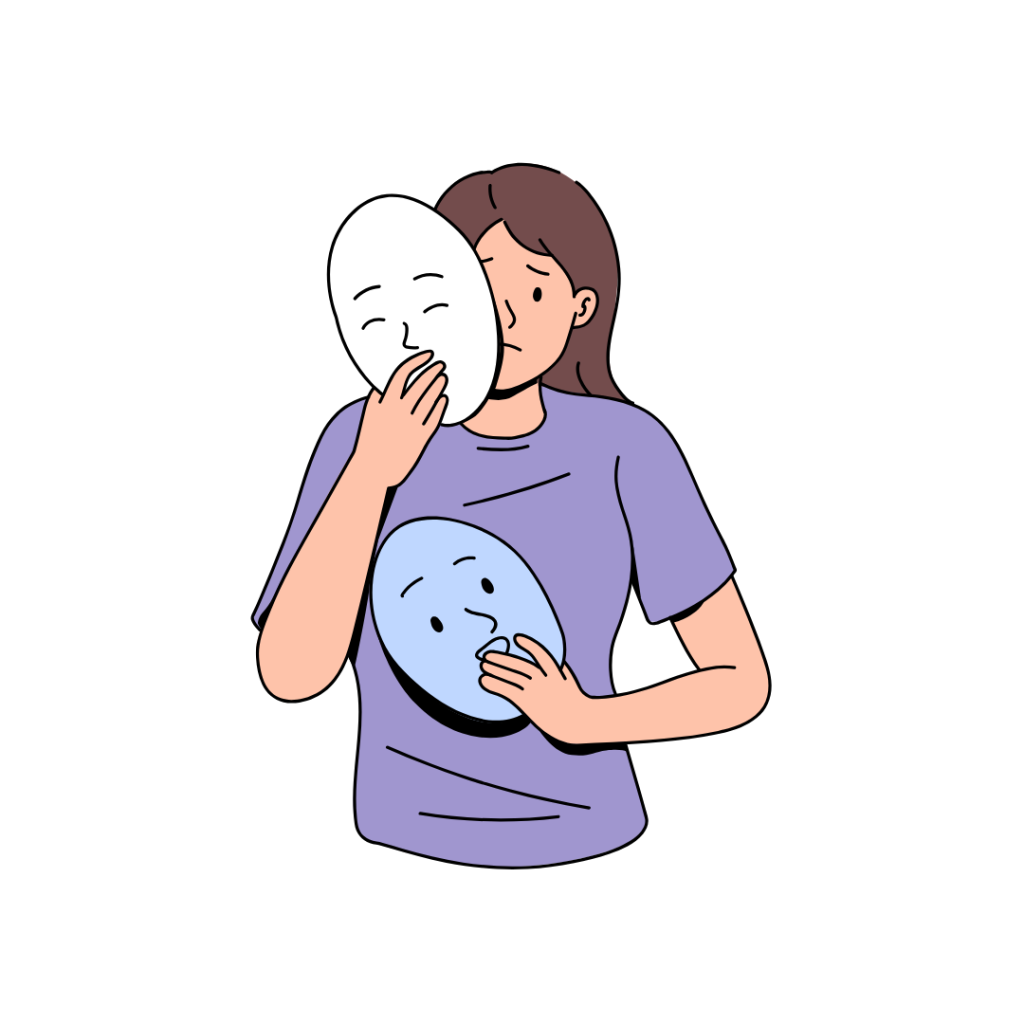
You look like you have it together.
You meet expectations. You show up. You get things done.
But underneath that, there’s constant effort — tracking, remembering, managing, holding everything in place so nothing slips.
And most of the time, no one sees how hard it actually is.
This is often what ADHD masking looks like in women.
ADHD masking is the process of hiding symptoms, overcompensating, and adapting behavior to appear “fine” — even when it comes at a significant internal cost.
This page explains what ADHD masking in women looks like, why it happens, and what it costs over time.
→ For a broader overview, see: ADHD in Women
Signs of ADHD Masking in Women
🔵 Constantly trying to appear organized or in control
🔵 Rehearsing conversations before they happen
🔵 Over-preparing to avoid mistakes
🔵 Hiding forgetfulness or disorganization
🔵 Suppressing natural behaviors (fidgeting, interrupting, etc.)
🔵 Saying yes to avoid letting people down
🔵 Being seen as capable while feeling overwhelmed internally
🔵 Feeling exhausted after social or work interactions
Masking is often so effective that even you may not fully recognize you’re doing it.
What ADHD Masking Feels Like
The external version of you and the internal experience don’t fully match.
🔵 Feeling like you’re performing instead of just being
🔵 Constantly tracking what you might be forgetting
🔵 Replaying conversations after they happen
🔵 Holding everything together until you’re alone
🔵 Feeling relief when you don’t have to “keep it up”
🔵 Wondering how long you can sustain this level of effort
Many women describe it as living a double life — one that looks fine, and one that feels much harder.
What Is ADHD Masking?
ADHD masking is the act of consciously or unconsciously hiding ADHD traits to meet expectations.
🔵 Suppressing behaviors that might be judged
🔵 Overcompensating for executive function challenges
🔵 Mirroring others to blend in
🔵 Creating systems to avoid being seen as struggling
Masking is not deception.
It is adaptation.
It develops because, at some point, it worked.
Why Women Mask More
Masking doesn’t happen randomly. It develops in response to pressure.
Social Expectations
🔵 Women are expected to be organized, emotionally regulated, and reliable
🔵 ADHD directly challenges those expectations
Fear of Judgment
🔵 Being labeled “lazy,” “scatterbrained,” or “too much”
🔵 Learning early that mistakes have consequences
Desire for Acceptance
🔵 Masking reduces the risk of rejection
🔵 It creates a sense of safety in social and professional environments
Early Conditioning
Girls are often corrected earlier and more consistently so many learn to hide struggles before they understand them
What ADHD Masking Looks Like in Real Life
Masking is not one behavior — it’s a pattern that shows up across daily life.
🔵 Double-checking everything to avoid mistakes
🔵 Spending extra time to appear organized
🔵 Overcommitting to avoid disappointing others
🔵 Hiding overwhelm until you’re alone
🔵 Maintaining a “put together” image while struggling internally
From the outside, it often looks like competence.
From the inside, it often feels like pressure.
The Hidden Cost of ADHD Masking
Masking works — until it doesn’t.
Over time, the cost becomes harder to ignore.
🔵 Burnout
Not just being tired, but losing the ability to maintain the systems that were holding everything together
🔵 Anxiety
Constant self-monitoring and pressure not to make mistakes
🔵 Identity confusion
Losing track of who you are underneath the performance
🔵 Isolation
Feeling unseen, even when you appear successful
🔵 Delayed diagnosis
Symptoms stay hidden — sometimes for decades
Many women don’t realize they are masking until something breaks — burnout, a life transition, or a point where the effort is no longer sustainable.
High Masking ADHD in Women
Some women mask so effectively that no one recognizes their ADHD.
🔵 High achievement with high internal cost
🔵 Extreme overcompensation
🔵 A significant gap between external success and internal experience
→ Learn more: High-Masking ADHD in Women
Masking vs High-Functioning ADHD
These terms overlap, but they are not identical.
🔵 Masking = hiding or compensating for symptoms
🔵 High-functioning = appearing successful despite symptoms
In many cases, what gets labeled “high-functioning” is actually masking.
→ Learn more: High-Functioning ADHD in Women
How Masking Leads to Burnout
Masking requires constant energy.
Over time:
🔵 Effort increases
🔵 Capacity decreases
🔵 Systems become harder to maintain
This often leads to ADHD burnout — especially during life transitions, increased demands, or hormonal changes.
→ Learn more: ADHD and Burnout
How to Start Unmasking
Unmasking is not about removing everything that helps you function.
It’s about reducing the cost.
🔵 Build awareness
Notice when and where you’re masking
🔵 Create safe environments
Identify where you don’t need to perform
🔵 Reduce overcompensation
Let go of unnecessary perfectionism
🔵 Practice self-compassion
Masking was a survival strategy, not a failure
This process is gradual — and often easier with support.
Getting Support
If this feels familiar, you’re not imagining it.
ADHD masking in women is common — and often misunderstood.
→ Start here: ADHD Symptoms Checklist for Women
→ Explore the bigger picture: ADHD in Women
If you are in North or South Carolina, I offer ADHD therapy for women focused on reducing overwhelm, supporting executive functioning, and helping you build a more sustainable way of living.
You don’t have to keep holding everything together alone.
Medical Disclaimer
This content is for informational purposes only and is not a substitute for professional medical or mental health advice, diagnosis, or treatment.
Reading this content does not establish a therapeutic relationship. If you have concerns about ADHD or your mental health, please consult a qualified healthcare provider.
If you are in crisis, contact emergency services or the 988 Suicide & Crisis Lifeline.
