ADHD and Anxiety in Women: Understanding the Overlap
By Kristen McClure, MSW, LCSW | Neurodivergent-affirming therapy for women
You've spent years working on your anxiety. You've done the CBT worksheets, practiced the breathing techniques, maybe tried a few different therapists. And the anxiety has never fully gone away. It comes back when things get busy, when a relationship feels uncertain, when you miss a deadline or forget something important. You've started to wonder whether something deeper is going on — whether the anxiety is actually the whole story.
For many women, it isn't.
Anxiety is real. The dread in your chest, the racing thoughts at 2 a.m., the sense that you are always one misstep away from disaster — that is not in your imagination. But anxiety can be a symptom of something else entirely. When ADHD is the underlying driver and it has never been identified, the anxiety it produces looks convincingly like the real thing. And that means women spend years treating a response without ever addressing the cause.
I've worked with women for over three decades as a licensed clinical social worker, specializing in ADHD in women. The pattern I see most often is not a woman who walks in knowing she has ADHD. It's a woman who has been managing anxiety for most of her adult life, who is exhausted, who has tried everything, and who is starting to wonder why nothing has ever quite worked. When ADHD is correctly understood, everything else tends to make more sense.
How ADHD and Anxiety Overlap
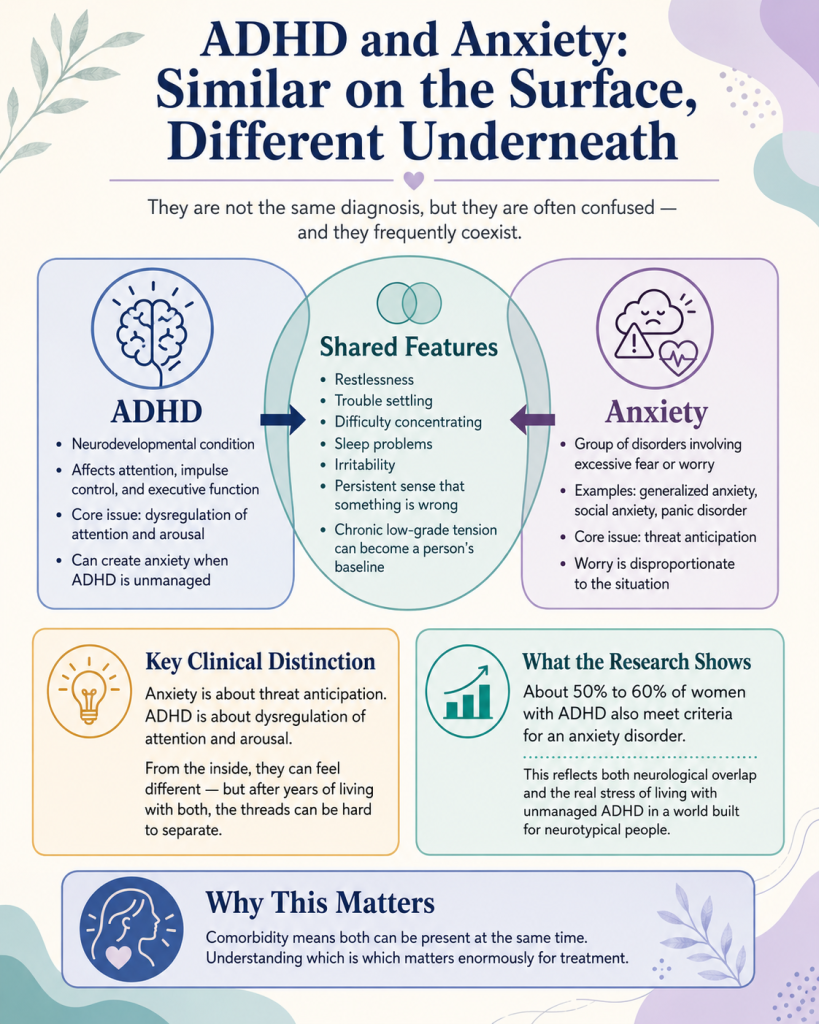
ADHD and anxiety are not the same diagnosis. But they share so many surface features that they are routinely confused — sometimes by clinicians, often by the women living with them.
Both can produce restlessness and an inability to settle. Both can look like trouble concentrating. Both can cause sleep problems, irritability, and a persistent feeling that something is wrong. Both create a kind of chronic low-grade tension that women learn to call their baseline.
ADHD is a neurodevelopmental condition affecting how the brain regulates attention, impulse control, and executive function. Anxiety disorders — generalized anxiety disorder, social anxiety, panic disorder — are characterized by excessive fear or worry that is disproportionate to circumstances. The key clinical distinction is direction. Anxiety is about threat anticipation. ADHD is about dysregulation of attention and arousal. They feel different from the inside, once you know what to look for. But when they've been tangled together for twenty or thirty years, the threads are hard to separate.
The overlap is also statistical. Research consistently shows that somewhere between 50% and 60% of women with ADHD also meet criteria for an anxiety disorder. That is not a coincidence. It reflects both neurological overlap — ADHD involves the same brain systems that regulate fear response — and the lived reality that having unmanaged ADHD in a world built for neurotypical people produces anxiety as a natural consequence.
Comorbidity means both can be present simultaneously. Understanding which is which matters enormously for treatment.
Anxiety as a Response to Unaddressed ADHD
When ADHD goes unidentified, something predictable happens. The woman compensates. She works harder, stays later, checks things three more times. She develops elaborate systems to manage the forgetting, the losing things, the misjudging how long tasks take. She white-knuckles her way through situations that seem effortless for everyone else. And she is constantly, quietly braced for the moment everything falls apart.
That bracing is anxiety. But it didn't start as an anxiety disorder. It started as a nervous system responding logically to a pattern of chronic failure and unpredictability. When you don't fully understand your own brain — when you've been told you're smart but disorganized, capable but unreliable — you learn to stay on alert. The anxiety is doing its job. It's trying to keep you from dropping the next ball.
This is sometimes called secondary anxiety: anxiety that develops as a response to the lived experience of ADHD rather than as a separate primary condition. It shows up as hypervigilance around deadlines and social situations. It shows up as anticipatory dread before tasks you've struggled with before. It shows up as the exhausting mental effort of trying to track everything at once because you've learned you can't trust yourself to remember.
Many women spend years in therapy addressing anxiety, depression, or chronic stress without ever identifying what's underneath. The late ADHD diagnosis experience — finally getting the right name for what has been happening — often brings profound relief — not because the challenges disappear, but because the explanation finally fits. The anxiety that was a mystery becomes legible.
Primary Anxiety vs. ADHD-Driven Anxiety — Why the Distinction Matters for Treatment
This is the clinical distinction that changes everything.
Primary generalized anxiety disorder responds well to specific treatments: cognitive behavioral therapy, particularly CBT focused on worry and avoidance patterns, and medications like SSRIs or SNRIs. When GAD is the core issue, addressing the anxiety directly tends to reduce it.
ADHD-driven anxiety is a different animal. Treating the anxiety without treating the ADHD is like taking pain medication without addressing the injury. The relief is incomplete and temporary. The anxiety returns because its source is still active.
When ADHD is driving the anxiety, the most effective interventions target the ADHD. ADHD medication, when it works well, often produces a dramatic reduction in anxiety — not because it directly targets anxiety, but because it reduces the chaos that was generating the anxiety in the first place. Women who start ADHD treatment frequently report that their anxiety, which they'd struggled with for years, becomes significantly more manageable. The to-do lists stop metastasizing at night. The sense of dread before tasks softens. They can think more clearly, which makes the world feel less threatening.
Therapy also looks different when you understand which you're treating. Anxiety-focused CBT teaches you to challenge your threat appraisals — to recognize that the danger your brain is signaling may not be proportional to reality. That's appropriate for primary anxiety. But for a woman with ADHD who has genuinely missed deadlines, lost important documents, and forgotten commitments, her brain's alarm is not distorted. Her history is real. The more useful therapeutic work involves understanding her ADHD, building accommodations that actually work, and developing self-compassion for a brain that has been navigating without a map.
Both presentations can coexist. Many women with ADHD do also have primary anxiety that warrants its own direct treatment. The goal is not to dismiss anxiety as always secondary to ADHD — it's to ensure that the ADHD is identified and addressed rather than hidden underneath years of anxiety treatment that never quite lands.
What This Looks Like in Women Specifically
ADHD presents differently in women than the clinical picture most people are familiar with. The hyperactive, disruptive young boy in the classroom is not the template. Women with ADHD are more likely to present as inattentive, internally scattered, externally composed. They have often spent a lifetime developing compensation strategies that make them look fine from the outside while they are working twice as hard to keep things together.
This presentation makes ADHD easy to miss — and anxiety easy to blame. A woman who is high-functioning, articulate, and clearly intelligent does not look like someone with a neurological difference. When she describes constant overthinking, difficulty completing tasks, sensitivity to criticism, and a pervasive sense of being behind, the diagnostic reflex for many clinicians is anxiety, perfectionism, or depression.
Women with ADHD are also more likely to internalize their struggles. Rather than acting out, they blame themselves. The anxiety they carry often has a specific flavor: shame. The shame of not being able to do what everyone else seems to do without effort. Shame at the gap between their intentions and their follow-through. Shame that has accumulated across decades of trying and not quite managing.
That shame-infused anxiety is not the same as generalized anxiety disorder. It has a specific texture — it's tied to performance, to self-perception, and to ADHD shame — the relentless comparison between who you are and who you think you should be. And it tends to lift when women finally understand that their brain works differently, not deficiently.
Hormones also add complexity. Estrogen directly influences dopamine availability in the brain — the same neurotransmitter most implicated in ADHD. This means ADHD symptoms and associated anxiety often intensify across the menstrual cycle, during perimenopause, and postpartum. Many women describe their anxiety becoming distinctly worse at specific hormonal phases without understanding why. Recognizing this pattern matters both for diagnosis and for treatment planning.
How the Empowerment Model Addresses the ADHD-Anxiety Connection
My approach to ADHD in women is organized around five areas of development. Each one directly addresses the anxiety that grows in the absence of self-understanding.
Self-Awareness
Most women with unidentified ADHD have spent years developing a narrative about themselves that is organized around failure. They are disorganized. They are unreliable. They don't try hard enough. Self-awareness, in the context of ADHD treatment, means replacing that narrative with an accurate one. Understanding your specific ADHD profile — how your attention actually works, what depletes you, what helps — is the first move away from chronic anxiety. You cannot work with a brain you don't understand.
Self-Compassion
Anxiety and shame reinforce each other. The shame of past failures feeds the anticipatory anxiety about future ones. Self-compassion is not a soft concept or a platitude — it is a clinical necessity when decades of accumulated shame are part of the picture. This means learning to respond to your own struggles with the same understanding you would offer someone else, rather than the relentless internal criticism that most women with ADHD have normalized.
Self-Accommodation
Much of the anxiety that women with ADHD carry comes from attempting to function in systems designed for a different kind of brain. Self-accommodation means building structures, routines, and tools that work with your nervous system rather than against it. When the environment is set up to support you, the number of situations where you have to brace for failure goes down. The anxiety that was a rational response to chronic unpredictability starts to reduce.
Self-Advocacy
For women who have spent years not understanding why they struggle, advocating for themselves — with employers, healthcare providers, partners — can feel terrifying. The anxiety of being disbelieved or dismissed is real. Self-advocacy in this context means developing the language and confidence to name what you need and ask for it, without apologizing for having a brain that works differently. That shift in self-presentation is both empowering and anxiety-reducing.
Self-Care
Anxiety dysregulates the nervous system. ADHD dysregulates the nervous system. Sleep deprivation, poor nutrition, and chronic overcommitment all make both worse. Sustainable self-care for women with ADHD does not look like a neurotypical wellness routine. It looks like identifying what actually helps you regulate — what you can realistically maintain — and building that in without the shame spiral that tends to follow when you miss a day.
Frequently Asked Questions
Yes — and this is one of the most important things to understand about ADHD in women. ADHD does not always cause a diagnosable anxiety disorder, but it reliably produces anxious experiences: chronic worry about forgetting things, anticipatory dread before tasks you've struggled with before, hypervigilance around deadlines, and the low-grade tension of living in a brain that feels unpredictable. When the ADHD is treated effectively, that anxiety often reduces significantly, even without direct anxiety treatment. This is one of the clearest clinical signals that the anxiety was secondary to the ADHD rather than a separate primary condition.
ADHD is a neurodevelopmental condition affecting attention regulation, impulse control, and executive function. Anxiety is a pattern of excessive worry or fear. They overlap in presentation — both can produce restlessness, difficulty concentrating, and trouble sleeping — but they have different mechanisms and respond to different treatments. In women specifically, ADHD is frequently missed and anxiety is diagnosed instead, partly because women are more likely to present with inattentive ADHD and internalized shame rather than the more visible hyperactive symptoms. The distinction matters because treating anxiety alone, when ADHD is the underlying driver, typically produces incomplete results.
Several reasons, operating simultaneously. First, ADHD and anxiety have overlapping neurological substrates — both involve dysregulation of dopamine and norepinephrine systems. Second, women with undiagnosed ADHD develop anxiety as a learned response to years of unpredictable performance, chronic forgetting, and the social and professional consequences that follow. Third, the constant effort required to compensate for ADHD in a world that isn't designed for it is exhausting, and chronic exhaustion destabilizes emotional regulation. Fourth, women with ADHD face significant shame, and shame is anxiety-provoking. Hormonal factors — particularly estrogen's influence on dopamine — add another layer, intensifying symptoms at specific life stages.
Often, yes — significantly. When anxiety is secondary to unmanaged ADHD, effective ADHD treatment addresses the source, and the anxiety reduces. Many women who start ADHD medication describe a quieting of the constant mental noise that had been feeding their anxiety for years. Therapy that incorporates accurate ADHD understanding also helps: when you understand why you've struggled, the shame and self-blame that drive so much anxiety begin to shift. If a primary anxiety disorder is also present — genuine GAD, panic disorder, or social anxiety — that may need its own direct treatment alongside ADHD care. The picture is not always simple, but ignoring the ADHD component almost always means incomplete results.
GAD and ADHD can co-occur, and research puts the co-occurrence rate at roughly 50% or higher among women with ADHD. When both are present, distinguishing them matters clinically. GAD is characterized by pervasive, difficult-to-control worry across multiple life domains, often focused on future threat. ADHD produces worry too — but it tends to be more directly connected to the functional challenges of ADHD: forgetting, disorganization, time management, and the social consequences of both. In clinical practice, identifying which came first, and which is driving which, shapes the treatment plan. Both can and should be treated, but the approach and sequencing differ.
Living with anxiety that never fully resolves is exhausting. If you've been treating anxiety for years and something still doesn't fit — if you recognize yourself in what's described here — it may be worth exploring whether ADHD in women is part of the picture. ADHD burnout and anxiety often arrive together after years of overcompensating; rejection sensitive dysphoria can look identical to social anxiety from the outside.
I work with women across North Carolina and South Carolina via telehealth, providing neurodivergent-affirming assessment, therapy, and support. With over 31 years of clinical experience and a specialty in ADHD in women, I understand how late identification changes everything — and how much is possible once the right framework is in place.
Continue Exploring
- ADHD in Women — the complete picture
- Rejection Sensitive Dysphoria in ADHD
- ADHD and Hormones in Women
- ADHD and Nighttime Anxiety
- ADHD and Cortisol in Women
- ADHD Burnout vs Depression
- ADHD and Shame
- ADHD and Panic Attacks
- ADHD and Bipolar Disorder in Women
If you're ready to explore whether ADHD might be underlying your anxiety, I'd welcome the conversation. Learn more about working with me at Flourishing Women, or visit my Psychology Today profile to request a consultation.
Ready to Work Together?
If what you've read here feels familiar, I'd love to hear from you. I work with women with ADHD across North Carolina and South Carolina via secure telehealth — from wherever you are in either state.
