The dishes are in the sink.
You have walked past them all day.
You care about your home. You care about your life. And yet they are still there.
If that feels familiar, this is not laziness.
Cleaning requires executive functioning. ADHD affects executive functioning. That overlap matters.
Let us look at what is actually happening.
Why Cleaning Is Hard With ADHD
From the outside, cleaning looks simple.
Neurologically, it is not.
“Clean the kitchen” requires starting a task with no clear endpoint. It requires deciding where to begin. It requires holding multiple steps in mind. It requires staying with something repetitive and low stimulation. It requires regulating frustration.
That is executive function.
If initiation, sequencing, working memory, and regulation are already more effortful for you, household tasks will feel heavier than they look.
It is not one task. It is many small decisions stacked together.
That stack can exceed capacity quickly.
This is a difference in brain wiring. Not a failure of character.
What This Often Looks Like
Most ADHD women recognize themselves here.
You stand in front of the mess and cannot begin. Not because you do not care. Because your brain is having difficulty generating activation.
You start cleaning and get pulled into something else. The original task remains half done.
You wait until you can “do it all,” because doing part of it feels pointless. But all is too big. So nothing happens.
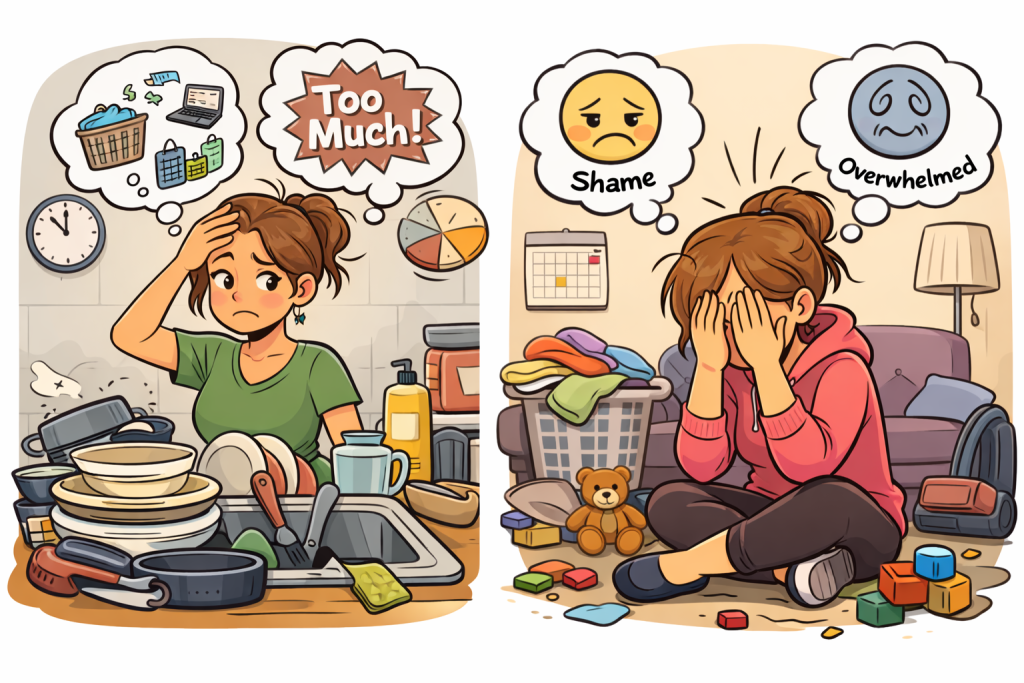
You walk into a cluttered room and feel immediate stress. That surge is not about morality. It is a nervous system response to cognitive overload.
You see the mess and feel shame. Shame makes starting harder. The mess grows. The shame grows with it.
Or you ignore it for days, then clean for hours in a burst of hyperfocus and exhaust yourself.
These are regulation patterns. Not personal defects.
Why This Carries Extra Weight for Women
Women are still judged more harshly for household disorder.
A messy home is often interpreted as a reflection of worth.
For mothers, the demands multiply. Work, children, planning, emotional labor, home management. All executive function heavy.
If your cognitive system already runs at higher cost, the gap between expectation and capacity can feel enormous.
That gap creates shame.
The shame is often more painful than the mess itself.
This is a systems mismatch, not a personal flaw.
What Does Not Help
Trying harder in the same way you have already tried.
Shaming yourself into action.
Building complicated systems that require ongoing executive effort to maintain.
Waiting to feel motivated.
For ADHD brains, motivation often follows action. It rarely arrives first.
What Helps
Lower the entry point.
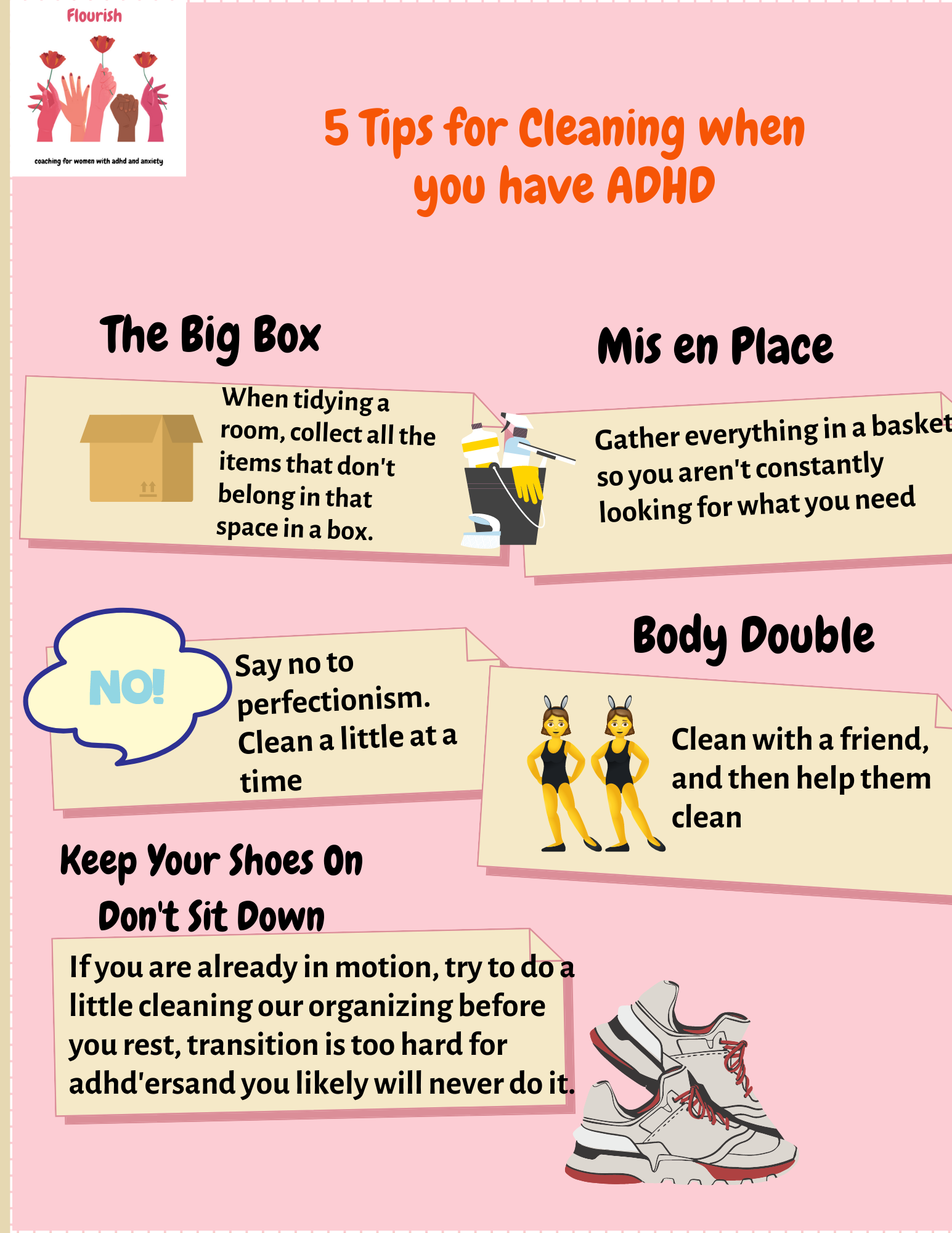
Do five dishes. Clear one surface. Set a timer for ten minutes. When it goes off, you can stop.
Beginning is the hardest step. Make beginning smaller.
Use external structure. Clean while someone else is present. Even a phone call can increase activation.
Lower the standard intentionally. A partially cleaned space is still progress.
Reduce volume when possible. Fewer items mean fewer decisions and less visual load.
If you have the ability to hire help, that is not indulgence. It is an accommodation for a real neurological difference.
The goal is not perfection. The goal is reducing friction and supporting your nervous system.
This Is Not About Character
You are not messy as an identity.
You are navigating tasks that cost you more cognitively than they appear to cost other people.
When we approach this as a design issue instead of a moral issue, things shift.
Getting Support
If cleaning and household management are wrapped in shame for you, that matters.
ADHD in women is often misread as irresponsibility when it is executive function strain in an environment that was not designed for this brain.
I specialize in working with ADHD women who are ready to understand their patterns through a neurodivergent-affirming lens.
You can learn more about ADHD therapy for women or contact me if you would like support.
